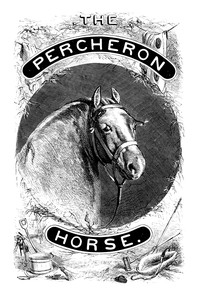
The Percheron horse — Reading Companion

(3 User reviews)   356
In Category - Gardening
Du Hays, Charles, 1818-1898 Project Gutenberg 2023 Not confirmed
Draft horses; Percheron horse Readers of public-domain and historical texts
Project Gutenberg digital edition en

Edition facts

Words 33,210
Reading time 145 min
Text sections 32

The source record for The Percheron horse — Reading Companion measures this digital text at 33,210 words, 2 hr 25 min estimated reading time, and 32 detected text sections.

The text analysis averages about 25.9 words per sentence, while the detected sections provide another way to judge how the source is divided.

Project Gutenberg metadata also associates the work with “Draft horses,” connecting these edition facts with the source record’s subject description.

Charles Du Hays's 1868 treatise on Percheron horses examines breed history, degeneration, and regeneration through selective breeding, foreign crosses, and stud-book management, with detailed physical standards and practical advice for breeders.
Share
Editorial Edition Score 4.8/5

Calculated from edition completeness, EPUB availability, text structure and catalogue metadata. Not a user rating.

How this score is calculated
  • Description quality20 pts
  • Title & short description10 pts
  • Source metadata20 pts
  • Text length15 pts
  • Chapters / structure15 pts
  • EPUB file integrity20 pts

Total of 100 points, scaled to a 2.5-5.0 range. Editions with an empty description or a missing EPUB file are not scored.

Edition quality

Read the Text

to the remark that this region, which has become so celebrated for its fine race of horses, represents an ellipse of about 25 leagues long by nearly 20 broad.

This ellipse is bounded on the north by Normandy; on the west, also by Normandy, and by Maine; on the east, by the portion of Beauce including Chartrain and Dunois; on the south, by the Vendomois—three portions of the ancient Orleanais.

At the present time, enclosed in the center of the four departments, Orne, Eure and Loir, Loir and Cher, and Sarthe, the territory of Perche comprises the following divisions:

_1st._—The district of Mortagne (department of Orne);

_2nd._—The district of Nogent-le-Rotrou, and a portion of those of Chartres, Dreux, and Chateaudun (department of Eure and Loir);

_3rd._—All the western side of the district of Vendôme (department of Loir and Cher);

_4th._—The eastern portion of the districts of Mamers and Saint Calais (department of Sarthe).

It is the summit region of the middle portion of the vast plateau extending between the sea and the basins of the Loire and the Seine. It is here that the rivers Sarthe, Huisne, Eure, Loire, Iton, Höene, Braye, Avre, Commanche, and Percheron Orne, take their source, springing up from the same plateau and crossing it on their way to the Channel and the ocean.

The country is, in general, uneven and hilly, cut up in every direction by small valleys watered by springs or small brooks flowing into the rivers above named. All these valleys, no matter of what extent, are natural meadows, and the most of them rich and fertile. But drainage could here be usefully applied everywhere, to rid them of their surplus humidity, and to purge them of their too abundant aquatic plants. The finest valley is that watered by the Huisne, which is second to none in France for length, extent, richness, and beauty of sites. Here are situated Nogent-le-Rotrou, Condé, Regmalard, Boissy, Corbon, Mauves, Pin-la-Garenne, Reveillon, etc., etc.,—all centers renowned for the beauty of their horses.

The land is generally clayey, lying upon a calcareous subsoil of the secondary formation. Some portions are silicious, the high and hilly points always so.

The Percheron country contains rather few meadows, in proportion to the total surface of the soil, and to this circumstance, probably, is due the superiority of its horses. Here the rearing takes place in the stable and the brood-mare is found under the hand of the breeder. The idea of making use of her comes naturally to his mind. He works and feeds her well. All the secret of his breeding lies in these few words.

Here, for many years, agriculture has flourished; artificial meadows are everywhere cultivated with success, and are necessary to produce the enormous quantity of fodder consumed by the number of horses raised.

Among the plants for green and dry forage, clover first and then fenugreek are the favorites of the Percheron farmer. He uses plaster and marl with care, and would tell you, should the opportunity offer, that it is through system and superior cultivation that Perche has been able hitherto to meet the large demands made upon her from the commencement of the present century, particularly for the last fifty years. He is, moreover, laborious and persevering. Disregarding the industrial arts, the glory of other districts, his true vocation, his favorite occupation, is cultivating the ground and raising horses, which he has practised with zeal from the most remote period. In fact cannot this be inferred, even from the example of his early lords? The Counts of Perche, those old Rotrous, triple knights, had they not adopted as an emblem of their nobility the stamp of their horses’ feet?... Not content with a single chevron, they placed three upon their standards, to signify both the superiority of their horses, and their infinite number. For in symbolical language (and none is more so than that of heraldry,) the number three implies infinity; and the oval form of the eastern courser’s foot, to which the chevron is distinctly traced, was used in early times as a sign of chivalry, replacing the ancient ring of Rome. Hence comes, as a distinctive mark of nobility, the large number of coats of arms with chevrons, among those of the knights. The simple chevron was the designation of the noble, and the particular marks which often accompanied the chevron served to recall some exploit, some distinguished feat of arms, the nature of the tastes, or the possessions of the warrior who bore this blazon.

Perche is very much cut up: the farms generally small; the fields, likewise small and mostly enclosed by hedges. The temper of the Percheron breeder is invariably mild. He knows all the importance of attention to the race which he rears, and nevertheless, it must be confessed, that with the exception of the mildness with which he treats it, he has done next to nothing to ameliorate it or preserve it in its beauty. Nature, time, and the climate, have done all.

Perche has a climate eminently favorable to horse-breeding. Under its influence, the water is tonic and the food nutritious, the air is pure, bracing, and drier than that of Normandy. The sea is farther off, and its influence, in consequence, is less felt.

However, these can be but general attributes, for the country varies in aspect according to the district. The portion near Normandy, which is watered by the Sarthe, is much the same as that province. The grasses are, however, sparser, and especially do not have that extreme sweetness and great tonic quality which distinguish those of the environs of Courtomer and Merlerault, situated only a few leagues from the limits of Perche.

On the side of Beauce, there are vast plains sometimes undulating, and having much similarity to that province.

On the Maine side, the country gradually assumes the characteristics of aspect and cultivation peculiar to it, so that the transition between these two provinces is not an abrupt change, but they blend like the tones of a picture. Upon some points woods, ponds in the north-east, forage and grain upon the remainder, are the chief features, and are the sources of the revenues of the country.

SKETCH OF THE PERCHERON RACE.

The height of the Percheron horse is generally 14¾ to 16 hands; he is of a sanguine temperament, mixed in variable proportions with the musculo-lymphatic; his color is almost always gray, and is, among the characteristic features, that which first strikes the eye.

According to their predominence, these temperaments constitute varieties which may be thus classed:

_1st._—The light Percheron, in which the sanguine temperament predominates;

_2nd._—The draft Percheron, in which the lymphatic temperament is the most fully developed;

_3rd._—The type intermediary between these two, partaking of the one by its lightness, and of the other by its muscular force.

The latter is the most numerous, but it has much degenerated of late years; and there is a tendency to its disappearance since the post-coach service, which formed it, has gradually given way to other means of conveyance. It has style, although the head is rather large and long; nostrils well open and well dilated; eye large and expressive; forehead broad; ear fine; neck rather short, but well filled out; whithers high; shoulder pretty long and sloping; breast rather flat, but high and deep; a well-rounded body; back rather long; the croup horizontal and muscular; tail attached high; short and strong joints, and the tendon generally weak; a foot always excellent, although rather flat in the low countries and natural meadows; a gray coat; fine skin; silky and abundant mane. Such are the most general characteristics of the old Percheron race. These are the points which are still noticed upon what remain of some old horses, preserved from the transformation which commenced long ago; for at the present moment everything is much changed. Since the time of the foreign crossings, the foot has become flatter, the head overcharged, the tendon still weaker, the back longer, the shoulder has lost its direction, and the croup has become shorter. The race has changed suddenly to fill new wants which have unexpectedly sprung up.

Of course these different characters are modified by the varieties upon which they are noticed, but the “_ensemble_” presents a striking similarity.

The light Percheron, suited to harness, is found particularly in the Norman portion, in the district of Mortagne, near Courtomer, Moulins-la-Marche, Aigle, Mesle-sur-Sarthe, and especially in the parishes of Mesnière, Bures, and Champeaux-sur-Sarthe. This is easily accounted for, as here is the best blood of France, near the region where has been found the best Norman type. Here the soil, temperature, and pasturage, are pretty near the same.

In going from Nogent-le-Rotrou to Montdoubleau, and following the limits of Perche-Manceau, by Saint-Calais, Vilvaye, Ferté-Bernard, Saint-Corme and Mamers, we travel over the birthplace of the heavy draft-horse. Here we meet with the heavy brood-mares.

In the center of Perche, at Mauves, Regmalard, Lougny, Corbon, Courgeon, Reveillon, Villiers, and Saint-Langis, nothing is bred; the farmer brings up the horse colts of Eperrais, Pin-la-Garenne, Coulimer, Saint-Quentin, Buré, Pervercheres and the breeding parishes of the district of Mortagne, Nogent-le-Rotrou, Montdoubleau and Courtalain.

Horses of different sexes and ages are never mingled in Perche; they are there separated with care. But it is not exactly the same in respect to kinds.

The post-coach and the heavy-draft horse are there to be met with upon the same ground. The post-coach horse is, to be sure, bred a little everywhere; his temperament and the conditions in which he is placed, prepare him for this specialty.

It is, as we see, at the two extremities of the ellipse (especially where the pasture grounds are), that the mares are found. In the center, at Mauves, Regmalard, Lougny, etc., etc., the inhabitants turn their attention to bringing up the colts.

ORIGIN OF THE PERCHERON.

What, now, is the origin of the Percheron? Some attribute to him an Arabian ancestry; others, less explicit and without positively assigning to him so noble an origin, hold him to be strongly impregnated with Arabian blood. M. Eugene Perrault, one of the most extensive and skillful dealers in fancy horses in all Europe, has frequently remarked to me that of all the various races of horses none were so interesting to him as the admirable Percheron, and that, judging from his appearance and qualities, he was satisfied he was a genuine Arab, modified in form by the climate and the rude services to which he had for ages been subjected.

We cannot, however, find in history the written positive proof that the Percheron is an Arab, but we believe it easy, by fair historical deduction, to prove what he is in fact.

It is well known that after the defeat of the famous Saracen chief Abderame by Charles Martel, on the plains of Vouille, the magnificent cavalry of the foe fell into the hands of the victors, since more than 300,000 infidels were killed on that day, and the horses which they rode were, like themselves, from the East. Upon a division of the spoil a large number of these were assigned to the men of La Perche, of Orleanais, and Normandy, who composed the bulk of the French forces, and they must necessarily have left in their progeny indelible traces of their blood.

La Perche, like all Christian countries, furnished, as is well known, her contingent of fighting men to the crusades, and the chronicles cite several Counts of Bellesmer, Mortagne, and Nogent, barons and gentlemen of that province, who, with many of their vassals, made pilgrimages to the Holy Land.

The Abbe Faet, in a letter addressed to the Congress of Mortagne, July 16, 1843, and in his great work upon La Perche, cites in this connection a lord of Montdoubleau, Geffroy IV., and Rotrou, Count of La Perche, as having brought back from Palestine several stallions, which were put to mares, and the progeny most carefully preserved. The small number of the sires, their incomparable beauty, and manifest superiority, must have led to the _in-and-in_ breeding so much deprecated by most breeders; but the qualities of the sires became indelibly fixed upon their progeny.

The lord of Montdoubleau was, it is said, the most zealous of the advocates and breeders of the new blood, and, being the most zealous, was the most successful; hence it is that the Montdoubleau stock is to this day the best in Perche. The Count Roger, of Bellesmer, imported both Arabian and Spanish horses, as did Goroze, the lord of Saint Cerney, Courville, and Courseroult; these are historical facts which have their importance. Like chronicles, it is true, exist for other provinces—for Limousin, for Navarre, for Auvergne (the land of noble horses), also for Brittany and Maine; but in the latter not the least sign of Eastern blood is perceptible. The fact is, the crusaders from all the French provinces naturally brought back with them more or less of the Eastern blood, which they had learned to appreciate on the plains of Palestine—but the truth is, it has not been preserved elsewhere; and that we in La Perche, after so many centuries, should be so fortunate as to be able to show the traces of it, should stimulate us to its careful preservation.

From the time of the Roman domination, the horse in his oriental forms was not only valued by the Gauls, but was particularly prized in Perche. In 1861 a subterranean vault was discovered in the middle of a field, near Jargeau (Loiret), upon the borders of Perche. It contained a statue of Bacchus, surrounded by bacchanals, with which were found a horse, a stag, a boar, some fish, a grape vine, and other native products of the country; but the horse was indubitably of the Arab form, which goes to prove, either that at that remote period there were Arabians in the country, or that the native local race from which the portrait was taken resembled the Arabian.

These historical data, these inductions, incomplete as they may be, lead to the belief that for antiquity the Percheron yields to no other of our French races, and that the soil which has nourished and preserved it, must be one of the best in France for horse breeding.

Under the feudal rule and inhabited by tenants ever at war, Perche must always have been an equestrian country, and the horse must have been there in every age the companion of man. He must have been really a first class necessity. In those times of continued war and hostile surprises, what property was more movable and so easily taken to a place of safety? How glorious the possession of such noble coursers, and like the Rotrous, to own more than could be counted, as was proudly shown by the heraldic chevrons upon their broad banners, displayed from the towers of Mortagne and Nogent!

But had the Percheron then, as a race, the characteristics it now possesses? This is not probable; it must have been lighter, but still possessing within itself the character which it now presents. The essential point is to prove that there was, at that period, a native race; and if the extraordinary life formerly led there—if the aspect of the country, which must have been always fertile—if the historical inductions do not prove it—the universal tradition of the whole country should not leave us in any doubt in respect to the fact.

Let us, then, take no account of the silence of historians. This silence is no proof of the non-existence of the Percheron. Most of these writers were gentlemen of the equestrian order; they prized the saddle-horse, while they ignored the equally useful breeds of all work.

MODIFICATIONS OF THE PERCHERON RACE.

The Percheron race comes from the Arab; but it is useful to know the causes which have separated it from the primitive type. How has it been modified? How has it lost the Arabian character, in which it must have been at first clothed? A large number of the French races have been even more profoundly modified, and have become abject, miserable, puny, and misshapen. All equine races have been changed by the effects of climate, by the extinction of the feudal system, and by the inauguration of peaceful habits which have made an agricultural and draft-horse of the horse primitively used for the saddle and for war. The Percherons must have been especially modified by contact with the breed of Brittany, where their striking characteristics are now met with in a large number of individuals.

However, it has been vigorously attempted to offset the intrusion of the heavy horse by the continued use of the Arabian horse. Indeed, we see, towards 1760, under the administration of the Marquis of Brigges, manager of the stud-stables of Pin, all the large number of fine Arabian, Barb, and eastern stallions, that this establishment owned, were put at the disposition of the Count of Mallart for use at his mare-stables of Cóèsme, near Bellesme. The arrival of the Danish and English stallions at the stud-stables of Pin put an unfortunate end to the influence of the Arab horse in Perche, and it will now be many a long year before the eastern blood will be seen as before. It is only towards 1820, still at the same chateau of Cóèsme, with the grandsons of those old admirers of the Arabians, that we find again two Arab horses from the stud-stables of Pin, _Godolphin_ and _Gallipoli_. These two valuable stock-getters, both gray, again gave tone and ardor to the Percheron race, and transformed definitely into gray horses the stock of the entire country, which had, it was said, become less uniform, and of all colors.

The Brittany horses have been strongly attracted towards Perche by the immense outlet offered by the public service, since the increase of the roads, to the Percherons. Mixtures between the two races must have been frequent. And when a good Brittany horse was there met with, he must have been made use of, and the old native type has gradually tended to disappear, and its traces become more and more rare. This mixture of Percheron and Brittany blood, too well marked to be questioned, arises from several causes, which we will take up successively in review.

THE FIRST MODIFICATION, DUE TO CONTACT WITH THE BRITTANY RACE.

Perche is bounded, in its whole length, by the immense plains of Beauce. On account of this position, it was always traversed by the post-coaches for Paris, and by all the supplies that came from the West.

Being the intermediate point between the principal home of the Brittany draft-horse and the immense markets which Beauce and Paris offered, its territory was the necessary stopping-place of everything that came from the West. It has been for many years the rendezvous of the draft races of the whole West.

Now, see in what an exceptional position this country is placed. First and foremost, I do not hesitate to say that there exists no French race which could have multiplied and preserved its original type under such unhappy influences. We can but deplore the slight care taken in preserving it pure and intact, and the want of judgment in the delicate operation of crossing.

There has been no uniform and logical plan for improving as well as increasing it. To make the greatest possible profit out of this hen with the golden eggs has been the only aim.

When the post-coaches, wagon transportation, and the public conveyances were organized and generalized; when every thing requiring the use of the horse had undergone excessive development; when the improvements of our roads, the multiplicity of business transactions, and the enormous internal traffic, required increased and rapid locomotion, all eyes were turned towards Perche, and it became necessary for her to satisfy the increased demand.

Let us see in what condition was the Percheron breeder to satisfy all these demands. As for race, he possessed the best. Strong, yet quick, it was that, of all others, which contained the most blood. It owed this to the soil and climate. It was the best to feed, the easiest to raise, and the most favorably situated to be cheaply multiplied. And with all this, it had at its door the best of known markets.

Wagons, diligences, and post-coaches, required horses such as the Percheron cultivator loved to breed for himself. Hence that sympathetic understanding which developed itself more and more between the Percheron producer and the consumer occupied in public transportation. And the anxiety to meet the demand was one of the most active causes of degeneration and of the drafts made upon this and the neighboring breeds.

CONDITIONS UNDER WHICH THEY ARE BRED.

Charles Du Hays's The Percheron Horse (1868) opens with a sweeping historical survey of the Perche region, then narrows to a forensic analysis of breed decline and recovery. The work is structured as a three-part argument: first, the greatness and degeneration of the Percheron; second, means of regeneration; third, practical information for buyers. Du Hays repeatedly invokes nature's 'relentless logic' against ill-considered crosses, and his prose moves between precise anatomical description—'shoulder fine and well-sloped,' 'girth enormous'—and cautionary tales of fraudulent English horse traders. The book's recurring image is the horse as a product of patient, almost moral, husbandry.

A Three-Part Argument for Breed Recovery

Du Hays divides his book into three distinct movements. Part First traces the Percheron's 'Greatness and Decline,' beginning with a geographical sketch of Perche and moving through chapters on origin, modifications from contact with the Brittany race, and causes of degeneracy. Part Second proposes 'Means of Regenerating' the breed through selection, management of consanguinity, and foreign crossings—particularly with Arab and English blood. Part Third offers practical information for strangers buying Percherons, including feeding, breeding districts, and speed trials. This structure mirrors the arc of diagnosis, prescription, and application, giving the work a logical, almost medical, progression.

Recurring Anatomical Detail and the Ideal Type

Throughout the excerpts, Du Hays returns to specific physical benchmarks. He praises a stallion with 'chest magnificent,' 'loins broad, well-sustained,' and 'croup horizontal,' while faulting limbs 'not quite free enough from fat.' For a mare, he demands a 'fine and expressive head' and 'lean, elegant, and perfect limbs.' The ideal Percheron combines 'size with vigor, hardiness of constitution with style, and weight with elegance.' These repeated descriptions create a composite portrait of the breed standard, and Du Hays uses them to measure both excellence and deviation.

Movement Between Local and International Contexts

Du Hays shifts between the local landscapes of Perche, Alençon, and Merlerault and the international stage of English and Arab imports. He warns against 'spurious English' horses that may be 'forlorn hope of some nameless region,' and recounts a scheme where 'persons from the other side of the Channel visit the continent' to buy heavy colts and resell them as Norfolk horses. This movement—from the French countryside to English farms and back—underscores the book's concern with authenticity and the risks of global trade in breeding stock.

The Rhetoric of Nature and Patience

Du Hays personifies nature as a force that 'refuses to acknowledge' unnatural crosses, 'stops short,' and opposes 'so-called science' with 'relentless logic.' He advises breeders to 'respect the will of nature' and never 'violate her laws.' The language of patience pervades his method: improvement requires 'constant care, unflinching attention, and unwearied patience.' Even successful first-cross offspring may be 'lighter built than their dams,' and only after three generations of careful selection can the breeder solve the 'difficult problem' of combining weight with elegance. This moralized view of breeding gives the technical advice a philosophical weight.

Readers will find that Du Hays's book rewards attention to its layered structure: the historical narrative of decline, the systematic breeding proposals, and the practical buyer's guide each inform the others. The recurring physical ideals—the well-sloped shoulder, the expressive eye, the horizontal croup—anchor the argument in observable traits. Whether one approaches this as a historical document or a manual for breeders, the work's insistence on patience, authenticity, and respect for natural limits offers a coherent, if demanding, vision of horse husbandry.

There’s something consoling in a book that treats breeding as a slow, careful conversation with the past—each generation a quiet reply to the one before. It reminds me of tending a garden, really, the way patience shapes both. Wood and garden — Text and Context holds that same unhurried understanding, and I find myself returning to them both.

Isaac Robinson
2 weeks ago

Benjamin Young
1 month ago

Henry Thomas
1 week ago

5
5 out of 5 (3 User reviews )

Add a Review

Your Rating *
There are no comments for this eBook.

Reader reflection

How did this book work for you?

Your answers remain private and are stored only in this browser.

Your progress 0 / 10
1

Have you finished this book?

2

What was your overall reaction to the book?

3

Would you pass this book on to a friend?

4

Did the language feel accessible?

Related eBooks