The book of garden design — Edition Insights
Edition facts
For The book of garden design — Edition Insights, the stored edition analysis reports 31,577 words, 2 hr 18 min estimated reading time, and 24 detected text sections.
The text analysis averages about 21.6 words per sentence, while the detected sections provide another way to judge how the source is divided.
Project Gutenberg metadata also associates the work with “Gardening,” connecting these edition facts with the source record’s subject description.
Calculated from edition completeness, EPUB availability, text structure and catalogue metadata. Not a user rating.
How this score is calculated
- Description quality20 pts
- Title & short description10 pts
- Source metadata20 pts
- Text length15 pts
- Chapters / structure15 pts
- EPUB file integrity20 pts
Total of 100 points, scaled to a 2.5-5.0 range. Editions with an empty description or a missing EPUB file are not scored.
Read the Text
Italic text is denoted by _underscores_.
Bold text is denoted by =equal signs=.
Some minor changes to the text are noted at the end of the book.
HANDBOOKS OF PRACTICAL GARDENING—XXV EDITED BY HARRY ROBERTS
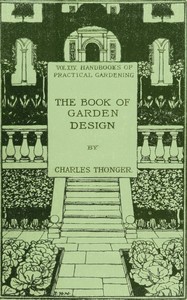
THE BOOK OF GARDEN DESIGN
AUTHOR OF “THE BOOK OF GARDEN FURNITURE”
“A garden is a beautiful book, writ by the finger of God; every flower and every leaf is a letter. You have only to learn them—and he is a poor dunce that cannot, if he will, do that—to learn them and to join them, and then to go on reading and reading, and you will find yourself carried away from the earth to the skies by the beautiful story you are going through.”—DOUGLAS JERROLD.
JOHN LANE: THE BODLEY HEAD LONDON AND NEW YORK. MCMV
_Turnbull & Spears, Printers, Edinburgh._
The whole subject of Garden Design is so diverse and complicated that I must be pardoned for disclaiming any ideas of completeness for this small and unpretending book. To refer, however briefly, to the methods of different workers, and the varied effects obtained by them; or to present in detail the many phases of garden making as practised in England to-day, would necessitate not one volume, but several.
If the reader’s object in perusing these pages is to find a model or plan which he may slavishly duplicate in his own garden, he will, I am afraid, search in vain. Garden “design” is not of necessity formal, and suggestive though the name may be of set patterns and geometrical figures, more may be learnt concerning it in the woods and meadows of Nature than in all the musty volumes which line the shelves of the professional’s office. The pleasures of garden making are so real that each one should jealously guard for himself the privilege of being his own designer.
It is with the idea of helping the novice to help himself that I ask his acceptance of whatever may be of value to him in “The Book of Garden Design.”
WOODBRIDGE, SUFFOLK, _May 1904_.
I. OF GARDENS AND GARDEN DESIGNERS 1
Nature’s Gardens—Qualifications necessary for the Designer—“Garden Architects”—Formal Gardens, Old and Modern—“Capability Brown”—Repton—Artificial and Natural Design—Uselessness of Stock Plans and Patterns.
II. GENERAL PRINCIPLES 12
Comfort and Convenience the Primary Essentials—Undue Complexity to be avoided—Variety Desirable—Garden Paths—Eccentricity Condemned—Attempting too much—Colour and Contrast.
III. THE SELECTION OF A SITE 21
Accessibility—Approach—Soils—Aspect—Altitude—Shelter— Surroundings—Outlines of Property—Existing Timber to be retained.
IV. WALKS AND LAWNS 30
Carriage Drives to be Direct—Walks for Different Parts of the Garden—Serpentine Paths—Edging—Value of Lawns—Breadth and Space conveyed.
V. FORMAL AND LANDSCAPE PLANTING 37
Avenues often Pretentious—Objections to Clipped Yew Hedges—Topiary—Flower Walks—The Maze—Natural Planting—Boundary Plantations—Specimen Trees—Grouping.
VI. KITCHEN-GARDEN AND ORCHARD 44
Unfounded Prejudice against Kitchen-Gardens—Site—Aspect—Boundaries— Borders—Good Walks a Necessity—Water-Supply—Fruit Plantations— The Orchard Beautiful.
VII. THE TREATMENT OF WATER 52
Value of Water in the Garden Scene—Artificial Treatment—Natural Effects generally Preferred—Running Water—Planting on the Margin—Banks.
VIII. HARDY HERBACEOUS PERENNIALS 60
Importance of Living Plants to Design—Border Plants with Various Coloured Flowers.
IX. PLANTS FOR ALPINE, AQUATIC, AND BOG GARDENS 69
Alpines, with Blue, Pink, Yellow, and White Flowers—Water Plants—Suitable Subjects for Marshy Margins—Bog Plants.
X. FLOWERING TREES AND SHRUBS 74
Evergreens Overplanted—Deciduous Trees—List of Varieties.
XI. HARDY CLIMBERS 83
Climbers on Trees—Roses, Clematis, and other Desirable Subjects.
LIST OF ILLUSTRATIONS
LAWN AND SHADE _Frontispiece_
SUNDIAL IN GARDEN WALK 40
STREAM AND WOODLAND 54
HERBACEOUS GROUPING 64
_Photographs by F. Mason Good._
THE BOOK OF GARDEN DESIGN
OF GARDENS AND GARDEN DESIGNERS
From the earliest times the garden has been regarded as a fitting adjunct to the dwelling-places of man. The very name seems to suggest a place of beauty and repose, where the fairest of fruits and flowers are collected into a small compass for our special pleasure and edification. The term “garden,” too, is often employed in a broader sense, meaning a tract of country, so lavishly endowed with natural beauties, as to almost suggest that it is the special property and care of some master hand, who cultivates his broad acres where we are content with inches. Eden, where, according to Milton’s famous description in “Paradise Lost,” the “cedar and pine and fir and branching palm,” mingled together in a tangle of sylvan loveliness, was a garden of Nature. We speak of Italy as the “garden” of the world, and are accustomed to attribute the same term to some specially favoured district or locality in each county at home. From each of these all suggestion of design is absent; a mightier hand than ours has planted their groves, watered their fertile valleys, and strewn the meadows and hedgerows with flowers. To these favoured spots of earth, those at any rate which are left us, the garden designer must cast his eye, as he sets out to learn the rudiments of his craft. Not that garden making consists in the endeavour to duplicate a whole landscape on a small scale—this was an error into which Brown’s followers blindly fell—but because so much that is of value to us may be gathered from an intelligent study of the means by which Nature achieves her most beautiful effects. The disposition of wood and water in a stretch of well-balanced scenery, the beautifully proportioned effect of level and rising ground, of valleys and hills; all these afford an object lesson, which, at some time or other, is bound to prove suggestive when endeavouring to forecast results in artificially arranged grounds. Nature, then, is the school where the novice should go to be thoroughly taught the rudiments of his art. Not only will he learn much that is not to be found in books, but his love of the picturesque and beautiful will be fostered and encouraged—a necessary proceeding if he is to achieve any measure of success as a maker of gardens.
To a certain extent the good designer is born not made, but much may be done by intelligent study and a real fondness for the work, to make up for any lack of natural ability in this direction. But in order to plan a really satisfactory garden, one qualification is absolutely essential: before all things the designer must be himself a gardener. That is, he must have spent some portion of his life actually working among the flowers and trees, whose suitable arrangement he afterwards proposes to decide. He must have sown and planted with his own hand, watched the growth of leaf and bud, and observed the habit of each plant and its adaptability to certain situations. Colour effects must also be noted, in short, nothing should be allowed to escape his eye which concerns the varied phases in the life of the simplest of the garden trees and flowers. Here lies the secret of half the failures which have occurred since garden making came to be regarded as something more than mere haphazard treatment of a piece of enclosed ground. Its votaries have many of them been men who knew absolutely nothing of the ways of flowers, to whom the wonders of nature were as a sealed book. That they were clever draughtsmen none will deny, and that many beautiful gardens were made on paper is equally to be admitted. But that was all, they were unable to see how their gardens would look after being planted a few years—probably they did not care, at any rate they were miserable failures, as must ever be the case when a well drawn design is considered sufficient proof of supreme ability. This class of garden maker is by no means extinct to-day, and with paper, drawing appliances, and a few books of plans for guidance, is able to turn out sketches which, to the uninitiated, seem to suggest unlimited acquaintance with the subject. But transfer these designs to the ground, lay out the paths and beds as he suggests, plant trees and raise mounds, dig watercourses and build rockeries to satisfy his caprice, and what do we find? Our garden is a wretched affair, a thoughtless jumble of half-matured ideas, a desecration of common-sense and good taste. Trees are planted where their graceful outline is cramped and hidden, flowering plants have no possible chance of displaying their full beauty before us, and everywhere we look there are signs of ignorance and wasted opportunity. There is something so contradictory in the term “garden architect”; it suggest the union of two totally distinct professions. Bricks and mortar, cut stonework and terracing, are now pushed into the garden, with the result that its real object is lost and its beauties crowded out. The architect is greedy; not content with designing the house and its approaches, its stabling and many accessories, he must needs take the garden in hand also, and we find his work everywhere and weary of its endless repetition. But we have brought it on ourselves, and must either rest content with that we know to be false, or make an effort to free ourselves from this meretricious form of art without further delay. All may not possess the faculty for suggesting a complicated plan for themselves, but there are few who may not study the outlines of the subject, so that they may be better able to control those whom they employ. After all, the garden should reflect the ideas and taste of the owner, not of the professional. The art of garden making consists very largely in the exercise of common-sense and a due perception of the fitness of things. These, coupled with a love for flowers and a knowledge of their requirements, will lead the beginner to success far more quickly than any ability he may possess for map and plan drawing.
The formal garden, as it existed in the days before its modern substitute cast a slur on the word “formality,” reflected no small credit on the skill and taste of its originators. There was a sense of breadth and stateliness about it which is sadly lacking in its modern rival. Especially praiseworthy were the open stretches of turf, and bold grouping of trees, which were characteristic of the time. The planting of avenues, to whose beauty many of our older houses owe so much, the alleys and greens bounded with hedges of clipped yew, and the wide borders filled with herbaceous flowers, were all pleasing in spite of their stiffness. Aided by handsome terraces, used only where needed, as at Haddon and other places, these old time gardens were free from any suggestion of trickery or deception. Their designers were men whose ideas, if a trifle austere, were perfectly honest; they liked their handiwork to display its beauties in a straightforward manner, with the consequence that their gardens were well-proportioned, and clearly betokened that money had been ungrudgingly spent where necessary. The modern formal garden is of quite another stamp, with its flimsily-constructed terraces, its ill-designed vases and statuary. There is a certain straining after effect noticeable, and a lack of dignity displayed, which makes this latter a very feeble imitation of its prototype. How can a modern villa be expected to act as a suitable foil to a style of garden design which is a cheap adaptation of that practised at Versailles or Chatsworth?
But, leaving the formal garden for a moment, and passing to a consideration of that which was the outcome of an entirely different set of ideas. The landscape school of designers believed that severity and stiffness were totally out of place in a garden, and the only way to secure artistic and beautiful effects was to go direct to Nature for a model. This was right in so far as it went; it became ridiculous when carried to extremes. If “Capability Brown,” himself the most noted member of the new school, and his followers had been content to study Nature, gathering thus many valuable lessons, and then being content to adapt them to the altered conditions which the nature of a garden imposed, much good might have resulted. But instead, their great ambition was to stifle any ideas they might have on the subject, and become slavish imitators, trying to reproduce a whole landscape within the small limits of the garden boundaries. Brown was hailed as a genius, and his advice requisitioned in the remodelling of many of England’s best gardens. All traces of formality were swept away, the terraces, stately parterres, yew hedges, and regular-shaped beds were abolished, and the ground laid out on entirely new lines. This consisted in the introduction of miniature mountains, streams and torrents, the latter crossed by bridges; the remaking of paths, so that they wound in serpentine curves, entailing needless labour to traverse. At Blenheim, Brown turned a river into a valley, with such effect that he is said to have proudly declared “the Thames would never forgive him.” He abhorred avenues, and this style of planting gave place under his rule to the irregular dotting of belts and clumps at varying intervals over an estate. There is no doubt but that some of the “follies” of his satellites were wrongly attributed to him, but, in spite of this, Brown was a consummate mannerist, and undoubtedly was the means of spoiling many a good garden by his efforts at deceptive planting and arrangement.
After Brown’s death in 1784, Humphry Repton was considered the leading garden designer for many years. To him we owe the origin of the term “landscape gardener,” a name chosen to designate a science which combined the united resources of the landscape painter and the practical gardener. Repton is entitled to our respect, in that his schemes were not directed towards the sweeping away of old gardens, but rather to increase, if possible, their beauty and attractiveness. He considered himself a disciple of Brown, but on examination of his methods and work, we are led to conclude that he differed from him in many material particulars. Brown would not tolerate formality in any shape or form, but Repton, realising that few extremes are pleasing, preferred to strike a mean, and combine the ideas of the early designers with those of his predecessor. Thus, whilst duly appreciating the charms of a garden laid out with proper regard to natural effect, he wisely saw that it was ridiculous to attempt to bring this style to the very doors of the house. Architectural features do not readily combine with those of the field and moorland. Hence we find that gardens designed by him were somewhat severe in treatment close to the house, gradually merging into a freer and more natural style, as the work of the builder and mason was left behind. Thus, by slow gradations, the most formal design was merged without incongruity into the wild and uncultivated landscape which bordered the property. Repton also made a number of sketches in connection with his work, tending to show how the general appearance of his garden would change from time to time, as the trees grew and the idea of newness disappeared. Though we cannot agree with many of the rules laid down by him for the benefit of future workers, there is much to admire in his methods of garden planning and arrangement. If he cannot be considered as the inventor of any marked and novel departure (the “gardenesque” style excepted), at any rate he did nothing to spoil existing gardens by the introduction of foolish innovations, which was the fault of many who went before him. Where his ideas on garden planning must be considered as at total variance with our own was in the banishing of many necessary conveniences, simply because they did not happen to be ornamental or harmonise exactly with the landscape. A garden is a place of pleasure and recreation, and there can be no possible harm in erecting comfortable summer houses, seats and resting places, from which to view its beauties, even though these are not to be found in natural scenery of the ideal type.
But the examination in detail of the idiosyncrasies of each and every garden designer would be, to say the least of it, a proceeding which could do no good, and might be productive of much harm. The novice, seeking for assistance and advice, will be needlessly confused by any lengthened reference to the various “styles” laid down as correct by individuals of widely differing tastes and ideas. After all, when we have laboriously studied the art of garden making in this and other countries as it existed over a number of years, and have nodded approval at the work of a certain exponent, only to find later that our ideas are more in accord with those of his successor, what do we find? That the greater part of what we have read is calculated to perplex rather than help, and in the end leave us no whit better able to form opinions as to the right and wrong way of setting about our own business. Putting aside all minor considerations, and looking at the matter in the broadest and simplest light, there are, and have been from time immemorial, but two styles of garden design. On the one hand, we have the artificial, on the other, the natural. The first is generally the offspring of the professional designer, the paper planner, the lover of architectural features, the supporter of the makers of fountains, terracing and statuary. The second can in its truest form emanate only from the garden lover, the man who grows flowers and trees for the sake of their individual beauty, and strives with the materials which Nature lavishly supplies, to make a picturesque and beautiful enclosure near his dwelling. From this it must not be inferred that architectural adornments are wrong, or that a garden can be made in any situation without their aid. The contrary is the case. On a sloping hillside, a garden may only be possible by the aid of terracing: an uninteresting corner may be redeemed by a well-placed sundial or statue: a simple fountain, with the music of its falling water, may by its presence give pleasure during the long summer days. But in spite of all, architectural features must ever be the exception, not the rule, in the well ordered garden, and it is only when they are really needed to further our scheme of “lawn and tree, flower and shrub deftly interwoven,” that there is the slightest excuse for introducing them.
Charles Thonger opens The Book of Garden Design with a disclaimer: his small volume makes no claim to completeness. The subject, he writes, is so diverse that covering all methods would require several volumes. Instead, he aims to help the novice help himself. The preface sets a tone of modest practicality—garden design, Thonger insists, is not about slavishly copying a plan but about learning from the woods and meadows of nature. This emphasis on observation over prescription runs throughout the book, which moves from general principles to specific advice on walks, lawns, planting, and the often-overlooked utility areas of a garden.
Principles over Patterns
Thonger explicitly rejects the idea of providing ready-made plans. In the preface he warns that readers seeking a model to duplicate will search in vain. Instead, he advocates for comfort and convenience as primary essentials, condemning undue complexity and eccentricity. He advises against attempting too much and stresses the importance of variety, colour, and contrast. The designer, he argues, should be guided by the site’s natural features rather than by rigid geometry. This principle is reinforced throughout the chapters, where he repeatedly cautions against pretentious avenues and clipped yew hedges, favouring a more naturalistic approach that respects the existing landscape.
The Practical Garden: Paths, Lawns, and Safety
Thonger devotes considerable attention to the practical layout of walks and lawns. Carriage drives should be direct, while paths in different parts of the garden may be serpentine. He values lawns for the sense of breadth and space they convey. A notable detail is his concern for safety around water features. He recounts an incident where a lady, distracted by the garden’s beauty, fell into a lily tank. Thonger wryly notes the specialist’s greater distress over the lost Nymphæa than the ruined Paris frock. He urges designers to render fountains and ponds safe, a practical touch that reflects his overall emphasis on usability.
Utility and the Orchard Beautiful
The book does not neglect the working parts of a garden. Thonger recommends a separate enclosure for frames, hot beds, and compost heaps, placed outside the main garden to avoid untidiness. He also advocates for a well-built toolhouse, possibly with an upper fruit room, noting that many large gardens are miserably provided with such structures. The orchard receives particular attention: Thonger distinguishes between the utilitarian orchard and the orchard beautiful, the latter achieved through neglect and nature’s reassertion. He suggests planting damson trees for shelter and describes the old grass orchard as a wild garden of true beauty, with daffodils, narcissi, and clematis creating vistas of colour among grey trunks.
Movement between Scenes
Thonger’s structure moves deliberately from the general to the specific, and from the ornamental to the practical. The book opens with philosophical principles, then proceeds to site selection, walks, lawns, and planting. Later chapters address the kitchen garden, orchard, and service areas. This progression mirrors the designer’s own movement through a property: from the approach and pleasure grounds to the productive and utilitarian zones. The recurring image of paths—their direction, edging, and junctions—serves as a structural thread, connecting the formal and the natural. Thonger’s advice to place a sunk tank at the junction of four paths exemplifies his preference for symmetry in service of convenience.
Thonger’s book is best read as a companion for the gardener who wishes to think independently. Its value lies not in prescriptive diagrams but in the author’s insistence on observing one’s own site, soil, and surroundings. The Edwardian voice—confident, anecdotal, occasionally wry—offers a perspective that remains useful for understanding the principles of garden design as a dialogue between human intention and natural growth.
Reading Thonger’s quiet insistence that a garden grows best from its own soil, rather than borrowed blueprints, lingered with me afterwards. It felt like a whisper across decades to another stubborn, earthy belief—that land, given patient care and honest observation, keeps its promises. That gentleness led me back to The Farm That Won't Wear Out — Themes and Context. Both books trust nature's slow, unglamorous intelligence over quick, tidy answers.
There are no reviews for this eBook.
How will you remember this book?
Save your reaction, strongest insight, and memorable passage.

Shelley Huber - 1 month ago
Michelle Brown - 3 weeks ago
Kimberly Donald Harris - 3 weeks ago