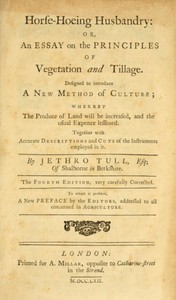
Horse-hoeing husbandry — Reading Notes
Edition facts
Horse-hoeing husbandry — Reading Notes can be approached with a clearer sense of reading commitment from its source measurements: 163,553 words, 11 hr 52 min estimated reading time, and 35 detected text sections.
The text analysis averages about 42.2 words per sentence, while the detected sections provide another way to judge how the source is divided.
Project Gutenberg metadata also associates the work with “Agriculture -- Early works to 1800,” connecting these edition facts with the source record’s subject description.
Calculated from edition completeness, EPUB availability, text structure and catalogue metadata. Not a user rating.
How this score is calculated
- Description quality20 pts
- Title & short description10 pts
- Source metadata20 pts
- Text length15 pts
- Chapters / structure15 pts
- EPUB file integrity20 pts
Total of 100 points, scaled to a 2.5-5.0 range. Editions with an empty description or a missing EPUB file are not scored.
Read the Text
nerally used in every Part of the Kingdom; which would be far from rendering Mr. _Tull_’s Method of Culture useless; seeing that, when it is well understood, it will be found the surest Method to improve both.
For although Mr. _Tull_ chiefly confined the Practice of his Method to the Production of Grain (which is a great Pity), yet it may be extended to every Vegetable which is the Object of Culture in the Fields, Gardens, Woods, _&c._ and perhaps may be applied to many other Crops, to equal, if not greater Advantage, than to Corn.
In the Vineyard it has been long practised with Success; and may be used in the Hop-Ground with no less Advantage. For the Culture of Beans, Peas, Woad, Madder, and other large-growing Vegetables; as also for Lucern, Saintfoin, and the larger Grasses; we dare venture to pronounce it the only Method of Culture for Profit to the Farmer; seeing that, in all these Crops, one Sixth Part of the Seeds now commonly sown will be sufficient for the same Quantity of Land, and the Crop in Return will be much greater; which, when the Expence of Seeds is duly considered, will be found no small Saving to the Farmer.
Nor should this Method of Culture be confined to _Europe_: for it may be practised to as great Advantage in the _British_ Colonies in _America_, where, in the Culture of the Sugar-Cane, Indigo, Cotton, Rice, and almost all the Crops of that Country, it will certainly save a great Expence of Labour, and improve the Growth of every Plant, more than can be imagined by such as are ignorant of the Benefit arising from this Culture. And should the Subjects of _Great Britain_ neglect to introduce this Method into her Colonies, it may be presumed our Neighbours will take care not to _be blameable on this Head_; for they seem to be as intent upon extending every Branch of Trade, and making the greatest Improvements of their Land, as we are indifferent to both: So that, unless a contrary Spirit be soon exerted, the Balance of Trade, Power, and every other Advantage, must be against us.
There have been Objections made by some to Mr. _Tull_’s Method, as if it were practicable only on such Lands as are soft and light, and not at all on stiff and stony Ground. That it hath not been practised on either of these Lands in _England_ we are willing to grant; but we must not from thence infer that it is impossible to apply it to them. For the Hoe-Plough has been very long used in the Vineyards in many Countries, where the Soil is stronger, and abounds with Stones full as much as any Part of this Country. However, though the Use of this Plough may be attended with some Difficulties upon such Land, for Wheat, or Plants of low Growth, whose Roots may be in Danger of being turned out of the Ground, or their Tops buried by the Clods or Stones; yet none of the larger-growing Plants are subject to the same Inconveniencies. Besides, the stronger the Soil is, the more Benefit will it receive from this Method of Culture, if the Land be thereby more pulverized; which will certainly be the Consequence, where the Method laid down by Mr. _Tull_ is duly observed.
But as most Instruments, in their First Use, are attended with some Difficulty, especially in the Hands of such as are indocile, the Hoe-plough has been complained of, as cumbersome and unwieldy to the Horse and Ploughman. But perhaps this arises chiefly from the Unwillingness of the Workmen to introduce any new Instrument: Indeed, seeing little is to be expected from those who have been long attached to different Methods, the surest Way to promote the Use of it, is to engage young Persons, who may probably be better disposed, to make the Trial at their first entering into Business; and then a little Use will make it easy. It is proper to observe here, that the Swing-plough, which is commonly used in the deep Land about _London_, will do the Business of the Hoe-plough in all Ground that is not very strong, or very stony; and that where it is so, the Foot-plough, made proportionably strong, will completely answer all Purposes. But it must be remembered, that when these are used to hoe Corn, the Board on the Left Hand of the Plough, answering the Mould-Board, must be taken off; otherwise so much Earth will run to the Left Side, as to injure the Crop when it is low.
The _Drills_ are excellent Instruments; yet we imagine them capable of some farther Improvement. Parallel Grooves, at about an Inch asunder, round the Inside of the Hopper, would shew the Man who follows the Drill, whether or no both Boxes vent the Seed equally. By an Hitch from the Plank to the Harrow, the latter may be lifted to a proper Height, so as not to be in the Way when the Ploughman turns at the Headland. Two light Handles on the Plank, like those of the common Plough, would enable the Person who follows the Drill to keep it from falling off the Middle of the Ridge. It may also be useful, in wet Weather, to double the Drills; by which means Two Ridges may be sown at the same time, the Horse going between them: For the Planks of Two Drills, each Plank having one of the Shafts fixed to it, may be joined End for End by Two flat Bars of Iron, one on each Side, well secured by Iron Pins and Screws; and, by corresponding Holes in the Planks and Bars, the Distance between the Drills may be altered, according to the different Spaces between the Ridges.
The Alterations made by the Editors of this Impression are little more than omitting the controversial Parts of the Book, which were judged of no Service to the Reader, as they no-ways affected the Merits of Mr. _Tull_’s Principles.
But as he endeavoured to recommend his Theory by drawing a Comparison between the Old Method of Culture and the New, so we beg leave to annex a Computation of the Expence and Profit of each; for which we are obliged to a Gentleman, who for some Years practised both in a Country where the Soil was of the same Nature with that from whence Mr. _Tull_ drew his Observations, _viz._ light and chalky. And we chuse to give this the rather, as it comes from one who has no Attachment to Mr. _Tull_’s Method, farther than that he found it answer in his Trials. We appeal to Experience, whether every Article in this Calculation is not estimated in favour of the Common Husbandry; whether the Expence be not rated lower than most Farmers find it, and the Crop such as they would rejoice to see, but seldom do, in the Country where this Computation was made.
In the New Husbandry every Article is put at its full Value, and the Crop of each Year is Four Bushels short of the other; tho’, in several Years Experience, it has equalled, and generally exceeded, those of the Neighbourhood in the Old Way.
_An Estimate of the Expence and Profit of Ten Acres of Land in Twenty Years._
First Year, for Wheat, costs 33_l._ 5_s._ _viz._ _l._ _s._ _d._ _l._ _s._ _d._
First Plowing, at 6_s._ _per_ Acre 3 0 0 Second and Third Ditto, at 8_s._ _per_ Acre 4 0 0 Manure, 30_s._ _per_ Acre 15 0 0 ------------ 22 0 0
Two Harrowings, and Sowing, at 2_s._ 6_d._ _per_ Acre 1 5 0 Seed, three Bushels _per_ Acre, at 4_s._ _per_ Bush. 6 0 0 Weeding, at 2_s._ _per_ Acre 1 0 0 Reaping, Binding, and Carrying, at 3 0 0 6_s._ _per_ Acre ------------ 11 5 0 ------------- 33 5 0
Second Year, for Barley, costs 11_l._ 6_s._ 8_d._ _viz._
Once Plowing, at 6_s._ _per_ Acre 3 0 0 Harrowing and Sowing, at 1_s._ 6_d._ _per_ Acre, 0 15 0 Weeding, at 1_s._ _per_ Acre 0 10 0 Seed, 4 Bushels _per_ Acre, at 2_s._ _per_ Bushel 4 0 0 Cutting, Raking, and Carrying, at 3_s._ 2_d._ _per_ Acre 1 11 8 Grass-Seeds, at 3_s._ _per_ Acre 1 10 0 ------------ 11 6 8 ------------- 44 11 8 ------------- Third and Fourth Years, lying in Grass, cost nothing: So that the Expence of Ten Acres in Four Years comes to 44_l._ 11_s._ 8_d._ and in Twenty Years to 222 18 4
First Year’s Produce is half a Load of Wheat _per_ Acre, at 7_l._ 35 0 0 Second Years Produce is Two Quarters of Barley _per_ Acre, at 1_l._ 20 0 0 Third and Fourth Years Grass is valued at 1_l._ 10_s._ _per_ Acre 15 0 0 ------------ So that the Produce of Ten Acres in Four Years is 70 0 0 ------------ And in Twenty Years it will be 350 0 0 ------------- Deduct the Expence, and there remains clear Profit on Ten Acres in 20 Years by the Old Way 127 1 8 -------------
II. _In the New Way._
First Year’s extraordinary Expence is, for plowing and manuring the Land, the same as in Old Way 22 0 0
Plowing once more, at 4_s._ _per_ Acre 2 0 0 Seed, 9 Gallons _per_ Acre, at 4_s._ _per_ Bushel 2 5 0 Drilling, at 7_d._ _per_ Acre 0 5 10 Hand-hoeing and Weeding, at 2_s._ 6_d._ _per_ Acre 1 5 0 Horse-hoeing Six times, at 10_s._ _per_ Acre 5 0 0 Reaping, Binding, and Carrying, at 6_s._ _per_ Acre 3 0 0 ------------ The standing annual Charge on Ten Acres is 13 15 10 ------------ Therefore the Expence on Ten Acres in Twenty Years is 275 16 8 ------------- Add the Extraordinaries of the First Year, and the Sum is 297 16 8 ------------- The yearly Produce is at least Two Quarters of Wheat _per_ Acre, at 1_l._ 8_s._ _per_ Quarter; which, on Ten Acres in Twenty Years, amounts to 560 0 0 ------------- Therefore, all things paid, there remains clear Profit on Ten Acres in Twenty Years by the New Way 262 3 4 -------------
So that the Profit on Ten Acres of Land in Twenty Years, in the New Way, exceeds that in the Old by 135_l._ 1_s._ 8_d._ and consequently is considerably more than double thereof: an ample Encouragement to practise a Scheme, whereby so great Advantage will arise from so small a Quantity of Land, in the Compass of a Twenty-one Years Lease; One Year being allowed, both in the Old and New Way, for preparing the Ground.
It ought withal to be observed, that Mr. _Tull_’s Husbandry requires no Manure at all, tho’ we have here, to prevent Objections, allowed the Charge thereof for the first Year; and moreover, that tho’ the Crop of Wheat from the _Drill-plough_ is here put only at Two Quarters on an Acre, yet Mr. _Tull_ himself, by actual Experiment and Measure, found the Produce of his drilled Wheat-crop amounted to almost Four Quarters on an Acre: And, as he has delivered this Fact upon his own Knowlege, so there is no Reason to doubt of his Veracity, which has never yet been called in question. But that we might not be supposed to have any Prejudice in favour of his Scheme, we have chosen to take the Calculations of others rather than his, having no other View in what we have said, than to promote the Cause of Truth, and the public Welfare.
The Wheat and Turnep Drill-Boxes, or the Drill-Plough complete, mentioned in this Treatise, may be had at Mr. _Mulford_’s in _Cursitor-street, Chancery-lane, London_.
_Of_ ROOTS _and_ LEAVES.
Since the most immediate Use of _Agriculture_, in feeding Plants, relates to their _Roots_, they ought to be treated of in the first Place.
_Roots_ are very different in different Plants: But ’tis not necessary here to take notice of all the nice Distinctions of them; therefore I shall only divide them in general into two Sorts, _viz._ _Horizontal-Roots_, and _Tap-Roots_, which may include them all.
All have Branchings and Fibres going all manner of ways, ready to fill the Earth that is open.
But such _Roots_ as I call Horizontal (except of Trees) have seldom any of their Branchings deeper than the Surface or Staple of the Earth, that is commonly mov’d by the Plough or Spade.
The Tap-Root commonly runs down Single and Perpendicular[1] reaching sometimes many Fathoms below.
[1] In this manner descends the first Root of every Seed; but of Corn very little, if at all, deeper than the Earth is tilled.
These first Seed-Roots of Corn die as soon as the other Roots come out near the Surface, above the Grain: and therefore this first is not called a Tap Root; but yet some of the next Roots that come out near the Surface of the Ground, always reach down to the Bottom of the pulveriz’d Staple; as may be seen, if you carefully examine it in the Spring time; but this first Root in Saint-foin becomes a Tap Root.
This (tho’ it goes never so deep) has horizontal ones passing out all round the Sides; and extend to several Yards Distance from it, after they are by their Minuteness, and earthly Tincture, become invisible to the naked Eye.
_A Method how to find the Distance to which_ Roots _extend Horizontally._
_Pl._ 6. _Fig._ 7. Is a Piece or Plot dug and made fine in whole hard Ground, the End _A_ 2 Feet, the End _B_ 12 Feet, the Length of the Piece 20 Yards; the Figures in the middle of it are 20 _Turneps_, sown early, and well ho’d.
The manner of this Hoing must be at first near the Plants, with a Spade, and each time afterwards, a Foot farther Distance, till all the Earth be once well dug; and if Weeds appear where it has been so dug, hoe them out shallow with the Hand-Hoe. But dig all the Piece next the out Lines deep every time, that it may be the finer for the _Roots_ to enter, when they are permitted to come thither.
If these _Turneps_ are all gradually bigger, as they stand nearer to the End _B_, ’tis a Proof they all extend to the Outside of the Piece; and the _Turnep_ 20 will appear to draw Nourishment from six Feet Distance from its Centre.
But if the _Turneps_ 16, 17, 18, 19, 20, acquire no greater Bulk than the _Turnep_ 15, it will be clear, that their _Roots_ extend no farther than those of the _Turnep_ 15 does; which is but about 4 Feet.
By this Method the Distance of the Extent of _Roots_ of any Plant may be discover’d.
What put me upon this Method was an Observation of two Lands (or Ridges) drill’d with _Turneps_ in Rows, a Foot asunder, and very even in them; the Ground, at both Ends, and one Side, was hard and unplow’d; the _Turneps_ not being ho’d, were very poor, small, and yellow, except the Three outside Rows, _B_, _C_, _D_, which stood next to the Land (or Ridge) _E_, which Land being plow’d and harrow’d, at the time the Land _A_ ought to have been ho’d, gave a dark flourishing Colour to these three Rows; and the _Turneps_ in the Row _D_, which stood farthest off from the new-plow’d Land _E_, received so much Benefit from it, as to grow twice as big as any of the more distant Rows. The Row _C_, being a Foot nearer to the new-plow’d Land, became twice as large as those in _D_; but the Row _B_, which was next to the Land _E_, grew much larger yet[2].
[2] A like Observation to this on the Land E, has been made in several Turnep Fields of divers Farmers, where Lands adjoining to the Turneps have been well tilled; all the Turneps of the contiguous Lands that were within three or four Feet, or more, of the newly pulveriz’d Earth, received as great, or greater increase, in the Manner as my Rows B C D did; and what is yet a greater Proof of the Length of Roots, and of the Benefit of deep Hoing, all these Turneps have been well Hand-ho’d; which is a good Reason why the Benefit of the deep Pulveration should be perceivable at a greater Distance from it than mine, because my Turneps, not being hoed at all, had not Strength to send out their Roots through so many Feet of unpulveriz’d Earth, as these can through their Earth pulveriz’d by the Hoe, tho’ but shallowly.
This Observation, as ’tis related to me (I being unable to go far enough to see it myself) sufficiently demonstrates the mighty Difference there is between Hand-hoing and Horse-hoing.
_F_ Plate 6. is a Piece of hard whole Ground, of about two Perch in Length, and about two or three Feet broad, lying betwixt those two Lands, which had not been plow’d that Year; ’twas remarkable, that during the Length of this interjacent hard Ground, the Rows _B_, _C_, _D_, were as small and yellow as any in the Land.
The _Turneps_ in the Row _D_, about three Feet distant from the Land _E_, receiving a double Increase, proves they had as much Nourishment from the Land _E_, as from the Land _A_, wherein they stood; which Nourishment was brought by less than half the Number of _Roots_ of each of these _Turneps_.
In their own Land they must have extended a Yard all round, else they could not have reach’d the Land _E_, wherein ’tis probable these few Roots went more than another Yard, to give each _Turnep_ as much Increase as all the Roots had done in their own Land.
Except that it will hereafter appear, that the new Nourishment taken at the Extremities of the Roots in the Land _E_, might enable the Plants to send out more new Roots in their own Land, and receive something more from thence.
The Row _C_ being twice as big as the Row _D_, must be suppos’d to extend twice as far; and the Row _B_, four times as far, in proportion as it was of a Bulk quadruple to the Row _D_.
A _Turnep_ has a Tap-Root, from whence all these Horizontal Roots are deriv’d.
And ’tis observable; that betwixt these two Lands there was a Trench, or Furrow, of about the Depth of nine or ten Inches, where these Roots must descend first, and then ascend into the Land _E_: But it must be noted, that some small Quantity of Earth was, by the Harrowing, fall’n into this Furrow, else the Roots could not have pass’d thro’ it.
_Roots_ will follow the open Mould[3], by descending perpendicularly, and mounting again in the same manner: As I have observ’d the Roots of a Hedge to do, that have pass’d a steep Ditch two Feet deep, and reach’d the Mould on the other side, and there fill it; and digging Five Feet distant from the Ditch, found the Roots large, tho’ this Mould was very shallow, and no Roots below the good Mould.
[3] A Chalk-Pit, contiguous to a Barn, the Area of which being about 40 Perch of Ground, was made clean and swept; so that there was not the Appearance of any Part of a Vegetable, more than in the Barn’s Floor: Straw was thrown from thence into the Pit, for Cattle to lie on; the Dung made thereby was haled away about three Years after the Pit had been cleansed; when, at the Bottom of it, and upon the Top of the Chalk, the Pit was covered all over with Roots, which came from a Witch-Elm, not more than Five or Six Yards in Length, from Top to Bottom, and which was about Five Yards above, and Eleven Yards from the Area of the Pit; so that in three Years the Roots of this Tree extended themselves Eight times the Length of the Tree, beyond the Extremities of the old Roots, at Eleven Yards Distance from the Body: The annual-increased Length of the Roots was near Three times as much as the Height of the Tree.
I’m told an Objection hath been made from hence against the Growth of a Plant’s being in proportion to the Length of its Roots; but when the Case is fully stated, the Objection may vanish. This Witch-Elm is a very old decay’d Stump, which is here called a _Staggar_, appearing by its Crookedness to have been formerly a _Plasher_ in an old White-thorn Hedge wherein it stands: It had been lopped many Years before that accidental Increase of Roots happened; it was stunted, and sent out poor Shoots; but in the third Year of these Roots, its Boughs being most of them horizontally inclined, were observed to grow vigorously, and the Leaves were broad, and of a flourishing Colour; at the End of the third Year all these Roots were taken away, and the _Area_ being a Chalk-Rock lying uncovered, round the Place where the Single Root, that produced all these, came out of the Bank, no more Roots could run out on the bare Chalk, and the Growth of the Boughs has been but little since.
Jethro Tull’s Horse-hoeing Husbandry opens with a pointed critique of Roman agricultural methods, particularly their handling of Medica (alfalfa). Tull contrasts the Romans’ labor-intensive finger-weeding and hand-watering with his own horse-hoe system, which he claims would have been far more efficient. The excerpt reveals a writer who is both a practical farmer and a polemicist, eager to expose the errors of ancient authorities like Columella. Tull’s tone is sharp and ironic, as when he notes that “Fingers were made before the Bidens,” yet he insists that iron tools would have been superior. This editorial note examines the specific tensions in Tull’s argument: his reliance on classical texts, his confidence in mechanical innovation, and his frustration with farmers’ resistance to change.
The Roman Precedent and Its Flaws
Tull repeatedly invokes Roman writers—especially Columella—to illustrate what he sees as misguided practices. He quotes Columella’s instruction to water Medica repeatedly after cutting, and to pick out grass by hand in dry ground. Tull seizes on these details to argue that the Romans’ failure to use the Bidens (a two-pronged hoe) on Medica was a costly error. He calculates that the horse-hoe would have done the same work “at a Twentieth Part of that Expence.” The passage is notable for its quantitative bent: Tull is not content to assert superiority; he tries to measure it. Yet his evidence is entirely textual—he has no Roman fields to test. The tension lies in his reverence for classical authority even as he dismantles it. He treats Columella as both a source of data and a cautionary tale, using the ancients’ own words to condemn their methods.
Iron, Wood, and the Antipathy of Plants
A curious argument appears when Tull addresses the Roman belief that Medica had an “Antipathy to Iron.” He scoffs at this notion, pointing out that the real problem was burial depth, not metal. A wooden plough would bury seed just as deep as an iron one. Tull’s reasoning is grounded in physical principles: the weight of the implement, not its material, determines how deeply it presses seed. He even notes that Columella himself recommended light wooden rakes (Rastellis ligneis), implying that the Roman author sensed the issue but failed to articulate it. This section reveals Tull’s method: he combines close reading of classical texts with practical observation, but he never tests his claims experimentally. The reader is left to weigh his logic against the absent evidence of field trials.
The Farmer’s Resistance and Tull’s Frustration
The preface to the fourth edition, written by the editors, provides a striking counterpoint to Tull’s own voice. It laments that farmers “cannot be prevailed on to alter their usual Methods upon any Consideration,” even when convinced that their practices lead to ruin. The editors attribute this to the character of farmers and their power to “defeat any Scheme which is not agreeable to their own Notions.” Tull’s own writing, however, suggests a different obstacle: his arguments are dense, classical, and often sarcastic. He expects readers to follow his citations and calculations without hand-holding. The tension between the editors’ plea for practical adoption and Tull’s scholarly tone is palpable. The book is thus not only a treatise on tillage but also a document of the gap between innovation and implementation in eighteenth-century agriculture.
Tull’s Horse-hoeing Husbandry rewards readers who attend to its layered argumentation. The text moves between ancient authority, mechanical reasoning, and sharp polemic, often within a single paragraph. Readers should note that Tull’s evidence is drawn from books, not fields; his claims about cost and yield are theoretical. The book is best approached as a work of advocacy and intellectual history rather than a practical manual. Its value lies in the clarity of its central insight—that tillage can substitute for manure—and in the vivid picture it paints of an author battling both classical tradition and contemporary inertia.
Jethro Tull’s Horse-hoeing husbandry always felt to me like a man whispering to his own rows, stubborn and tender. Years later, I found that same quiet patience in a different voice, bent over blossoms rather than furrows. There is a kinship there—two souls trusting the soil’s reply. I keep them side by side now, Gardening for women — Text and Context beside the old treatise, like old friends sharing one bench.
Anthony Nguyen
2 weeks agoCarter White
2 weeks agoWhat did you think of this book?
Answer a few questions and save a private reflection on this device.

Wyatt Lee
3 weeks ago