About 290 minutes
The agricultural and forest products of British West Africa — Context and Discussion
Gardening
66,581 recorded words. 3 minutes difference from this book's estimate.
View Gutenberg source #70973
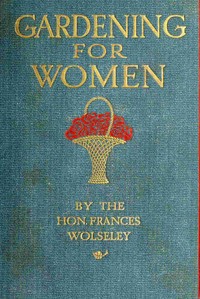
The source record for Gardening for women — Text and Context measures this digital text at 67,331 words, 4 hr 53 min estimated reading time, and 25 detected text sections.
The text analysis averages about 17.9 words per sentence, while the detected sections provide another way to judge how the source is divided.
Project Gutenberg metadata also associates the work with “Gardening,” connecting these edition facts with the source record’s subject description.
Explore this collection
These alternatives are selected using recorded categories and estimated reading time.
About 290 minutes
Gardening
66,581 recorded words. 3 minutes difference from this book's estimate.
View Gutenberg source #70973About 297 minutes
Gardening
68,263 recorded words. 4 minutes difference from this book's estimate.
View Gutenberg source #54606About 284 minutes
Gardening
65,175 recorded words. 9 minutes difference from this book's estimate.
View Gutenberg source #25278Search stored excerpts and compare books → Choose by your preferences →
Choices use stored catalog measurements. Estimates vary with reading speed. A shared category is a catalog label, not a claim that two books have the same argument or literary quality.
Search reads excerpt text stored with this catalog and links to its associated Gutenberg record. The connection is stored in the site database; this tool does not recheck that every excerpt is word-for-word identical to that external record. Excerpt search does not cover every chapter and does not verify historical publication dates.
Catalog snapshot checked: 2026-09-25. Coverage: 91 public books, 91 available source excerpts.
Read the complete public-domain text at its original source.
Read on Project GutenbergFrances Wolseley opens Gardening for Women not with planting instructions but with a profession: the book is framed as a guide to making gardening a paid career for women. As principal of the Glynde School for Lady Gardeners in Sussex, Wolseley writes from direct institutional experience. The volume mixes practical chapters on soil, propagation, and market gardening with sections on dress, cottage living, and the medical aspects of the work. A substantial portion surveys existing training programs in Britain, continental Europe, America, Canada, and Australia, and includes detailed syllabi from London County Council evening classes. The result is a document that is part handbook, part advocacy, and part international survey—all anchored to the specific conditions of early twentieth-century women seeking skilled outdoor employment.
Wolseley’s opening chapter is titled “Gardening as a Profession for Women,” and the word profession does real work throughout the book. She addresses women who want to earn a living, not merely to tend a private flower border. The table of contents lists chapters on “Jobbing Gardening and Floral Decoration,” “Market Gardening,” and “Some Hints upon Taking Up a Post as Head Gardener”—each treating gardening as a structured occupation with standards, wages, and advancement. The frontispiece shows “A Pupil in Working Costume” at Glynde, and a later chapter is devoted entirely to “Dress for Lady Gardeners,” treating clothing as practical equipment rather than ornament. Wolseley also includes a chapter titled “For Those who Hesitate to Employ Lady Gardeners,” which suggests she anticipated skepticism from potential employers and wrote to counter it with evidence of competence.
Part II of the book is a detailed survey of schools and colleges for lady gardeners in Great Britain, continental Europe, America, Canada, and Australia. Wolseley lists institutions, describes their programs, and in some cases reproduces their syllabi verbatim. For example, she includes the full syllabus for a London County Council horticulture course at Brownhill Road Evening Centre, Catford, which covers “the cultivation of vegetables, hardy fruit, etc.; the management of the orchard house, flower garden, flowers under glass, seed growing, propagation.” She also prints the syllabus for a biology and nature-study course at the same centre, taught by Mr. G. Alford, which includes investigation of “external features, general structure, mode of life, surroundings, life-history, and habits of flowering plants, yeast, frog, amœba.” These inclusions give the book a documentary quality, preserving the exact curriculum that early twentieth-century women students would have followed.
Wolseley’s survey extends well beyond Britain. She devotes chapters to continental schools and colleges, to schools and colleges in America, and to “Gardening and Nature-Study in Canada and Australia.” The American chapter lists institutions and describes their approaches, while the Canadian and Australian chapter addresses the specific conditions of those colonies. At the same time, the book is rooted in Sussex: the Glynde school appears repeatedly, and photographs show its walled garden, cottage, and pupils at work. Wolseley also includes a chapter on “Italian Pot Gardens: A Suggestion,” which proposes a decorative style using terracotta pots and oil jars—illustrated with photographs of “Italian Orange Pots and Oil Jars.” This combination of local practice, national advocacy, and international comparison gives the book a distinctive range, moving from the practical details of a single school to a global view of women’s horticultural education.
Readers coming to Gardening for Women for planting advice will find it, but the book’s real subject is the infrastructure of a profession: training, dress, wages, employer attitudes, and the geography of opportunity. Wolseley’s voice is that of an administrator and advocate, not a memoirist. The syllabi and school lists are not appendices but central evidence. For anyone interested in the history of women’s work, agricultural education, or the Edwardian gardening movement, this is a primary document of unusual breadth.
Reading Wolseley’s practical pages, I remembered my grandmother’s hands patting soil around sweet peas, her quiet certainty that work and worth were the same thing. That same sturdy dignity lives in The English Husbandman The First Part: Contayning the Knowledge of the true Nature of euery Soyle within this Kingdome: how to Plow it; and the manner of the Plough, and — Reading Companion, where an older voice treats land and labor with the same unhurried reverence.
Answer a few questions and save a private reflection on this device.