The English Husbandman The First Part: Contayning the Knowledge of the true Nature of euery Soyle within this Kingdome: how to Plow it; and the manner of the Plough, and — Reading Companion
Edition facts
The English Husbandman The First Part: Contayning the Knowledge of the true Nature of euery Soyle within this Kingdome: how to Plow it; and the manner of the Plough, and — Reading Companion can be approached with a clearer sense of reading commitment from its source measurements: 71,618 words, 5 hr 12 min estimated reading time, and 8 detected text sections.
The text analysis averages about 70.9 words per sentence, while the detected sections provide another way to judge how the source is divided.
Project Gutenberg metadata also associates the work with “Agriculture -- England -- Early works to 1800,” connecting these edition facts with the source record’s subject description.
Calculated from edition completeness, EPUB availability, text structure and catalogue metadata. Not a user rating.
How this score is calculated
- Description quality20 pts
- Title & short description10 pts
- Source metadata20 pts
- Text length15 pts
- Chapters / structure15 pts
- EPUB file integrity20 pts
Total of 100 points, scaled to a 2.5-5.0 range. Editions with an empty description or a missing EPUB file are not scored.
Read the Text
Produced by Louise Pryor, Jonathan Ingram and the Online Distributed Proofreading Team at http://www.pgdp.net
Spellings are inconsistent, especially the use of ee and ee. Notes of changes that have been made for obvious misprints, and of other anomalies, are at the end of this etext.
There are many sidenotes in the original. They are indicated thus: {SN: }, and have been grouped together at the start of the paragraph in which they appear.]
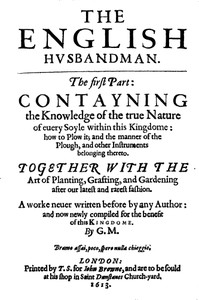
THE ENGLISH HVSBANDMAN.
_The first Part_: CONTAYNING the Knowledge of the true Nature of euery Soyle within this Kingdome: how to Plow it; and the manner of the Plough, and other Instruments belonging thereto.
_TOGETHER WITH THE_ Art of Planting, Grafting, and Gardening after our latest and rarest fashion.
A worke neuer written before by any Author: and now newly compiled for the benefit of this KINGDOME.
_Bramo assai, poco, spero nulla chieggio._
_LONDON:_ Printed by _T. S._ for _Iohn Browne_, and are to be sould at his shop in Saint _Dunstanes_ Church-yard.
TO THE RIGHT HONOVRABLE, and his singular good Lord, the Lord _Clifton_, Baron of Layton.
It was a custome (right Honorable, and my most singular good Lord) both amongst the auntient _Romans_, and also amongst the wise _Lacedemonians_, that euery idle person should giue an account of the expence of his howers: Now I that am most idle, and least imployed in your Familie, present here vnto your Lordships hands an account of the expence of my idle time, which how well, or ill, it is, your Noble wisedome must both iudge and correct; onely this I am acertain'd, that for the generall rules and Maximes of the whole worke, they are most infallibly true, and perfectly agreeing with our English climate. Now if your Lordship shall doubt of the true tast of the liquor because it proceedeth from such a vessell as my selfe, whom you may imagine vtterly vnseasoned vvith any of these knowledges, beleeue it (my most best Lord) that for diuers yeeres, wherein I liued most happily, I liued a Husbandman, amongst Husbandmen of most excellent knowledge; during all which time I let no obseruation ouer-slip me: for I haue euer from my Cradle beene naturally giuen to obserue, and albe I haue not that oylie tongue of ostentation which loueth euer to be babling all, and somewhat more then it knoweth, drawing from ignorance admiration, and from wisedome laughter, filling meale-times with much vnprofitable noyse; yet I thanke my maker I haue a breast which containeth contentment inough for my selfe, and I hope much benefit for the whole Kingdome; how euer or whatsoeuer it is, it is all your Lordships, vnder the couert of whose fauourable protection if it may finde grace it is the vttermost aime whereunto my wishes aspire, nor shall I feare the malignitie of the curious, for it is not to them but the honest plaine English Husbandman, I intend my labours, vvhose defender you haue euer beene, and for whose Honorable prosperitie both they and I will continually pray.
_Your honours in all seruiceable humblenesse_,
The Epistle to the generall and gentle Reader.
Although (generall reader) the nature of this worst part of this last age hath conuerted all things to such vildnesse that whatsoeuer is truely good is now esteemed most vitious, learning being derided, fortitude drawne into so many definitions that it consisteth in meere words onely, and although nothing is happy or prosperous, but meere fashion & ostentation, a tedious fustian-tale at a great mans table, stuft with bigge words, with out sence, or a mimicke Iester, that can play three parts in one; the Foole, the Pandar and the Parasit, yet notwithstanding in this apostate age I haue aduentured to thrust into the world this booke, which nothing at all belongeth to the silken scorner, but to the plaine russet honest Husbandman, for whose particular benefit, and the kingdomes generall profit, I haue with much paine, care, and industry, passed through the same. Now for the motiues which first drew me to vndertake the worke, they were diuers: as first, when I saw one man translate and paraphrase most excellently vpon _Virgils Georgickes_, a worke onely belonging to the Italian climbe, & nothing agreeable with ours another translates _Libault & Steuens_, a worke of infinit excellency, yet onely proper and naturall to the French, and not to vs: and another takes collections from _Zenophon_, and others; all forrainers and vtterly vnacquainted with our climbes: when this I beheld, and saw with what good liking they were entertained of all men; and that euery man was dumbe to speake any thing of the _Husbandry_ of our owne kingdome, I could not but imagine it a worke most acceptable to men, and most profitable to the kingdome, to set downe the true manner and nature of our right English _Husbandry_, our soyle being as delicate, apt, and fit for increase as any forraine soyle whatsoeuer, and as farre out-going other kingdomes in some commoditie, as they vs in other some. Hence, and from these considerations, I began this worke, of which I haue here sent thee but a small tast, which if I finde accepted, according to mine intent, I will not cease (God permitting mee life) to passe through all manner of English _Husbandry_ and _Huswifery_ whatsoeuer, without omission of the least scruple that can any way belong to either of their knowledges. Now gentle reader whereas you may be driuen to some amazement, at two titles which insue in the booke, namely, a former part before the first, and the first part, you shall vnderstand that those first sheetes were detained both from the Stationer and me, till the booke was almost all printed; and my selfe by extreame sicknesse kept from ouer-viewing the same, wherefore I must intreate your fauour in this impression and the rather in as much as there wanteth neither any of the words or matter whatsoeuer: _Farewell_.
A FORMER PART, before the first Part: Being an absolute perfect Introduction into all the Rules of true Husbandry; and must first of all be read, or the Readers labour will be frustrate.
_The Proem of the Author. What a Husbandman is: His Vtilitie and Necessitie._
It is a common Adage in our English speech, that a man generally seene in all things can bee particularly perfect or compleate in none: Which Prouerbe there is no question will both by the curious and enuious be heauily imposed vpon my backe, because in this, and other workes, I haue delt with many things of much importance, and such as any one of them would require a whole liues experience, whereas neither my Birth, my Education, nor the generall course of my life can promise no singularitie in any part of those Artes they treate of: but for suggestions (the liberty whereof the wisedome of Kings could neuer bridle) let them poison themselues with their owne gall, they shall not so much as make me looke ouer my shoulder from my labour: onely to the curteous and well meaning I giue this satisfaction, I am but onely a publique Notary, who record the most true and infallible experience of the best knowing Husbands in this land.
Besides, I am not altogether vnseene in these misteries I write of: for it is well knowne I followed the profession of a Husbandman so long my selfe, as well might make mee worthy to be a graduate in the vocation: wherein my simplicitie was not such but I both obserued well those which were esteemed famous in the profession, and preserued to my selfe those rules which I found infallible by experience. _Virgill_ was an excellent Poet, and a seruant, of trusty account, to _Augustus_, whose court and study-imployments would haue said he should haue little knowledge in rurall businesse, yet who hath set downe more excellently the manner of Italian Husbandry then himselfe, being a perfect lanthorne, from whose light both Italie and other countries haue seene to trace into the true path of profit and frugallitie? _Steuens_ and _Libault_, two famous Phisitions, a profession that neuer medleth with the Plough, yet who hath done more rarely! nay, their workes are vtterly vncontrolable touching all manner of french Husbandry whatsoeuer; so my selfe although by profession I am onely a horse-man, it being the predominant outward vertue I can boast of, yet why may not I, hauing the sence of man, by the ayde of obseruation and relation, set downe all the rules and principles of our English Husbandry in as good and as perfect order as any of the former? there is no doubt but I may and this I dare bouldly assure vnto all Readers that there is not any rule prescribed through this whole worke, but hath his authoritie from as good and well experienced men, in the Art of which the rule treateth, as any this kingdome can produce: neither haue I beene so hasty, or willing, to publish this part as men may imagining, for it is well knowne it hath laine at rest this many yeeres, and onely now at the Instigation of many of my friends is bolted into the world, to try the censure of wits, and to giue aide to the ignorant Husbandman. Wherefore to leaue off any further digression, I will fall to mine intended purpose: and because the whole scope of my labour hath all his aime and reuerence to the English Husbandman, I will first shew you what a Husbandman is.
{SN: The definition of a Husbandman.} A Husbandman is he which with discretion and good order tilleth the ground in his due seasons, making it fruitfull to bring forth Corne, and plants, meete for the sustenance of man. This Husbandman is he to whom God in the scriptures giueth many blessings, for his labours of all other are most excellent, and therefore to be a Husbandman is to be a good man; whence the auntients did baptise, and wee euen to this day doe seriously obserue to call euery Husbandman, both in our ordinary conference and euery particular salutation, goodman such a one, a title (if wee rightly obserue it) of more honour and vertuous note, then many which precede it at feasts and in gaudy places.
{SN: The Vtillitie of the Husbandman.} A Husbandman is the Maister of the earth, turning sterillitie and barrainenesse, into fruitfulnesse and increase, whereby all common wealths are maintained and upheld, it is his labour which giueth bread to all men and maketh vs forsake the societie of beasts drinking vpon the water springs, feeding vs with a much more nourishing liquor. The labour of the Husbandman giueth liberty to all vocations, Arts, misteries and trades, to follow their seuerall functions, with peace and industry, for the filling and emptying of his barnes is the increase and prosperitie of all their labours. To conclude, what can we say in this world is profitable where Husbandry is wanting, it being the great Nerue and Sinew which houldeth together all the ioynts of a Monarchie?
{SN: Of the necessitie of a Husbandman.} Now for the necessitie, the profit inferreth it without any larger amplification: for if of all things it be most profitable, then of all things it must needs be most necessary, sith next vnto heauenly things, profit is the whole aime of our liues in this world: besides it is most necessary for keeping the earth in order, which else would grow wilde, and like a wildernesse, brambles and weeds choaking vp better Plants, and nothing remayning but a Chaos of confusednesse. And thus much of the Husbandman his vtillity and necessitie.
_Of the situation of the Husbandmans house; the necessaries there to belonging, together with the modell thereof._
Since couerture is the most necessariest thing belonging vnto mans life, and that it was the first thing that euer man inuented, I thinke it not amisse first to beginne, before I enter into any other part of Husbandry, with the Husbandmans house, without which no Husbandry can be maintained or preserued. And albeit the generall Husbandman must take such a house as hee can conueniently get, and according to the custome and abillitie of the soyle wherein he liueth, for many countries are very much vnprouided of generall matter for well building: some wanting timber, some stone, some lime, some one thing, some another: yet to that Husbandman whom God hath enabled with power both of riches and euery other necessary fit to haue all things in a comely conuenientnesse about him, if he desire to plant himselfe decently and profitable, I would then aduise him to chuse for his situation no high hill, or great promontary (the seate of Princes Courts) where hee may be gazed vpon by the eye of euery traueller, but some pretty hard knole of constant and firme earth, rather assending then descending, free from the danger of water, and being inuironed either with some pretty groues, of tall young spiers, or else with rowes of greater timber, which besids the pleasure and profit thereof (hauing wode so neare a mans dore) the shelter will be most excellent to keepe off the bleaknesse of the sharpe stormes and tempests in winter, and be an excellent wormestall for cattell in the summer. This house would be planted, if possible, neare to some riuer, or fresh running brooke, but by no meanes vpon the verge of the riuer, nor within the danger of the ouerflow thereof: for the one is subiect to too much coldnesse and moisture, the other to danger. You shall plant the face, or forefront, of your house vpon the rising of the Sunne, that the vigor of his warmth may at no time depart from some part thereof, but that as he riseth on the oneside so he may set on the other. You shall place the vpper or best end of your house, as namely, where your dining Parlor and cheifest roomes are, which euer would haue their prospect into your garden, to the South, that your buttery, kitching and other inferiour offices may stand to the North, coldnesse bringing vnto them a manifold benefit. Now touching the forme, fashion, or modell of the house, it is impossible almost for any man to prescribe a certaine forme, the world is so plentifull in inuention and euery mans minde so much adicted to nouelty and curiouity, yet for as much as it is most commended by the generall consent of all the auntients, and that from the modell of that proportion may be contracted and drawne the most curious formes that are almost at this day extant, I will commend vnto you that modell which beareth the proportion of the Roman _H._ which as it is most plaine of all other, and most easie for conuaiance, so if a man vpon that plaine song, (hauing a great purse) will make descant, there is no proportion in which he may with best ease show more curiositie, and therefore for the plaine Husbandmans better vnderstanding I will here shew him a _facsimile_ (for to adde a scale were needlesse in this generall worke, all men not being desirous to build of one bignesse) & this it is:
Here you behould the modell of a plaine country mans house, without plaster or imbosture, because it is to be intended that it is as well to be built of studde and plaster, as of lime and stone, or if timber be not plentifull it may be built of courser woode, and couered with lime and haire, yet if a man would bestow cost in this modell, the foure inward corners of the hall would be conuenient for foure turrets, and the foure gauell ends, being thrust out with bay windowes might be formed in any curious manner: and where I place a gate and a plaine pale, might be either a tarrisse, or a gatehouse: of any fashion whatsoeuer, besides all those windowes which I make plaine might be made bay windowes, either with battlements, or without, but the scope of my booke tendeth onely to the vse of the honest Husbandman, and not to instruct men of dignitie, who in Architecture are able wonderfully to controle me; therefore that the Husbandman may know the vse of this _facsimile_, he shall vnderstand it by this which followeth.
_A._ Signifieth the great hall.
_B._ The dining Parlor for entertainment of strangers.
_C._ An inward closset within the Parlor for the Mistrisses vse, for necessaries.
_D._ A strangers lodging within the Parlor.
_E._ A staire-case into the roomes ouer the Parlor.
_F._ A staire-case into the Good-mans roomes ouer the Kitchin and Buttery.
_G._ The Skreene in the hall.
_H._ An inward cellar within the buttery, which may serue for a Larder.
_K._ The Kitchin, in whose range may be placed a bruing lead, and conuenient Ouens, the bruing vessels adioyning.
_L._ The Dairy house for necessary businesse.
_M._ The Milke house.
_N._ A faire sawne pale before the formost court.
_O._ The great gate to ride in at to the hall dore.
_P._ A place where a Pumpe would be placed to serue the offices of the house.
{Illustration: This figure signifieth the dores of the house.}
{Illustration: This figure signifieth the windowes of the house.}
{Illustration: This figure signifieth the Chimnies of the house.}
Now you shall further vnderstand that on the South side of your house, you shall plant your Garden and Orchard, as wel for the prospect thereof to al your best roomes, as also because your house will be a defence against the Northerne coldnesse, whereby your fruits will much better prosper. You shall on the West side of your house, within your inward dairy and kitchin court, fence in a large base court, in the midst whereof would be a faire large Pond, well ston'd and grauelled in the bottome, in which your Cattell may drinke, and horses when necessitie shall vrge be washt: for I doe by no meanes alow washing of horses after instant labour. Neere to this Pond you shall build your Doue-coate, for Pigions delight much in the water: and you shall by no meanes make your Doue-house too high, for Pigions cannot endure a high mount, but you shall build it moderately, cleane, neate, and close, with water pentisses to keepe away vermine. On the North side of your base-court you shall build your Stables, Oxe-house, Cow-house, and Swine-coates, the dores and windowes opening all to the South. On the South side of the base-court, you shall builde your Hay-barnes, Corne-barnes, pullen-houses for Hennes, Capons, Duckes, and Geese, your french Kilne, and Malting flowres, with such like necessaries: and ouer crosse betwixt both these sides, you shall build your bound houels, to cary your Pease, of good and sufficient timber, vnder which you shall place when they are out of vse your Cartes, Waynes, Tumbrels, Ploughs, Harrowes, and such like, together with Plough timber, and axletrees: all which would very carefully be kept from wet, which of all things doth soonest rot and consume them. And thus much of the Husbandmans house, and the necessaries there to belonging.
_Of the seuerall parts and members of an ordinarie Plough, and of the ioyning of them together._
If a workeman of any trade, or mistery, cannot giue directions how, and in what manner, the tooles where with he worketh should be made or fashioned, doubtlesse hee shall neuer worke well with them, nor know when they are in temper and when out. And so it fareth with the Husbandman, for if hee know not how his Plough should be made, nor the seuerall members of which it consisteth, with the vertue and vse of euery member, it is impossible that euer hee should make a good furrow, or turne ouer his ground in Husbandly manner: Therefore that euery Husbandman may know how a well shaped Plough is made, he shall vnderstand that the first member thereof, as being the strongest and most principallest peece of timber belonging to the same, is called the Plough-beame, being a large long peece of timber much bending, according to the forme of this figure.
This beame hath no certaine length nor thicknesse, but is proportioned according to the ground, for if it be for a clay ground the length is almost seauen foote, if for any other mixt or lighter earth, then fiue or sixe foote is long inough.
The second member or part of the Plough, is called the skeath, and is a peece of woode of two foote and a halfe in length, and of eight inches in breadth, and two inches in thicknesse: it is driuen extreamly hard into the Plough-beame, slopewise, so that ioyned they present this figure.
Gervase Markham organizes The English Husbandman around the physical properties of soil, moving methodically from one earth type to the next. The table of contents lists chapters on black clay, white clay, red sand, white sand, gravel with flint, and compounded soils, each with its own plowing instructions and implements. This taxonomic structure mirrors the husbandman's need to adapt tools and timing to local ground. Markham insists that the reader begin with the introductory section—'A Former Part'—or else 'the Readers labour will be frustrate,' signaling that his method depends on sequential learning.
Plowing by Soil Type
Markham devotes separate chapters to each soil, prescribing specific plow adjustments and 'Earings' (plowings). For 'rich, stiffe, blacke Clay' he recommends one set of implements; for 'white or gray Clay' another. The repeated phrase 'his Earings, Plough, and Implements' becomes a structural refrain, reinforcing the idea that husbandry is a matter of matching machine to material. In the chapter on gravel with pible stones or flint, the variation in ground composition dictates both the plow's temper and the number of passes. This granular approach suggests that Markham expects the reader to identify his own soil type and follow the corresponding recipe.
Orchard as Ordered Space
The second part shifts from arable fields to the orchard, where Markham prescribes a geometric layout. He instructs that fruit trees be planted 'in such arteficiall rowes that which way soeuer a man shall cast his eyes yet hée shall sée the trées euery way stand in rowes.' The orchard is divided into quarters, each devoted to a single fruit—apples in one, pears in another, quinces in a third. Summer and winter varieties are kept separate. Plum trees form a 'fence or guard' around the quarters, planted five feet apart. Markham even includes a diagram (referenced as 'the figure before') to illustrate the pattern of 'lesser prickes' for plums and 'greater prickes' for apples.
Grafting and the Infinite Variety of Apples
In the grafting chapter, Markham catalogues apple varieties with a sense of abundance: 'the tastes of Apples are infinite, according to there composition and mixture in grafting.' He lists early fruits (Ienitings, Wibourns, Pomederoy, Quéene-Apples) and winter keepers (Pippin, Peare-maine, Apple-Iohn, Russetting). The same logic applies to pears and plums, each with early and late types. The grafting instructions are practical—how to join scion to stock—but the list itself functions as a kind of varietal map, showing the husbandman what to plant for a succession of harvests.
Situation and Shelter
Markham repeatedly emphasizes the orchard's exposure: it should 'stand most open and plaine, vpon the South and West sunne, and most defended from the East and North windes.' He acknowledges that ideal conditions are rare, and devotes a passage to 'framing of Orchard-plots there where both nature, the situation, and barrainnesse, doe vtterly deny the enioying of any such commoditie.' On uneven, stony, or sandy ground, the husbandman must compensate with labor. This recognition of imperfect sites grounds the book in real-world constraints, moving from prescription to adaptation.
Markham's book is best read as a reference keyed to local conditions. The reader might begin by identifying his own soil in the first chapters, then consult the orchard and grafting sections as needed. The repeated structural cues—soil types, tree spacing, seasonal lists—make it easy to locate specific advice without reading straight through. The work rewards a practical, piecemeal approach, matching Markham's own methodical attention to the particulars of English ground.
I found myself setting down old Markham's plough-craft, a book of such patient, wheeling care for the soil, and thinking of a quieter, steadier companion. His orderly rows felt like a promise to the land. The Farm That Won't Wear Out — Themes and Context seems to hold that same tender conversation, one where the earth itself remembers our manners.
Noah Mitchell
2 weeks agoCamila Baker
1 month agoVictoria Smith
1 week agoVictoria Ramirez
3 weeks ago-
Lisa Campbell - 1 month ago
A rare and wonderful window into 17th-century English agriculture. The language, while Elizabethan, is surprisingly clear, and the detailed descriptions of soils, plowing techniques, and farming tools are both informative and fascinating. It’s a must-have for history buffs and anyone interested in the origins of modern farming. I loved the sense of timeless wisdom it conveys. Only for those willing to engage with its vintage prose. -
Christian Rose - 3 weeks ago
This historical work is a treasure for those who enjoy reading primary sources on agriculture. It's genuinely impressive how much practical knowledge was recorded back then. The main drawback is the spelling and the old English style, which can be a bit of a slog. It’s best appreciated as a historical document rather than a farming manual. Worth picking up if you're interested in our agricultural roots. -
Faith Thompson - 2 weeks ago
I cannot recommend this to anyone but the most dedicated historians. The language is so antiquated that it's nearly unreadable without a glossary, and the advice is completely irrelevant to modern farming. It's more of a curiosity than a useful guide. The novelty wears off quickly, leaving you with the tedious task of deciphering every sentence. There are better translations and edited versions out there if you're serious.
Record your reading impressions
A brief reflection can help important ideas stay with you longer.
Harper Rivera
2 weeks ago