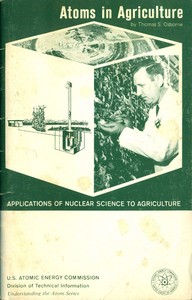
Atoms in Agriculture: Applications of Nuclear Science to Agriculture (Revised) — Key Ideas to Explore

(0 User reviews)   19
In Category - Gardening
Osborne, Thomas S. Project Gutenberg 2015 Not confirmed
Radioisotopes in agriculture; Agriculture -- Research Readers of public-domain and historical texts
Project Gutenberg digital edition en

Edition facts

Words 9,829
Reading time 43 min
Text sections 2

The source record for Atoms in Agriculture: Applications of Nuclear Science to Agriculture (Revised) — Key Ideas to Explore measures this digital text at 9,829 words, 43 min estimated reading time, and 2 detected text sections.

The text analysis averages about 18.2 words per sentence, while the detected sections provide another way to judge how the source is divided.

Project Gutenberg metadata also associates the work with “Radioisotopes in agriculture,” connecting these edition facts with the source record’s subject description.

This editorial note examines how Thomas S. Osborne's 1962 booklet uses plain language and a question-and-answer structure to explain radioisotope applications in agriculture, with attention to shifts in pace between technical detail and broader implications.
Share
Editorial Edition Score 4.5/5

Calculated from edition completeness, EPUB availability, text structure and catalogue metadata. Not a user rating.

How this score is calculated
  • Description quality20 pts
  • Title & short description10 pts
  • Source metadata20 pts
  • Text length15 pts
  • Chapters / structure15 pts
  • EPUB file integrity20 pts

Total of 100 points, scaled to a 2.5-5.0 range. Editions with an empty description or a missing EPUB file are not scored.

Edition quality

Read the Text

The Understanding the Atom Series

Nuclear energy is playing a vital role in the life of every man, woman, and child in the United States today. In the years ahead it will affect increasingly all the peoples of the earth. It is essential that all Americans gain an understanding of this vital force if they are to discharge thoughtfully their responsibilities as citizens and if they are to realize fully the myriad benefits that nuclear energy offers them.

The United States Atomic Energy Commission provides this booklet to help you achieve such understanding.

Edward J. Brunenkant, Director Division of Technical Information

UNITED STATES ATOMIC ENERGY COMMISSION

Dr. Glenn T. Seaborg, Chairman James T. Ramey Wilfrid E. Johnson Dr. Theos J. Thompson Dr. Clarence E. Larson

RESEARCH IN THE UNITED STATES 1 HOW ARE RADIOISOTOPES USED IN RESEARCH? 2 They May be Used as “Tracers” 2 How Effective Are Radioactive Tracers? 3 PLANT NUTRITION AND METABOLISM 4 What Happens to Fertilizer in the Soil? 4 Do Plants Absorb Through Roots Only? 4 Where Should Fertilizer be Placed? 5 Do Fertilizers Move Fast in Plants? 5 What Else Do Radioisotopes Tell Us? 5 PLANT DISEASES AND WEEDS 8 How Can We Combat Plant Diseases? 8 Why Do Chemicals Destroy Some Plants? 10 ANIMAL NUTRITION AND METABOLISM 11 How Nutritious Are Various Feedstuffs? 11 Can Lean Meat be Estimated “on the Hoof”? 12 Does Thyroid Affect Milk—Egg Production? 13 More Tracers in Animal Nutrition Research 13 INSECTS 15 Where and How Fast Do Insects Travel? 15 How Far Do Insects Carry Pollen? 15 Are Predators Used to Destroy Insects? 16 Can Tracers Measure Spray Residues? 17 RADIOISOTOPES AS RADIATION SOURCES 17 Can Radiation Produce New Plants? 18 Can Radiation Destroy Germs and Insects? 19 How Does Radiation Affect Farm Animals? 22 What Else Can Radiation Tell Us? 22 CONCLUSION 23 SUGGESTED REFERENCES 24

United States Atomic Energy Commission Division of Technical Information Library of Congress Catalog Card Number: 64-60274 1962; 1963(Rev.)

Thomas S. Osborne is in charge of plant-breeding research being conducted by the University of Tennessee’s Agricultural Research Laboratory for the Atomic Energy Commission. He has been in this work since 1953.

But Dr. Osborne is a teacher at heart. Hence when students wrote inquiring about the effects of radiation on seeds, he took great interest in replying. From these replies grew mimeographed literature suggesting experiments for students; then this and other booklets.

Dr. Osborne received his undergraduate degree from Oklahoma State University and his doctorate from Washington State University.

by Thomas S. Osborne, Associate Professor of Agronomy, University of Tennessee.

_To know what questions to put to Nature—that is 95 per cent of scientific research._ —Whitehead

If man’s existence on the earth is compared to a calendar year, then he began farming in the very early morning of December 30 and began applying systematic knowledge to agriculture at 10:15 p.m. on December 31.

The first traces of man on the earth are dated at about one and three-quarter million years ago. Plant life then was very much like plant life today, but the animal population was quite different. Man became a producer of plants and animals instead of merely a gatherer and hunter about 8000 years ago. He has applied systematic study to cultivated plants and animals for only 300 years.

Research in the United States

Estimates of crop losses in the United States each year are approximately $5 billion to weeds, $4 billion to insects, and $3 billion to diseases. This total loss of $12 billion a year is about $22,500 a minute.

In an effort to reduce these losses and to raise the standard of living, agricultural research has become more specialized and more complex. Over the years it has gradually changed from trial-and-error attempts to increase production to the actual study of basic questions. To study such intricate systems as the leaf of a plant or the liver of an animal, agricultural science has had to draw from every other science. The use of radioactive tracers and radiations in research looks especially promising to agriculture.

In fact, agriculture has already begun to benefit from the applications of such research. Radioactive techniques have been used to study soils, plants, microbes, insects, farm animals, and new ways to use and preserve foodstuffs. Radioactive atoms are not used directly by farmers but are used in research directed by the U. S. Department of Agriculture and Atomic Energy Commission, by the agricultural experiment stations of the various states, and by numerous public and private research institutions. From such research come improved materials and methods which are used on the farm.

In more highly developed countries agricultural research has brought a shift of emphasis from production to utilization. In the United States today, each farmer produces enough food for himself and 25 other people. Moreover, for every person who works on a farm, there are two or three other people who sell him goods and services or process and distribute the things he produces.

In agriculture, as in all areas of research, the number of questions to be asked of Nature seems infinite. Future generations seeking to answer these questions will probably rely more on techniques using radioactive isotopes than on any other methods known today.

How Are Radioisotopes Used in Research?

They May Be Used as “Tracers”

Man’s attempts to describe the universe consist of finding answers to the questions he puts to Nature:

How deep is a well? Toss in a rock. Where is the cat? Hang a bell on him. How far does a wild duck fly? Put a marker on his leg. Where are the fireflies? Just watch at dusk. Is our satellite still up? Listen for the radio signal.

Other questions arise in agricultural research:

How fast do roots grow? How deep? How soon does water get to them after a rain? When does a mouthful of hay reach a cow’s stomach? How long until nutrients get into her blood? Her milk? How far will pine pollen travel on the wind? How deep does an earthworm burrow?

To answer these questions, scientists need some kind of miniature genie, one who will shout at the proper moment, “I’m here!” When the root has reached the fertilizer or the water has reached the root; when the hay becomes transmuted to milk, or the earthworm arrives at a particular spot—then this invisible little servant who has made the trip could announce, “I’m here!”

Such a helpful genie exists as the radioactive atom: he is invisibly small, obedient, transportable, digestible, immune to fire, flood, or famine, able to travel under his invisible cloak to the secret hiding places of Nature’s creatures and announce to waiting Geiger tubes, “I’m here!”

The physically unstable radioactive atom behaves chemically exactly like its stable counterpart until the instant it emits its radiation and becomes stable. For example, radioactive phosphorus behaves, biologically and chemically, like stable phosphorus until it emits a beta particle and becomes stable sulfur. If the beta particle enters a gas-filled Geiger tube, it produces a tiny burst of electrical energy which is registered by the counter.

Like fireflies which reveal themselves at dusk by flashes of light, radioisotopes announce their numbers and locations to sensitive Geiger tubes by flashes of invisible “light.”

How Effective Are Radioactive Tracers?

One way to see how valuable radioactive tracers are is to compare them to standard chemical techniques. A sensitive chemical test can perceive molecules as dilute as 10⁻⁷; that is, it can detect a molecule surrounded by 10 million molecules of another kind. A good radioactive tracer technique, by comparison, can distinguish concentrations of 10⁻¹¹; that is, it can trace one in 100 _billion_.

In other words by the chemical test you could find a person in metropolitan New York with a secret tattoo on the roof of his mouth. By the tracer method you could find this same person anywhere in the world, even if the world population were multiplied fiftyfold.

In the chemical test you could distinguish the equivalent of one kernel of corn in one-tenth of a boxcar load; in the tracer, one kernel in 850 boxcars.

Plant Nutrition and Metabolism

Most studies of plant nutrition and metabolism pertain to the following questions. What do plants need for their best growth? How do they take in the materials they need? What things are absorbed by roots and what things by foliage? How does the plant turn water and other simple compounds into carbohydrates and proteins?

Specific problems that atomic energy has helped to solve are listed.

What Happens to Fertilizer in the Soil?

Early research indicated that only 10 to 12 per cent of phosphorus fertilizers was taken up by plants in the first year; the rest was “locked into” the soil or washed away. With radioactive phosphorus-32 scientists found that as much as 50 to 70 per cent of the phosphorus in a plant came from the fertilizer during the first two or three weeks of growth.

Do Plants Absorb Through Roots Only?

Fertilizer applied to soil is largely wasted because it is either bound by soil particles or is washed out of the root zone. If chemical elements could go directly into leaves and bypass the wastefulness of soils, a tremendous saving would result.

Botanists have learned in recent years that the foliage of plants can take in some nutrients much as roots can. With tracers they discovered that many nutrients are readily taken up by foliage, including bark of dormant trees, even at temperatures below freezing. As shown by isotopic tracers, elements such as phosphorus, nitrogen, and potassium move both up and down from the point of application at rates similar to those following root absorption. Urea (a nitrogen compound) is now used as a nutrient foliar spray for many fruit and vegetable crops in this country.

Where Should Fertilizer Be Placed?

Even before the use of tracers, agronomists realized the inefficiency of spreading fertilizer uniformly over a seed-bed. They know the fertilizer should be placed somewhere near the seed, but where? Above? Below? Beside? Below and beside? How far away? They had conducted some research, but the methods were slow and tedious.

Using tracers, the researchers confirmed earlier findings that roots within two or three days reached fertilizer placed less than two inches directly below seeds, but the roots tended to congregate there. When the fertilizer was two inches below and two inches to the side, roots reached it within a week and a better root system developed. With three inches between seeds and fertilizer, the desired seedling “boost” was delayed three or four weeks. (See Fig. 1.)

Do Fertilizers Move Fast in Plants?

The movement of radioactive phosphorus from root to leaf was found to be remarkably fast, sometimes requiring less than twenty minutes. (See Fig. 2.)

What Else Do Radioisotopes Tell Us?

Some plants take in chemicals that the plant probably cannot use: for example, the so-called locoweeds accumulate enormous amounts of selenium. With tracer techniques, we can see that the root uptake process has poor powers of discrimination.

Fig. 1—Soil tests tell _how much_ of each fertilizer element is needed but not where to put it to give seedlings the much-needed “push.” With tracers it is found that:

Fig. 2—Radioactive plant nutrients injected in soil roots

Tracer experiments reveal that roots cannot distinguish potassium (needed in large amounts) from other elements which are chemically similar but quite different in size. Once inside the plant, only potassium can be metabolized and similar but heavier elements (rubidium, cesium) are useless. This is like an absentminded builder who buys brick, boulders, and gravel indiscriminately for his wall and then finds he can use only part of his materials.

The process called photosynthesis whereby green plants use energy from the sun to convert simple compounds from air and soil into complex, energy-rich substances has been termed the most important chemical reaction in the world. It is the basis for man’s entire food supply and, except for nuclear energy, all significant fuel as well. Tracer techniques have multiplied the research efforts on photosynthesis tremendously.

When only chemical tests were available, food manufacturing in green leaves had to progress for hours before scientists could measure the products. But with tracers and other new techniques they have narrowed the experimental time to minutes and finally to seconds. Today they know that a green leaf has formed sugars more complex than fructose, “fruit sugar,” after exposure to light for only _one second_!

When the incredible complexities of photosynthesis are finally unraveled, radioactive tracers, especially radioactive carbon-14, will have provided the significant clues.

Plant Diseases and Weeds

How Can We Combat Plant Diseases?

At one time to stop epidemic spread of plant diseases was virtually impossible; farmers had to abandon fields and crops. Such catastrophes caused by microbes have changed the course of history. For example, the Irish famines of the 1840’s resulted from the potato blight and caused mass emigrations from Ireland.

In this country today plant diseases result in losses estimated at $3 billion a year. So far, the most economical means of reducing the ravages of plant diseases has been to breed resistant plant varieties. Although such a variety may cost $100,000 to develop, its cost is usually repaid within a year or two.

But the victory is only temporary. Although plants are bred to resist the pathogen (fungus) of the moment, Nature is constantly changing the microbial population by mutation and hybridization. Within a few years virulent strains of fungi which can attack the “resistant” variety increase to such an extent that the new variety must be replaced.

For crops that provide high per-acre income such as some vegetables and vine and tree fruits, chemical control of fungous diseases is economically possible; in fact, it is a real necessity. But such treatment is too costly for most field crops, unless some cheap seed treatment or fertilizer additive can be found.

A general breakthrough in control of plant diseases is yet to come. Because of thousands of pathogenic species, with hundreds of strains, it does not seem possible that the following questions could be answered about each one. What is the life cycle of the microbe? What conditions of temperature and humidity encourage it to spread? What plant species does it attack? How does it enter? What chemical changes within the cells of the plant determine whether they resist or succumb to the invader? How long can germs remain potent? How far can they travel by wind or water? What combination of resistant varieties, cultural methods, and chemical treatment will control the disease?

With tracers it is possible for the first time to measure chemical uptake in single spores and to follow chemicals through the plant. Perhaps the most enlightening information from such studies is that some fungicides are 10,000 times less effective per unit of “body weight” than are other chemicals used to destroy weeds and insects. Obviously the breakthrough in chemical control of plant diseases is yet to come.

Why Do Chemicals Destroy Some Plants?

Weeds cost this country an estimated $5 billion annually, which is more than the loss to either plant diseases or insects. Selective chemical weed killers such as “2, 4-D” have become so widely used that more than $135 million worth was sold in the United States in 1959. In proper concentration these compounds will destroy many unwanted plants without harming lawn grasses or crop plants.

As in many other instances, beneficial use of the chemicals has far outreached an understanding of how they work. The still scanty knowledge of the process has come almost entirely from tracer studies.

All plants readily absorb selective weed killers (“herbicides”), which are not destroyed within the plants. Resistant plants show no effect of the chemicals, but sensitive plants suffer damage in actively growing roots and shoots. Sugar formation during photosynthesis is disrupted in these plants, and phosphorus movement is retarded. In order to predict what new classes of chemicals might be of value as herbicides, we must await the results of research using radioactive tracers.

Animal Nutrition and Metabolism

How Nutritious Are Various Feedstuffs?

An endless phase of animal nutrition research deals with efficiency of rations, that is, the pounds gained by the animal per pound of feed consumed. The standard form of such research is to feed groups of animals on different rations for several weeks or months and determine average change in weight per pound of feed used.

In recent years scientists have used chemical tests to compare the amount of calcium in the diet against the amount excreted. The apparent digestibility of such minerals has thus been computed for different rations. Yet one important source of error in these chemical tests plagued researchers.

There is a “turnover” in nutrients fed to animals; elements in feed are absorbed into the animal’s body, retained for a time, and later excreted. For example, a cow actually loses more calcium (through milk and excreta) during the first six months of milk production than her normal ration contains. As long as the amount of recycling was unknown, scientists could not tell, for instance, how much calcium in alfalfa hay could be digested by simply measuring incoming and outgoing calcium.

Formerly scientists could study the problem only by withholding all calcium from the diet. Under this unnatural condition all outgoing calcium came from the animal’s body.

With radioactive calcium in a steer’s diet (or injected into the blood), scientists can quickly tell how much of the excreted calcium comes from the animal’s blood and organs under normal conditions. In a typical instance a ration thought to have 24 per cent digestible calcium, chemically determined, was found to have 38 per cent by the tracer technique.

The tracer method shows that milk contains phosphorus, only 20 per cent of which may come from the feed and 80 per cent from the cow’s bones. With eggs, about 65 per cent of the phosphorus is provided by feed and 35 per cent by the hen. Radioactive tracers permit measurement of such “biological pathways,” as the biochemist calls them.

Can Lean Meat be Estimated “on the Hoof”?

The proof of the ration, one might say, is in the cutting. That is, the worth of a particular feed was formerly unknown until the carcass had been cut and priced.

Because of the time and expense, researchers in the past have merely tested groups of animals on a ration for a few weeks and then estimated the total gain by weighing and measuring. The main drawback to such a method is that it measures total growth only. In meat animals, knowing total growth is less important than knowing how much gain is in the more valuable lean meat, how much is in fat, and how much merely water. Techniques based on atomic energy have provided a new approach without adding radioactive contamination to the animal.

Of the “background radiation” that has existed since the earth was formed, part comes from cosmic rays (from outer space) and part from radioactive materials in the earth itself. One of these naturally radioactive isotopes is radioactive potassium, which is present to a small but significant extent in food, in human bodies, and in construction materials.

While some chemicals such as carbon, hydrogen, and oxygen go into almost every kind of substance in living things, potassium plays a special role in animals: it lodges almost exclusively, not in bone or fat or water, but in lean meat.

Biological and medical researchers are now cooperating to build “whole-body” radiation counters. A human being or an animal is actually enclosed by these huge devices, some of which are so sensitive they measure nearly every ray that emerges from the body. These counters will help answer many questions, but here only their use to measure radiopotassium in meat animals is explained. The animal is fed a test ration containing no added radioactivity. At intervals of a week or more, the animal is weighed and is also tested for natural radioactivity. Weighing tells total gain, while radiopotassium counting shows how much gain is in the desired lean meat. This method is remarkably simple, and since no radioactivity is added to its diet, the animal can still be marketed.

Does Thyroid Affect Milk—Egg Production?

Recognition of the significance of the thyroid gland in animals, the association of iodine with the thyroid, and the availability of an excellent radioisotope of iodine have resulted in increased study of this important gland. Chemical tests had hinted at a link between the thyroid gland and the production of milk and eggs. Using radioactive iodine, scientists learned that thyroid activity increases with the onset of milk and egg formation. In hot weather, when yield of milk and eggs decreases, activity of the thyroid gland diminishes.

It may be that a dairy breeder can soon select calves for potential milk production because of thyroid activity as measured by radioactive iodine. At present he must let the animals grow and produce milk for several years before he chooses those to use in herd improvement. (See Fig. 4.)

More Tracers in Animal Nutrition Research

Thomas S. Osborne’s Atoms in Agriculture opens with a striking metaphor: radioactive atoms are compared to fireflies, their flashes of light becoming a steady glow when compressed. This image sets the tone for a booklet that consistently translates nuclear science into accessible terms. Published by the U.S. Atomic Energy Commission as part of the Understanding the Atom series, the work is structured around practical questions—such as “How Effective Are Radioactive Tracers?” and “Can Radiation Produce New Plants?”—that guide the reader through research methods and findings. The author, a plant breeder and teacher, writes with a clear pedagogical aim, often anticipating the reader’s curiosity or skepticism.

From Fireflies to Fertilizer: The Tracer Metaphor

The booklet’s opening analogy—radioactive atoms as fireflies in a jar—is not merely decorative. It establishes a conceptual bridge between a familiar phenomenon and an invisible process. Osborne returns to this idea of “tracers” throughout, emphasizing how minute quantities of radioactive isotopes can be detected as they move through soil, plants, or animals. The language is deliberately concrete: tracers are “tagged” atoms that “report” their location. This personification makes the science feel active and investigative. The pace here is steady, with each paragraph building on the last, but the author occasionally inserts a rhetorical question to maintain engagement, such as “What Else Do Radioisotopes Tell Us?” These questions act as signposts, breaking the flow into digestible segments.

The Lottery of Mutation: Shifts in Tone and Tempo

When discussing radiation-induced mutations, Osborne’s voice shifts noticeably. He acknowledges public fascination with “creating new plant varieties” but immediately tempers it with caution: “the claims of over-enthusiastic gardeners and seed dealers are doubted.” The prose becomes more measured, listing fourteen crop varieties developed through radiation, each with place and date, in a dry, factual cadence. Then comes a sudden acceleration: “In most cases hundreds of thousands of plants were examined before the desirable ones were found.” The contrast between the hopeful promise and the laborious reality is sharp. Osborne also introduces an “ingenious reverse twist”—irradiating fungi to anticipate new diseases—which injects a note of cleverness. This section demonstrates how the author modulates pace to manage reader expectations, moving from wonder to realism to strategic insight.

Questions as Structure: The Pedagogical Rhythm

The booklet’s table of contents is a series of questions: “Do Plants Absorb Through Roots Only?” “How Far Do Insects Travel?” This interrogative structure dictates the rhythm of the text. Each section begins with a question, then provides evidence in a straightforward, declarative style. The answers are rarely simple; Osborne often qualifies them with phrases like “clear proof exists” or “it seems likely that.” This creates a pattern of tension and resolution. The pace is brisk when introducing a question, slows for explanation, and then picks up again with a new query. Notably, the author avoids jargon without oversimplifying. For instance, he explains that “high-energy radiations can cause sudden hereditary changes” but notes that “most of these changes are undesirable.” The result is a narrative that feels both authoritative and conversational, suitable for a general audience curious about atomic science’s practical benefits.

Readers approaching Atoms in Agriculture should note that it is a product of its time—a Cold War-era educational booklet promoting nuclear technology. Osborne’s tone is optimistic but measured, and his use of questions as organizing devices makes the text easy to navigate. Pay attention to how he balances technical detail with broader implications, and how the pace shifts between the wonder of discovery and the grind of research. This is not a comprehensive textbook but a concise introduction, best read as a snapshot of mid-century scientific outreach.

That rainy afternoon, Osborne’s pamphlet made radioactivity feel less like a threat and more like a quiet tool for nurturing soil. I lingered on his patient explanations, then wandered to a shelf and pulled down The Percheron horse — Reading Companion. It struck me how both books trusted the land’s slow rhythms, trusting patience over spectacle.

There are no reviews for this eBook.

0
0 out of 5 (0 User reviews )

Add a Review

Your Rating *
There are no comments for this eBook.

Reader reflection

How will you remember this book?

Save your reaction, strongest insight, and memorable passage.

Your progress 0 / 10
1

Have you finished this book?

2

Did this book hold your interest?

3

Would you recommend this book to another reader?

4

How much effort did this book require?

Related eBooks