About 48 minutes
Making a garden of perennials — Key Ideas to Explore
Gardening
11,037 recorded words. 10 minutes difference from this book's estimate.
View Gutenberg source #24671
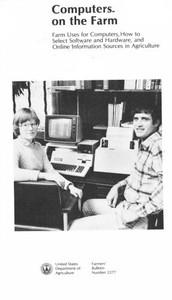
The source record for Computers on the Farm Farm Uses for Computers, How to Select Software and Hardware, and Online Information Sources in Agriculture — Text and Context measures this digital text at 13,243 words, 58 min estimated reading time, and 2 detected text sections.
The text analysis averages about 18.9 words per sentence, while the detected sections provide another way to judge how the source is divided.
Project Gutenberg metadata also associates the work with “Microcomputers,” connecting these edition facts with the source record’s subject description.
Explore this collection
These alternatives are selected using recorded categories and estimated reading time.
About 48 minutes
Gardening
11,037 recorded words. 10 minutes difference from this book's estimate.
View Gutenberg source #24671About 70 minutes
Gardening
15,955 recorded words. 12 minutes difference from this book's estimate.
View Gutenberg source #28730About 70 minutes
Gardening
16,047 recorded words. 12 minutes difference from this book's estimate.
View Gutenberg source #70741Search stored excerpts and compare books → Choose by your preferences →
Choices use stored catalog measurements. Estimates vary with reading speed. A shared category is a catalog label, not a claim that two books have the same argument or literary quality.
Search reads excerpt text stored with this catalog and links to its associated Gutenberg record. The connection is stored in the site database; this tool does not recheck that every excerpt is word-for-word identical to that external record. Excerpt search does not cover every chapter and does not verify historical publication dates.
Catalog snapshot checked: 2026-09-25. Coverage: 91 public books, 91 available source excerpts.
Read the complete public-domain text at its original source.
Read on Project GutenbergThe bulletin opens by framing the computer as a practical farm tool, not a novelty. Its first question—"How can a computer help you operate your farm better?"—sets a utilitarian tone that persists throughout. The author, Deborah Takiff Smith, addresses the farmer directly, using second-person "you" to create a sense of personal consultation. The language is plain and instructional, avoiding technical jargon until the glossary. The bulletin’s structure mirrors a decision-making process: it first lists potential uses, then guides readers through software and hardware selection, and finally catalogs online information services. This logical flow suggests the author assumed readers had little prior computer experience but were motivated by concrete farm problems.
The bulletin opens with a list of practical applications that reveal the author’s understanding of farm operations. It mentions determining "the most economical feed ration for dairy cows," scheduling irrigation, and keeping "livestock breeding and production records." These are not generic office tasks; they are specific to agricultural cycles and decision-making. The author also includes tax records and cash-flow tracking, acknowledging that farm finances are intertwined with household and business accounting. The list is ordered by apparent frequency of use, with recordkeeping first. Notably, the bulletin does not claim computers will revolutionize farming; instead, it presents them as tools for existing tasks. The phrase "get quick access to records" emphasizes efficiency over transformation. This section establishes that the author’s primary audience is the working farmer, not a tech enthusiast.
The bulletin includes two detailed checklists: one for evaluating software and one for hardware. Each checklist is a series of questions, such as "Is the software easy to use?" and "Does the hardware have enough memory?" The author avoids recommending specific brands, instead teaching a method of evaluation. The software checklist emphasizes compatibility and support: "Can you get help if you have problems?" The hardware checklist asks about expandability and service. These lists reflect the author’s awareness that farmers might be wary of rapid technological change. By providing criteria rather than answers, the bulletin empowers the reader to make informed choices. The checklists also serve as a subtle argument: buying a computer is a deliberate investment, not a fad. The author’s tone is neutral but insistent on due diligence, a stance that aligns with the USDA’s role as an objective advisor.
A substantial portion of the bulletin catalogs online information sources, many of which are now obscure. The author lists services like CompuServe, Chase Econometrics, and the Computerized Management Network (CMN). Each entry includes an address and a description of the data offered. For example, CMN is described as "designed to be used by people who have no special training with computers." The author highlights USDA sources such as the Statistical Reporting Service and the Economic Research Service. The inclusion of addresses suggests that farmers would contact these services by mail or phone. The bulletin treats online access as a novel but practical resource, not a futuristic dream. The language is factual and administrative, listing what each service provides without hype. This section reveals the early infrastructure of agricultural informatics, where government, university, and private systems coexisted.
The bulletin ends with a glossary of computer terms, defined in plain language. Terms like "hardware," "software," and "online" are explained without condescension. The glossary is not merely a reference; it is a pedagogical tool. By placing it at the end, the author allows readers to consult it as needed without interrupting the main text. The definitions are short and functional: "Hardware—the physical equipment itself." This simplicity reflects the author’s assumption that the reader is intelligent but not technically trained. The glossary also serves as a subtle reassurance: the jargon of computing can be learned. The bulletin’s overall structure—from uses to selection to sources to definitions—creates a complete learning arc. The author’s voice remains consistent: patient, precise, and focused on the farmer’s practical needs.
This bulletin is best read as a historical artifact of agricultural extension in the mid-1980s. Its value lies not in technical accuracy—many services and systems are obsolete—but in its depiction of how computers were introduced to a skeptical, task-oriented audience. The author’s choices in diction, structure, and content reveal a deliberate effort to demystify technology without overselling it. Readers interested in the rhetoric of technology adoption or the history of farm computing will find this a rich primary source.
That old 1984 bulletin makes me think of orderly lists and careful planning, a farmer’s ledger for the future. Reading it now, I find myself nostalgic for that particular faith in neat solutions. It reminds me, oddly, of a gentler promise found in Hardy Perennials and Old Fashioned Flowers Describing the Most Desirable Plants, for Borders, Rockeries, and Shrubberies. — Themes and Context, where things simply persist and return, year after year, without much fuss.
Save your reaction, strongest insight, and memorable passage.