A-B-C of Gardening — Reading Notes
Edition facts
This digital edition of A-B-C of Gardening — Reading Notes is described by source-level measurements including 25,972 words, 1 hr 53 min estimated reading time, and 3 detected text sections.
The text analysis averages about 22.0 words per sentence, while the detected sections provide another way to judge how the source is divided.
Project Gutenberg metadata also associates the work with “Gardening,” connecting these edition facts with the source record’s subject description.
Calculated from edition completeness, EPUB availability, text structure and catalogue metadata. Not a user rating.
How this score is calculated
- Description quality20 pts
- Title & short description10 pts
- Source metadata20 pts
- Text length15 pts
- Chapters / structure15 pts
- EPUB file integrity20 pts
Total of 100 points, scaled to a 2.5-5.0 range. Editions with an empty description or a missing EPUB file are not scored.
Read the Text
HARPER'S A-B-C SERIES
A-B-C OF HOUSEKEEPING.
By CHRISTINE TERHUNE HERRICK
A-B-C OF ELECTRICITY.
By WILLIAM M. MEADOWCROFT
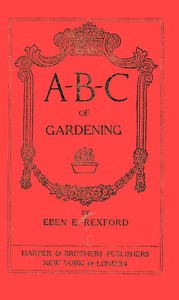
A-B-C OF GARDENING. By EBEN E. REXFORD
A-B-C OF MANNERS. By ANNE SEYMOUR
HARPER & BROTHERS, NEW YORK
HARPER & BROTHERS PUBLISHERS NEW YORK & LONDON
COPYRIGHT, 1915, BY HARPER & BROTHERS
PRINTED IN THE UNITED STATES OF AMERICA PUBLISHED MARCH, 1915
I. MAKING THE GARDEN 1
VI. SPRING WORK IN THE GARDEN 21
VII. MIDSUMMER IN THE GARDEN 26
VIII. WINDOW-BOXES 30
IX. THE USE OF GROWING PLANTS FOR TABLE DECORATION 33
X. DECORATIVE PLANTS 39
XII. GETTING READY FOR WINTER 48
XIII. BULBS FOR WINTER FLOWERING 54
XIV. THE WINTER WINDOW-GARDEN 61
XV. THE INSECT ENEMIES OF PLANTS 67
XVI. GARDENING FOR CHILDREN 72
XVII. HOME AND GARDEN CONVENIENCES 75
XVIII. GARDEN DON'TS 81
XIX. A CHAPTER OF HELPFUL HINTS 99
The first thing to do in making a garden is to spade up the soil to the depth of a foot.
The second thing to do is to work this spaded-up soil over and over until it is thoroughly pulverized.
The third thing to do is to add to it whatever fertilizer you decide on using. This may be old, well-rotted manure from the cow-yard, if you can get it, for it is the ideal fertilizer for nearly all kinds of plants. But if you live in city or village the probabilities are that you will be obliged to make use of a substitute. Bone meal--the finely ground article--is about as good as anything I know of for amateur use. The amount to use will depend on the condition of the soil to which you apply it. If of simply ordinary richness, I would advise a teacupful of the meal to a yard square of ground. If the soil happens to be poor, a large quantity should be used. It is not possible to say just how much or how little, because no two soils are exactly alike. One can decide about this when he sees the effect of what has been used on the plants whose cultivation he has undertaken. I speak of using it by measure rather than by weight because the gardener will find it easier to use a cup than a set of scales.
When the soil has been thoroughly pulverized and the fertilizer has been well worked into it you are ready for sowing seed--that is, if the weather conditions are favorable. It is always advisable to wait until all danger from frost is over and the ground is warm enough to facilitate prompt germination. At the North the seed of our hardier plants can safely be put into the ground about the middle of May, but the tenderer kinds can well afford to wait until the first of June.
In sowing seed don't follow the old way of making a furrow an inch deep in the soil, by drawing the hoe-handle along it, and then covering the seed deeply. Fine seed often fail to germinate when given this treatment. Simply scatter the seed _on the surface_, and then sift a little fine soil over it, or press the ground down firmly with a smooth board, thus imbedding the seed in the ground to a depth that is sufficient to insure enough moisture to facilitate the process of germination.
Large seed, like that of the sweet-pea, nasturtium, mirabilis, and morning-glory can be covered with half an inch of soil.
Weeding should begin as soon as you can tell the weeds and the flowering plants apart. It is absolutely necessary to keep the beds clean if you would have good flowers. Allow weeds to remain, and in an incredibly short time they will get such a start of the other plants in the bed that these will have received a check from which it will take them a long time to recover, when given an opportunity to do so by the removal of the enemy. There can be no compromise between weeds and flowering plants. One must give way to the other, and weeds will have it all their own way if given the ghost of a chance.
Every gardener should be the owner of a wheelbarrow, a hoe, a spade, an iron rake, a watering-pot, and a weeding-hook. The last, which will cost ten or fifteen cents, will enable you to destroy as many weeds in half an hour as you could pull in half a day by hand, and it will leave the soil in as light and porous a condition as would result from going over it with rake or hoe.
Most home-makers labor under the impression that it would be useless for them to undertake the making of a lawn, thinking it requires the knowledge and experience of the professional gardener to make such an undertaking successful. This is where they make a mistake. Anybody can make a lawn that will afford a great deal of pleasure if he sets about it, provided he is willing to do some hard work.
The first thing to do is to make the surface of the ground level. This can be done by the use of spade and hoe. Take off the tops of the hillocks, if there happens to be any, and fill the hollows with the soil thus obtained.
When you have a fairly even surface, go over it with an iron-toothed rake and make it fine and mellow. It is very important that all stones and rubbish of every kind should be removed if you want a good sward.
After reducing the soil to the necessary degree of fineness, add whatever fertilizer to it you propose to make use of, and then go over the ground again with the rake and work this fertilizer in thoroughly. It is necessary to have it evenly distributed. If it is not, there will be patches where the grass will be thick and luxuriant, and others where it will be scanty and poor. Such a result should be guarded against by working the fertilizer into the soil so evenly that no part of it will be without its proper share.
Then you are ready for sowing the seed.
The seed to sow is the very best kind in the market. This will cost you a little more than the inferior kind that is offered each season, but it is worth a good deal more, and it is what you must have if you would make your lawn a thing of beauty. Procure it from some reliable dealer who makes a specialty of "lawn-grass mixtures."
If you tell the dealer the size of your lawn and ask how much seed you will need, he will give you what he considers a fair estimate. I would advise you to double the amount, for this reason: a thickly seeded lawn will have the appearance, by the middle of the first season, of a lawn a year or two old. And because of the thickness of the grass it will be better able to stand the effect of drought and heat. You will find that the extra money invested in seed was a wise investment, and you will never have cause to regret making it.
Sowing seems, to the amateur gardener, a matter of so little importance that it requires no special attention. All there is to do is to scatter the seed over the ground. But nine out of ten amateurs who do the work with this idea in mind will speedily discover their mistake. When the grass comes up thickly here and there, with vacant places between, they will come to the conclusion that sowing grass seed evenly isn't the easiest thing in the world, for the seed is so light that the slightest puff of air will blow it away, and some will settle where you want it to, and some will lodge where other seed has already lodged, and the result will be very unsatisfactory. In order to prevent such a condition of things as far as possible, I would advise sowing from north to south, and then from east to west. Do this on a still, damp day, if possible, and hold your hand close to the ground as you scatter the seed. Don't attempt to broadcast it, as you may have seen some gardener do, but be content to scatter it over a small portion of soil each time you sow a handful of it. By doing this you will prevent most of it from being blown away.
The owner of a small lot is often puzzled to know what to do with it. Of course there must be flowers, but where shall they be put? As a general thing, they are set out here and there, indiscriminately, and the result of such haphazard planting is far from pleasing. There ought always to be at least a suggestion of system in all garden arrangements. To scatter shrubs all over the lawn breaks up the sense of breadth and dignity which should characterize it, however small it may be. This being the case, the best place for shrubs and perennials is at the sides of the lot, leaving the rear for the vegetable garden.
A border extending along the sides of the lot will serve as a frame for the home picture, and will be found the most satisfactory arrangement possible for small places. It ought to be at least four feet wide--six or eight will be found much better if ground can be spared for it--and a pleasing effect can be secured by letting it increase in width as it approaches the rear of the lot. It will be far more attractive if its inner edge curves a little here and there than if it is confined to straight lines.
I would advise a "mixed border." By that is meant one in which shrubs and perennials are grown together and where annuals and spring-flowering bulbs can be used effectively to "fill in."
The soil for such a border must be made and kept quite rich, for almost always we put so many plants into it that great demands are made upon the nutriment contained in it, and in order to have fine plants they must get all the food they can make good use of. You can't grow plants to perfection unless you feed them well. Every season--preferably in spring--manure should be applied liberally.
In setting out shrubs one should take a look ahead and endeavor to see, with the mind's eye, what they will be likely to be when fully developed. If this is not done we are pretty sure to plant them so close that by and by we have a thicket of them, in which none of them can properly display their charms.
Between the shrubs plant perennials and such summer-flowering plants as dahlias and gladioli.
Plant the taller perennials at the rear, and those of medium height in the center, of the row, with low-growing kinds in front. By doing this we secure a sort of banklike effect which will be very pleasing. In order to plant intelligently, study the catalogues of the florists, for most of them give the height of each plant listed in them.
If I were asked to name the best shrubs for amateur use, I would choose these: spiræa (especially the _Van Houttei_ variety), weigelia deutzia, lilacs in variety, flowering currant, and golden elder--the last a shrub with rich yellow foliage, capable of producing a most delightful effect when planted among richly colored flowering plants like the hollyhock and delphinium. From the perennial list I would select peonies, phlox, delphinium, iris, and hollyhocks.
My selection would include the kinds named above because of their hardiness and ease of culture as well as their beauty. There are many other kinds which richly deserve a place in all gardens that are large enough to allow of free selection, but the owner of the average home lot will be obliged to draw a line somewhere, and he will be safe in confining his choice to the kinds I have mentioned. They are among the very best plants we have in their respective classes.
The owner of a garden that is so small that but few plants can be grown in it naturally desires to confine her selection to such kinds as will be likely to give the greatest amount of bloom and require the least amount of care.
At the head of the list it is quite safe to place the sweet-pea. This old and universal favorite blooms profusely and throughout the entire season if prevented from ripening seed. It is beautiful, wonderfully varied as to coloring, and so fragrant that it is almost a rival of the rose in this respect. It requires a treatment so unlike that of ordinary plants that it is really in a class by itself, if one would secure the best results from it. It likes to get a start early in the season and to have its roots deep in the soil, where they will be cool and moist when the hot, dry, midsummer season comes. To gratify this desire on the part of the plant we sow its seed in trenches four or five inches deep, about the middle of April, at the North, or as soon as the ground is free from frost. These trenches are V-shaped, and can easily be made by drawing the corner of a hoe through the soil. Sow the seed quite thickly, and cover with an inch of soil, trampling it down firmly. When the young plants are about three inches tall draw in about them some of the soil thrown out from the trench, and continue to do this from time to time as the plants reach up, until the trench is full. In this way we succeed in getting the roots of the plant deep enough to prevent them from drying out if the season happens to be one of drought. The best support for the sweet-pea is brush. The next best is woven-wire netting with a large mesh.
Another plant that the amateur gardener cannot afford to overlook is the nasturtium. It is a most profuse and constant bloomer. Its colors run through all shades of yellow, orange, and red. It has a delicious spicy fragrance quite unlike that of any other flower I have any knowledge of. Fine for cutting.
The aster must also be given a place in all gardens, large or small, because of its beauty, its wide range of color, and its ease of culture. There are several quite distinct varieties, all good, but none better than the long-stalked "branching" kind. This is the ideal sort for cutting. Its flowers rival those of the chrysanthemum in general effect and lasting quality.
_Phlox Drummondii_ is an old favorite that holds its own against any of the new-comers. So is the verbena, and the calliopsis, and the good old "bachelor's-button," which you will find masquerading in the florists' catalogues as centaurea. It must not be blamed for this, as it has no reason to be ashamed of its old-fashioned name. The seedsmen alone are responsible for the change in nomenclature.
Other stand-bys among the annuals are poppies, larkspur, petunias, ten-week stock, marigolds, scabiosa, mignonette, eschscholtzia (better known as California poppy).
Of course the list of really desirable kinds could be extended almost indefinitely, but I do not think it advisable to make mention of other kinds here, because it is not the part of wisdom for the amateur gardener to attempt growing "a little of everything." It is better to confine one's attention to a few of the kinds with which success is reasonably sure until experience justifies one in undertaking the culture of those which are not so self-reliant and unexacting as the kinds mentioned.
If any one were to ask me to tell him what vine I considered best adapted to amateur culture _in all respects_, I would decide in favor of the ampelopsis--better known in many localities as Virginia creeper. My decision would be based on the beauty of the vine, its rapid growth, its hardiness, and its ability to furnish its own support on walls of wood, brick, or stone. Its foliage is very pleasing in summer, but it is doubly so in autumn, when its green gives place to a brilliant crimson and a rich maroon. At that season of the year all our flowering vines are eclipsed by its magnificent coloring. It grows well in all kinds of soil--better, of course, in a good one than a poor one--and it will go to the eaves of a three-story house if given an opportunity to do so, and cover every inch of the wall unless special efforts are made to prevent it from doing this. If you do not want your windows hidden under its luxuriance it will be necessary for you to cut away a good many of its branches during the summer.
The Dorothy Perkins rose--one of the rambler class--is a most charming vine when in full bloom, and it has the merit of being quite attractive at other periods, as its foliage is a rich, dark, shining green--something that cannot truthfully be said of some of the other members of this class of roses. It is the only rambler I would advise for use about porches and verandas. It blooms in wonderful profusion. Its flowers are a soft pink, borne in large, loose clusters or sprays. The general habit of the plant is all that could be desired. It is the only member of the rambler class that is really vinelike.
There are two varieties of clematis that I am always glad to speak a good word for. One is the native variety, catalogued as _C. flammula_. This is a very rampant grower, and well adapted for use wherever a dense shade is desired. It blooms in August. Its flowers are white. They are succeeded by seed with a feathery tail which makes the plant look as if covered with gray smoke. This variety is always greatly admired because of this peculiarity. The other variety that I have a special fondness for is _C. paniculata_. This is a late bloomer, being in the prime of its flowering period long after the plants in the garden have completed the work of the season. Its flowers are of the purest white. They are small, individually, but they are borne in such profusion that the upper portion of the vine will be completely covered with them. It will look as if a fall of snow had tried to hide it. I consider this one of our very best flowering vines. Unlike the hybrid members of the clematis family, with their enormous flowers of rich colors and scanty foliage, it is perfectly healthy, and it has ample foliage to make a charming background for its blossoms.
The trumpet honeysuckle is a favorite wherever grown. It is one of our best vines for porch use, as it does not climb to a great height. It bears its scarlet-and-orange flowers throughout the entire season. It is an especial favorite because its foliage is always clean and seldom attacked by insects.
The good old morning-glory is, all things considered, our best annual flowering vine. It grows rapidly, reaching to the windows of the second story by midsummer. It is a free and constant bloomer. It is excelled by no other vine in richness and variety of color--white, pink, purple, blue, violet, and crimson flowers will make a veritable "morning glory" of it. Care should be taken to provide it with stout cord to climb by. A light twine is not strong enough to support the weight of its heavy vines.
Another good flowering vine is the hyacinth bean. Why it should be given this name I do not know, as there is nothing about it suggestive in the remotest degree of the hyacinth. Its flowers are a brilliant scarlet. It seldom grows to a greater height than seven or eight feet, and is therefore well adapted to use about porches where a rampant grower is not wanted.
The wild cucumber, catalogued as echynocystis, is a good vine for covering tall buildings and screens. It will make a growth of twenty-five or thirty feet in a season. Its foliage is pretty, as are its white flowers, which make the vines look as if covered with foam. These give place to prickly fruit, somewhat resembling some varieties of cucumber, hence its popular name.
Rexford opens with a three-step method for making a garden: spading, pulverizing, and fertilizing, using a teacup of bone meal per yard square as a measure. The advice is concrete and avoids abstraction, reflecting a hands-on approach. The book's structure follows the calendar, from spring sowing to winter window-gardening, and includes chapters on vines, bulb-beds, and insect enemies. Rexford's voice is that of an experienced gardener speaking to a novice, often using direct address and simple comparisons, such as likening red spider specks to 'grains of fine Cayenne pepper.'
Soil Work and Fertilizer
Rexford insists on thorough soil preparation: spade to a foot deep, then work the soil 'over and over' until pulverized. He recommends well-rotted cow manure as ideal but offers bone meal as a substitute for city dwellers. The amount is given by teacup per yard square, adjusted by soil condition. He acknowledges that 'no two soils are exactly alike,' leaving room for the gardener's judgment. This emphasis on soil texture and fertility recurs throughout the excerpts, establishing a foundation for plant health.
Seasonal Timing and Sowing
Timing is critical: at the North, hardy seeds go in around mid-May, tender ones wait until June. Rexford warns against deep furrows made with a hoe-handle, which can bury fine seed too deeply. Instead, he advocates scattering seed on the surface. The advice is tied to weather conditions—wait until frost danger is past and the ground is warm for 'prompt germination.' This seasonal awareness structures the book's chapters, from spring work to midsummer care and winter preparation.
Watering and Winter Care
Watering should be governed by the soil's appearance, not a fixed schedule. Dormant plants need little water; actively growing ones need more. Rexford warns against superficial watering that only wets the surface, urging enough to moisten the entire pot. He advises a 'stated time' for watering, letting the soil's dry look dictate the amount. This practical rule extends to winter window-gardens, where dry indoor air and high temperatures favor pests like red spider.
Insect Enemies and Tobacco Baths
Rexford devotes a chapter to insect warfare, focusing on aphis (plant-louse) and red spider. He describes aphis as sucking the plant's 'life-blood' and propagating rapidly. His remedy is nicoticide, a tobacco extract sprayed on plants, which kills on contact. For red spider, he advises inspecting fallen leaves for tiny webs and yellowing leaves for red specks. He recommends preventive tobacco baths, finding it 'easier to keep the enemy away than to rout it.' The tone is pragmatic, with no alarmism.
Rexford's manual is best read as a companion for the growing season, not a one-sitting treatise. The chapters are short and self-contained, allowing the gardener to dip into specific topics like window-boxes or bulb planting as needed. His reliance on observation—watching plants, testing soil, checking for pests—makes the book a practical tool rather than a theoretical guide. Readers will find the most value by applying his methods to their own gardens and adjusting based on local conditions.
There’s a comfort in the old ABC’s insistence on knowing your soil before anything else—it feels like a patient hand on the shoulder. Reading it makes me wonder how many seasons we’ve tried to rush. That slower patience is exactly what lingers in Making a garden of perennials — Key Ideas to Explore, a quiet companion to those same unhurried mornings.
-
Daniel Johnson - 4 weeks ago
{'review_type': 'critical', 'content': "For a modern gardener, 'A B C Of Gardening' falls flat. The book is too basic and lacks in-depth explanations. The advice is often generic and not adaptable to different climates or soil conditions. The lack of up-to-date techniques is a major drawback. I'd suggest more contemporary guides that address today's challenges."} -
Francisco Stuart - 3 weeks ago
{'review_type': 'positive', 'content': "An absolute classic! 'A B C Of Gardening' is the perfect starting point for anyone new to gardening. The author breaks down the fundamentals—soil, planting, watering, and pest control—in an easy-to-understand format. The illustrations are charming and the tips are timeless. I have already recommended it to several friends. A must-have for your gardening bookshelf."} -
Catherine Brown - 2 weeks ago
{'review_type': 'neutral', 'content': "As a beginner, I found 'A B C Of Gardening' helpful, especially the sections on soil preparation. The writing is clear, and the layout is logical. However, I did wish for more advanced information, and some of the advice feels a bit dated. Still, it's a solid primer that will get you started on the right foot."}
How will you remember this book?
Save your reaction, strongest insight, and memorable passage.

Matthew Gonzalez
3 weeks ago