1

The agricultural and forest products of British West Africa — Context and Discussion
(9 User reviews)
1246
Project Gutenberg
2023
Not confirmed
Agriculture -- Africa, West; Forest products -- Africa, West
Readers of public-domain and historical texts
Project Gutenberg digital edition
en
Edition facts
Words
66,581
Reading time
290 min
Text sections
9
Before opening The agricultural and forest products of British West Africa — Context and Discussion, the edition data offers a quick orientation: 66,581 words, 4 hr 50 min estimated reading time, and 9 detected text sections.
The text analysis averages about 23.8 words per sentence, while the detected sections provide another way to judge how the source is divided.
Project Gutenberg metadata also associates the work with “Agriculture -- Africa, West,” connecting these edition facts with the source record’s subject description.
Source:
Project Gutenberg record #70973
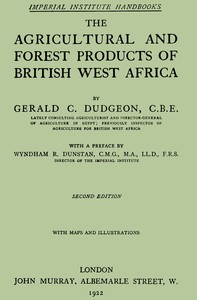
An editorial note on Dudgeon's 1922 handbook, examining its precise observations on West African agriculture, from cotton's post-war promise to the threat of Dutch palm oil rivals, and its quiet attention to trade networks like Haussa kola buyers and Volta salt canoes.
Editorial Edition Score
4.7/5
★★★★★
★★★★★
Calculated from edition completeness, EPUB availability, text structure and catalogue metadata. Not a user rating.
How this score is calculated
- Description quality20 pts
- Title & short description10 pts
- Source metadata20 pts
- Text length15 pts
- Chapters / structure15 pts
- EPUB file integrity20 pts
Total of 100 points, scaled to a 2.5-5.0 range. Editions with an empty description or a missing EPUB file are not scored.
Edition quality
Read the Text
Recent experiments have shown that good results can be obtained with ginger in Sierra Leone if care be taken to deep-hoe the ground and then plant out the selected eyes from clean rhizomes. The custom of attempting to grow a crop in hard laterite gravel without proper cultivation is the chief cause of the malformed and small rhizomes usually obtained in native cultivation. Under improved conditions a crop of five tons per acre of good quality ginger has been procured.
=Export Trade.=—The following amounts of ginger have been shipped during the last decade:
Tons Value Tons Value 1906 579 10,879 1913 2,048 35,468 1907 618 11,578 1914 1,213 15,639 1908 637 11,871 1915 567 8,091 1909 722 14,147 1916 971 25,814 1910 1,093 33,288 1917 1,136 25,863 1911 1,692 44,668 1918 1,576 39,306 1912 2,200 44,864
It is reported that, owing to the decline in price paid for Sierra Leone ginger in 1913, about one-third of the crop was left unharvested, and that the depreciation experienced was due to the competition from other sources of a better marketed product. It would be a pity if the promising opportunity of the country to become established as a large producer of ginger were altogether lost, owing to the want of a little care in cultivation and preparation of the product for the market.
The plant is essentially suited to certain parts of the Colony and Protectorate and is not subject to any serious diseases, the only recorded one being a fungus which attacks the rhizomes and causes yellowing of the leaves. This can be prevented from spreading if the plants be removed and burned as soon as the signs of attack are apparent on them.
=FIBRES.= =Jute Class.=—In the last few years several fibre plants indigenous to the country have been experimented with at the Imperial Institute, in order to ascertain whether any were capable of being exported for use as substitutes for Indian jute.
_Honckenya ficifolia_, known by the Timani name of “Napunti,” a plant which occurs in great profusion in the swamps and low lands, yields a fibre of excellent quality, but owing to the difficulties experienced in the extraction of it, further experiments are necessary to devise a means by which it can be economically prepared. The analyses of the fibre from this plant which have been made at the Imperial Institute (see _Selected Reports from the Imperial Institute_, Part I. [Cd. 4588], Fibres, p. 40) are very satisfactory, and this, combined with the fact that the natural supply of the plant is very large in districts which are quite useless for agricultural purposes, renders it important that the methods of extraction should be more carefully studied.
Among the other fibres of this class which have shown promise, _Hibiscus quinquelobus_, to which the Mendis give the name of “Korwey,” is found in a wild state in variable profusion throughout the country. Unlike the last, which produces erect stems growing close together, this plant has stems of an almost scandent character, growing under the shade of moderately large trees and perforating the upper branches, so that the flowering stems are often seen fifteen feet or more above the ground. Under cultivation the experiments seemed to show that the elongated character of the stems was not maintained, and this defect requires to be remedied if the fibre is to be prepared upon a commercial scale. The extraction is easily done by retting, and experimental shipments to Europe of several tons have shown that the product is quite marketable and is classed with, or a little below, medium jutes (_ibid._ p. 39).
Recently experiments were carried out in the extraction of fibre from _Hibiscus esculentus_, the “okra” of tropical countries. A specimen of the fibre having been examined at the Imperial Institute and favourably reported upon (_ibid._ p. 35), a plantation was made at Kangahun, in order to endeavour to produce a crop, which should have the additional advantage of yielding a marketable supply of the vegetable okra pods before being cut down and made into fibre. In order to do this, the seed was sown at close intervals, thereby introducing a straight growth of stem, and care was exercised not to permit the fruiting to continue long enough for the stems to become coarse. The fibre was extracted in the same manner as that of jute, except that the stems were immersed in a solution of caustic soda before retting to remove the thin outer bark. The marketed fibre from the first of these experiments realised an unsatisfactory price, but it was estimated that the crop of pods yielded £3 per acre.
_Corchorus capsularis_, one of the Indian jutes, was introduced and planted out in 1906, but the existing native methods of cultivation and the absence of manure rendered the conditions so different from those obtained in India, that a successful result was not brought about. Two species of Corchorus are found in the country, and are used only as vegetables.
=Ramie Fibre.=—Plantations of Ramie fibre or China grass were recently made in various parts of the Protectorate, but although the plant grows well during the rainy season, the long period of dry weather is detrimental to it.
=Piassava.=—This fibre is produced from the sheath of the leaf stem of _Raphia vinifera_, the wine palm, and is prepared at several places, especially in the swampy districts near the coast. The method of extraction is merely that of steeping and beating out, and the resulting fibre is, in appearance, somewhat similar to fine whalebone. The largest amount was exported in 1915, when the figure reached 1,283 tons. The price in this year attained £61 per ton. The fibre is chiefly employed for the manufacture of stiff brooms.
=COTTON.=—The native cotton of Sierra Leone showed promise, at one time, of great development, but insurmountable difficulties met the efforts of the British Cotton Growing Association in their attempt to establish cotton growing for export upon a large scale.
The native mode of growing cotton is in combination with a number of other agricultural crops, the seeds of all being mixed before being broadcasted in a field, which has been lightly tilled. Cotton sown in this manner is permitted to yield crops for two seasons, but the second crop is generally much inferior. Owing to this irregular manner of planting, the amount of cotton available for use is small, and is nearly all absorbed for the supply of the native looms; being readily saleable in the weaving districts at about 2_d_. per lb. of seed cotton, or about twice as much as the British Cotton Growing Association were prepared to pay.
The inefficiency of the quality of the local cultivation, and the disinclination on the part of the native to adopt better methods, effectually prevented more cotton being grown, and the British Cotton Growing Association were unable to obtain sufficient material to keep their ginnery employed.
In connection with the cotton ginnery, erected at Moyamba, a large plantation was made; the indigenous as well as many exotic varieties of the plant being put in. The site, however, proved unsuitable, labour was found to be expensive, and the climatic conditions were complained of. In consequence of these adverse conditions, the Association were reluctantly obliged to abandon the work. The export of cotton was never significant and ceased altogether in 1909.
=Indigenous Varieties.=—Three well-marked types of cotton are found throughout the country, and are known by the native (Mendi) names of (1) Kwonde, (2) Fande Wa, (3) Dhoole. The first of these has a white lint and a seed covered with white wool. An examination of this at the Imperial Institute showed that the lint from it was the most valuable of the three; the staple measured about 1″, and was compared with very good quality “Indian Broach.” Two samples, valued in 1907, were priced at 5⅜_d_. and 5¾_d_. respectively, with good Broach at 5⅜_d_., and Middling American at 6·18_d_. The Fande Wa variety has a creamy lint and a green woolly seed. It was said to be of good quality, but the colour was not so good as the last, and the value was consequently lower. Dhoole is rather rarer than the other two, and has a brick-red or brown lint and a bare seed. Khaki or red cottons are not in demand upon an European market, but locally they are somewhat sought after.
=Native Weaving.=—A native cloth woven from the three different varieties of indigenous cottons is frequently seen; the careful arrangement of the naturally coloured yarns yielding a distinct pattern. More often, perhaps, only the first two kinds are used, and the yarn made from them is dyed with the local indigo. In width the native cloths are usually narrow, and the strips are sewn together in order to form gowns, etc. A photograph is given showing a native weaver at work at Pendembu (Fig. 13). In a few localities wider cloths are woven, but of no great length. These are often elaborately designed, and command a high price among the natives, being preferred to imported materials.
=Exotic Cottons.=—“Cambodia” and “Sea Island” have been tried experimentally. The latter, though withstanding the heavy rainfall well, was found to be very susceptible to attacks of the local cotton stainer. There is still no prospect of the revival of cotton exportation.
=RICE.=—Two forms of rice are grown in the Protectorate; one under irrigation or in swampy ground, near rivers, etc., and the other entirely without any conservance of water, depending on the rainfall.
The use of rice is general throughout the country—in fact, it is probably the most important food crop; and although, as mentioned above, there are two forms, divided according to their mode of cultivation, each form contains many varieties distinguished by different native names.
In the Timani country and the vicinity of Port Lokko the finest quality is grown, and the husking of this is said to be a prolonged process of drying, without previously parboiling or soaking. This rice only requires to be thoroughly dried before the husk will separate on pounding.
In the Mendi country, the heads of rice at the harvesting are cut and tied in small bunches to dry in the fields. The grain is then beaten out, and the chaff winnowed on a tray or in a gentle breeze. The next step is to parboil the grain while yet in the husk, during which operation the interior swells up so as to split the husk. The rice is then again thoroughly dried in the sun upon mats, and finally lightly pounded in a wooden mortar in order to separate the loosened husk, which is removed by winnowing. From the time of harvesting until the rice is ready for sale, the work is performed by women.
In spite of the fact that a very large quantity of rice is grown, it frequently happens that in a good season much remains unharvested, owing to the improvidence of the native. The price just after harvesting may fall as low as 1_s_. 6_d_. per bushel, but a few months later it may reach three times that amount. It is customary for the Protectorate native to realise at once upon his crop, without taking the precaution to lay in a store for his future requirements. In consequence of this he is compelled to buy back supplies for his own consumption at a very much enhanced rate. The native at the Coast takes advantage of this improvidence and profits considerably by it; buying up the cheap product at harvesting and realising a handsome profit after a few months.
In quality the local rice is excellent, but in appearance it is somewhat reddish, only a few of the finer qualities being nearly white. The imported rices are usually white, but are said to contain less nutriment than the local kinds.
Rice has always constituted the staple food of the aboriginal tribes of the Protectorate, for which reason its cultivation and the weather conditions necessary for its successful production locally are matters of great importance. No precaution is taken to plant any other crop as a stand-by in the event of an unfavourable rice season. In 1910 a disaster actually occurred, for the rainy season of 1909 set in so early that it prevented many farms being burned in time to sow rice. Most of the local varieties mature their grain from three to five months after sowing, the earlier producing approximately 15, and the later from 30 to 40 bushels, per acre. Owing to the failure of the rice crop in 1910, the commodity should not have been allowed to be exported in that year, but the importance of this was lost sight of in view of the remunerative trade in it which had become established with different coast ports to which it was shipped. In the previous edition of this volume a recommendation was made to foster the export of surplus Sierra Leone rice to the Gold Coast, where it was much appreciated, and doubtless this trade may yet become important when existing restrictions are removed, and if it is found possible to induce a larger number of the population in the Protectorate to engage in pure agriculture, and grow crops in excess of their immediate personal requirements.
The exports for the last nine years were as follows:
Bushels Value £ 1910 35,114 5,925 1911 22,621 4,716 1912 30,715 5,712 1913 21,548 3,991 1914 18,705 4,855 1915 19,600 7,228 1916 3,192 1,364 1917 1,022 697 1918 176 93
In 1915, owing to the falling off of imports, it was found necessary to exercise control over the exports, but in spite of this the amount exported was higher than in the previous year. In 1916 the urgency of the matter became even more pronounced and exports were restricted.
The Agricultural Department conducted several comparative trials with Indian and local varieties of rice. The Indian rices were much smaller in size of grain and were generally not considered so suitable as the local kinds, with respect to which it was found that, with a sufficiency of seed used in sowing and deep cultivation, excellent crops could be secured. The native method of using less than half a bushel of seed to sow an acre is accountable for much of the resultant crop becoming full of weeds. Excellent results were obtained in sowing 1½ to 3 bushels per acre, when the weeds were choked out.
=CAMWOOD.=—This material, from which red dye is got, is obtained from the leguminous tree _Baphia nitida_. The use of it in European countries has somewhat diminished during recent years, owing to the substitution for it of artificial red colouring-matter, but a small quantity is still exported, and is made use of for colouring sausage skins. The amount of camwood exported in 1915 is given as 635 tons, valued at £8,761.
=COPAL.=—The tree identified as _Copaifera Guibourtiana_ is tapped, in the Mendi country especially, for copal. The method in general practice is to cut small square patches of bark from the main trunk and branches in the month of January, and to permit these to exude resin until April, at which time the flow has ceased, and the resin hardened sufficiently to be collected.
The tree has been recorded from a few localities in Sierra Leone, but recently plantations have been made near Moyamba and elsewhere. In the Kwalu district, where clusters of large trees occur, much damage has been done by overtapping, and many dead trees are to be seen.
The value of Sierra Leone copal is high, sometimes attaining over two shillings a pound in the European markets. The quality is, however, somewhat irregular, and the local grading is frequently inefficient. Information as to the quality and value of Sierra Leone copal in comparison with other varieties is given in _Selected Reports from the Imperial Institute_, Part II., Gums and Resins [Cd. 4971], pp. 170-82.
About thirty tons were annually shipped to Europe for making varnish, but owing to the destructive methods of collection, the Government has prohibited trade for five years.
=GROUNDNUTS.=—Practically no trade at present exists in this crop, but efforts are being made to reintroduce the cultivation into Bullom, where at one time a large quantity was grown for export.
The cultivation of groundnuts for local consumption is carried on, but the ridge system of planting, which is in vogue in the Gambia, is not adopted in Sierra Leone, and the groundnut stalks are removed from the ground without the nuts attached to them. The nuts in Sierra Leone are permitted to remain in the ground and depreciate in quality through insufficient drying. The success of groundnut cultivation depends largely upon the plant being grown on a loose bed of friable soil, and, where such conditions exist, the Gambian method should prove satisfactory.
Experiments show that the nuts should be decorticated before sowing. The usual local method of sowing is to scatter the nuts upon the unbroken ground and then cover with loose earth. Some damage is done by rats, bushpig and termites, and in 1914 a fungoid disease (_Cercospora personata_) appeared in Karene. The Agricultural Department has obtained 12 cwts. to the acre in its trials.
The variety of nut grown is apparently identical with that of the Gambia, from which country the seed has probably been obtained in the past.
=COCOA.=—Some years ago cocoa was introduced into the Colony, but, although some of the Colonial planters had received their training in the cocoa estates of Fernando Po and San Thomé, no success attended their efforts in Sierra Leone. The heavy rainfall, combined with the long period of drought peculiar to the country, is detrimental to the industry. More recently experiments have been conducted in the Protectorate, where a lighter rainfall occurs; but here also the conditions are not generally favourable, as the long period of dry weather is not compensated for by humidity in the atmosphere.
=Importance of Correct Climatic Conditions.=—Cocoa plantations, in order to be successful, require atmospheric moisture fairly constantly throughout the year, and will not thrive if exposed to excessive and prolonged drought, or too much rain. Meteorological records taken at Bo, a place not far distant from that where cocoa experiments were made, show that the conditions in respect to distribution of rainfall, humidity and temperature are unfavourable there. Many attempts have been made in other localities, but only in Northern Sherbro has there been any appreciable success. The soil in this locality is deep and is kept in good tilth by the Gallinas. The price obtained locally for their cocoa beans was, in 1913, from 3_d_. to 4_d_. per lb.; in 1914 there was an increase in the number of plants put out, as the price rose in that year to 6_d_. per lb. A sample of native cocoa was submitted to the Imperial Institute for examination and report in 1916, and was found to be incompletely fermented with a rather harsh flavour. The trade valuation, however, was equal to the standard price ruling for Accra beans at the same time (cf. _Bull. Imp. Inst._, 1916, p. 589). Although the outlook for Northern Sherbro is promising, cocoa cannot attain much success in the country generally, on account of unsuitable climatic conditions and general ineptitude of most of the native tribes.
=COFFEE.=—A few years ago coffee was grown in the Colony for export, the indigenous variety, _Coffea stenophylla_ as well as _C. Liberica_ being planted. The former bears a very small berry and yields an excellent, strong-flavoured beverage. The latter is better known and has a large berry. Throughout the hill villages of the Colony a great number of trees are seen, but, owing to a fall in the price of the product, most of the crop remains unpicked, although it should not prove unremunerative even at the present prices to continue the export.
=INDIGO.=—Species of Indigofera and a scandent shrub, _Lonchocarpus cyanescens_, or “Gara” (Mendi), are used for the extraction of the blue dyes commonly employed in the country. The leaves of the latter plant are said to be in such demand that a quantity is annually imported from Southern Nigeria. A description of the method of dyeing with “Gara,” and an explanation of the process, are given in the _Bulletin of the Imperial Institute_, vol. v. (1907), p. 129.
=FRUIT.=—Some parts of the Colony seem favourable for the cultivation of various tropical fruits, such as bananas, oranges, mangoes, and pineapples, and it is possible that the proximity of Sierra Leone to European ports might enable some of these to be grown for export.
=BEESWAX.=—A small amount of beeswax is collected in the Protectorate, and instruction has been given to the natives in some localities with a view to the improvement of the methods employed by them. The Government has arranged for the instruction of some of the local officials while on leave in England in practical bee-keeping.
The bee found in Sierra Leone is identical with the variety of _Apis mellifera_ found throughout West Africa, and is named var. _Adansonii_. It is rather small, but produces an excellent honey, which is much appreciated.
Gerald C. Dudgeon’s handbook, issued under the Imperial Institute series, opens with a preface that frames West African agriculture in the aftermath of the Great War. The tone is cautiously optimistic: cotton cultivation in Nigeria is declared “successful and profitable,” yet the same paragraph warns that Dutch East Indies plantations may soon become “formidable rivals” in palm oil. This tension between imperial development and external competition runs through the work.
Dudgeon, a former Inspector of Agriculture for British West Africa, writes with the authority of someone who has observed fields and forests firsthand. The text is dense with specific yields, prices, and botanical names, but it also pauses to note how Haussa traders carry shea butter to Kumassi, or how guinea-fowls are conveyed as head-loads in open-work baskets. These small details reveal a world where commerce moves by canoe and calabash.
Cotton, War, and the Promise of Improvement
The preface, written by editor Wyndham R. Dunstan, treats the Great War as a catalyst. Dudgeon’s own chapters on cotton trace a deliberate improvement program: in Northern Nigeria, “American Upland” seed was perfected; in the south, an improved native cotton approached “Middling American” grade. The language is that of a colonial agronomist—precise about seed types and commercial grades—but the underlying narrative is one of fragile progress. The war disrupted development, yet it also created demand for margarine and edible oils, boosting palm kernels. Dudgeon does not celebrate; he reports. The future of cotton, he writes, “chiefly depends on effective action being taken on commercial lines.” That conditional phrasing—depends on—hints at the uncertainty beneath the official optimism.
The Shea Butter Trade and the Geography of Exchange
One of the most vivid passages describes shea butter, the “cooking oil of the ultra-forest country.” Dudgeon notes that the prepared butter is carried by Haussa traders who visit Ashanti to buy kola, and that it fetches a high price in Kumassi. He also traces a second route: canoes bring salt from Adda up the Volta to Yeji and Daboya, and shea butter moves back down. The analysis from the Imperial Institute confirms the butter’s quality, but Dudgeon’s real interest is in the movement of goods. He records prices—beeswax at £6 15s. per cwt., guinea-fowls at threepence each—and the means of transport: head-loads, calabashes, canoes. These details build a picture of an economy where value is measured in shillings and carried on foot.
Rubber, Dyes, and the Limits of Observation
Dudgeon’s account of rubber in the Northern Territories is notably cautious. A species of Landolphia was found near the Black Volta, and initially thought to be plentiful, but later reports indicated it “occurs rather rarely.” Another species had been mistaken for it. The passage is a small case study in the difficulty of colonial botany: plants are misidentified, specimens are dwarfed by annual grass fires, and the hoped-for root rubber does not develop. Similarly, when describing indigo preparation, Dudgeon admits the process “has not been carefully observed” and is “probably similar” to methods used elsewhere. These admissions of uncertainty are rare in a handbook that otherwise projects authority, and they give the reader a sense of the gaps in knowledge that the book was meant to fill.
Dudgeon’s handbook is best read not as a definitive survey but as a document of its moment—a colonial inventory that reveals as much about the limits of imperial knowledge as about the products it catalogs. The reader may find the most rewarding passages not in the tables of yields or botanical descriptions, but in the asides: the guinea-fowls carried in baskets, the bees hived in calabashes, the cattle that must be killed before entering the tsetse fly belt. These details resist the book’s official purpose and offer a glimpse of the human and ecological complexity that no handbook can fully contain.
The rain drummed on the tin roof as I traced Dudgeon’s notes on kola canoes, his careful map of old trade routes. That quiet regard for hands-on, practical education lingered. It sent me, almost without thinking, to A decade of negro extension work, 1914-1924 — A Reader’s Guide, pages yellowed in the lamplight, as if one field journal simply murmured to the next.
James Taylor
1 month agoOliver Williams
2 weeks agoJoseph Hall
2 weeks ago-

Charles Mullins - 1 month ago
I found this book to be excessively dry and outdated. Its focus on British colonial-era trade makes it feel like reading a government report from a century ago. The lack of visuals and the dense statistical data make it a challenging read. While it may have historical value, it's not engaging for general readers or even modern agricultural researchers seeking contemporary insights. -
Robin Edwards - 4 weeks ago
An invaluable historical and economic study of West African agriculture. The author provides detailed descriptions of the region's agricultural and forest products, from cacao to timber, and explains their significance in trade. This book is rich with data and contextual knowledge, making it a must-have for historians, economists, and anyone interested in the region's agricultural heritage. An excellent read! -
Michael Hayes - 1 week ago
This book offers a comprehensive look at the agricultural and forest products of British West Africa, with plenty of statistical information and descriptions. However, it's written in an academic style that might be heavy for casual readers, and it's naturally dated. Still, if you're researching the historical trade of the region, it's a valuable source.
Reader reflection
How did this book work for you?
Your answers remain private and are stored only in this browser.
Your progress
0
/
10
2
What was your overall reaction to the book?
3
Would you recommend this book to another reader?
4
Did the language feel accessible?
5
How did the pace of the book feel?
6
Did you gain anything practical from the text?
7
How closely did the book connect with your experience?
8
Could you see yourself revisiting this book?
9
Which lesson or insight stayed with you?
10






Ella Jones
3 weeks ago