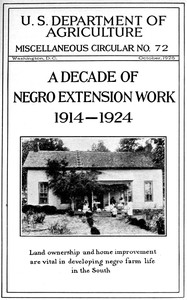
A decade of negro extension work, 1914-1924 — A Reader’s Guide
Edition facts
This digital edition of A decade of negro extension work, 1914-1924 — A Reader’s Guide is described by source-level measurements including 16,047 words, 1 hr 10 min estimated reading time, and 19 detected text sections.
The text analysis averages about 21.4 words per sentence, while the detected sections provide another way to judge how the source is divided.
Project Gutenberg metadata also associates the work with “Agriculture,” connecting these edition facts with the source record’s subject description.
Calculated from edition completeness, EPUB availability, text structure and catalogue metadata. Not a user rating.
How this score is calculated
- Description quality20 pts
- Title & short description10 pts
- Source metadata20 pts
- Text length15 pts
- Chapters / structure15 pts
- EPUB file integrity20 pts
Total of 100 points, scaled to a 2.5-5.0 range. Editions with an empty description or a missing EPUB file are not scored.
Read the Text
f service. In the same connection he expressed in the following excerpt an unusual and unique opinion of the pedagogy of extension work. His experience and his observations constitute a great inspiration for negro extension agents and educators generally.
I have sometimes regarded it as a fortunate circumstance that I never studied pedagogy. If I had done so, every time I attempted to do anything in a new way I should have felt compelled to reckon with all the past, and in my case that would have taken so much time that I should never have got anywhere. As it was, I was perfectly free to go ahead and do whatever seemed necessary at the time, without reference to whether that same thing had ever been done by anyone else at any previous time or not.
General Armstrong, who founded Hampton Institute in Virginia for Negroes and Indians in the reconstruction days immediately following the Civil War, expressed somewhat the same idea when he said:
Many teachers seem to me to have disproportionate ideas of the forces that make up man. * * * There is plenty of study of methods and not enough study of men or of the problems of life.
Negro home demonstration work was also developed through the interest and aid of white agents. White supervisory agents still take sympathetic interest in negro extension activities. In view of the fact that negro women and girls had always done much of the domestic labor in southern homes and because negro schools and colleges had given courses in home economics, home demonstration work for negroes was started in the best possible environment and atmosphere. Many white home demonstration agents and demonstrators took pleasure in giving instruction in gardening, canning, and preserving to negro women and girls whom they knew. But, as the work developed, it soon became apparent that negro women agents could get access to negro homes better than anybody else, so negro home demonstration agents began to be appointed. Annie Peters, of Boley, Okla., was appointed on January 23, 1912, as the first negro home demonstration agent, and Mattie Holmes, of Hampton Institute, Va., on May 24, 1912, as the second. Other appointments followed rapidly.
It has been possible to build up an extension organization in the South for negro people, because of such institutions as Hampton and Tuskegee. In fact, the influence of these two major institutions has affected all the schools and colleges where negro agents have been educated. Many smaller similar institutions have also contributed much to extension work. Table 1 gives the percentage of negro men and women extension agents who were graduated from Tuskegee and Hampton Institutes and from the State agricultural colleges.
TABLE 1.—_Percentage of negro extension agents who are college graduates_
—————————————————————————————————————+——————————————+——————————— Institution | Men | Women —————————————————————————————————————+——————————————+——————————— | _Percentage_ | _Percentage_ Hampton Institute | 7.50 | 5.40 Tuskegee Institute | 10.16 | 5.40 State agricultural college | 9.09 | 2.70 +——————————————+——————————— Graduates of the three combined | 26.75 | 13.50 —————————————————————————————————————+——————————————+———————————
In beginning farm and home demonstration work for negroes in 1906, the cooperation of the General Education Board of New York was most valuable and effective. The board was liberal in its appropriations and generous in the arrangements for the expenditure of them. The money was turned over to the authorities of the United States Department of Agriculture to be used as they thought best in starting and promoting the work. It was because of the demonstrated success of this plan of education that the National, State, and county authorities were more disposed to support it.
When it is realized that various Southern States are gradually increasing the appropriations to the State agricultural colleges, and also that a $9,000,000 endowment fund for Hampton and Tuskegee is being completed, it is possible to look forward to better-trained negro agents. Progress can be faster now because the way is clear. Every Southern State now has a group of efficient negro agents, whose numbers are increasing. (Fig. 3.)
In view of the facts that Booker T. Washington gave the credit for his own success to the influence General Armstrong had over his life and that Tuskegee Institute is an extension and modified enlargement of Hampton Institute, it is well to trace a further development of such teaching and also to get the observation of the recognized leaders. Long before the World War and before the migration of negroes to the North, Booker T. Washington saw the South as the permanent home of his people and he urged them to develop the resources of climate, soil, forests, and folks. He saw conditions clearly and urged his people to train for skill, to practice thrift, and to grow better by doing better. This was the best of preparation for the negro agency force now in the field.
In the first farmers’ conference at Tuskegee in February, 1892, which, by the way, was the forerunner of farm congresses at agricultural colleges for white people in various parts of the country, the following resolution, among other important deliverances, was adopted:
In view of our general condition, we would suggest the following remedies: (1) That as far as possible we aim to raise at home our own meat and bread; (2) that as fast as possible we buy land, even though a very few acres at a time; (3) that a larger number of our young people be taught trades, and that they be urged to prepare themselves to enter as largely as possible all the various vocations of life; (4) that we especially try to broaden the field of labor for our women; (5) that we make every sacrifice and practice every form of economy that we may purchase land and free ourselves from our burdensome habit of living in debt; (6) that we urge our ministers and teachers to give more attention to the material condition and home life of the people; (7) that we urge our people not to depend entirely upon the State to provide schoolhouses and lengthen the time of the schools, but to take hold of the matter themselves where the State leaves off, and by supplementing the public funds from their own pockets and by building schoolhouses, bring about the desired results; (8) that we urge patrons to give earnest attention to the mental and moral fitness of those who teach their schools; (9) that we urge the doing away with all sectarian prejudice in the management of the schools.
It has been extension experience that negroes are especially responsive to the demonstration method, because of their faith, confidence, and optimism. Demonstrations have reached the most ignorant and most needy better than any form of academic instruction, because demonstrators must be doers before they become teachers. The effect and power of a demonstration are measured by the success of the enterprise and the standing and influence of the demonstrator. The demonstration method has proved to be not only the best for the ignorant, but also for the intelligent. Certainly the more intelligent farmers can carry object lessons further than the ignorant ones. Furthermore, it is safe to assume a fair amount of good farm and home development in an intelligent, prosperous community. Perhaps one reason why farmers tire of institutes and lectures is because they feel that they have reached a stage of knowledge where they can do things fairly well and have thus become teachers and leaders themselves. They do not care to accumulate a lot of information upon diverse subjects just for the purpose of acquiring information. They want usable knowledge upon specific things. (Fig. 4.) The negro has made sufficient progress for extension agents to find men, women, boys, and girls in every community who can demonstrate better farming and home making.
The history of extension work for negroes has not been exactly parallel to that of the whites in the Southern States. The white agents started work with men demonstrators, followed in succession by boys, girls, and women. Negro work started with men and women first. The agents tried to meet the most urgent needs of the farms and homes. At the time when the Department of Agriculture and State agricultural colleges first began to appoint negro agents, the club work of white boys and girls had drifted somewhat away from the demonstration feature and was emphasizing the club feature. When the negro agents began later to enroll boys and girls they did so because they felt that these young folks should have an influence in farming and in home making in their communities. It was not so much a matter of teaching and telling as it was of doing and growing. One agent expressed it by saying, “We are emphasizing work rather than clubs.” Of course, in the natural process of evolution, agents came to pay more attention to meetings, organization, recreation, and group activities in general, but the central theme is the demonstration.
Negro club members have manifested a disposition for the boy to do the farming and the girl the home making. That tendency is general in all extension work, of course, but the line of differentiation has not been so clear in adult activities. Because of the limited funds available, few counties have been able to afford both negro men and women agents. Thus it comes about that the men agents do more home work and the women agents more farm work than in counties employing both county agricultural and home demonstration agents. As time goes on and more agents are appointed, this matter will adjust itself.
During the present period of readjustment and reconstruction it is becoming more and more apparent to students of extension work that the greatest ultimate reform will take place where the most successful demonstration of content and size are conducted and where such demonstrations are multiplied in the greatest numbers. Many negro agents seem to have the ability to encourage their demonstrators and magnify the influence of their work. They have caught the philosophy of the founder of demonstration work, Seaman A. Knapp, when he said, “Your value lies not in what you can do but in what you can get other people to do.” Negro agents seem to appreciate the standing in the community of a man or woman who has done better work than anybody else. They enter into the thought and life of the demonstrator who estimated that more than 50 men in his neighborhood had been influenced by his success with 10 acres of cotton along the roadside. They know that the boy who said, “My club acre has been noticed by many people in this section and I am sure it will cause some of my boy friends to join the club next year,” had developed in himself the real spirit of service. They appreciate the feeling of pride and satisfaction that came to the girl club member who raised a dairy calf, built a good house for it, and then saw more than a dozen like it built within a radius of 5 miles of her home. (Fig. 5.) The result has been to make each person carrying on a demonstration feel that he has a responsibility as a leader and teacher in his community.
The culminating evidence of these efforts toward improvement through the object-lesson method is found in the results obtained in home and lawn beautification. Particularly in recent years negro extension agents have brought about marked progress in the renovation, painting, and whitewashing of houses and outbuildings, and in the growing of flowers, grass, and shrubbery in the front yards.
VALUE OF COOPERATIVE ASSOCIATIONS
Negro farmers have manifested considerable interest in cooperative marketing. They belong to cotton, tobacco, peanut, potato, and similar associations. They usually follow carefully instructions in grading and standardization. They appreciate the opportunity of purchasing fertilizers and other supplies through the farm bureau and other organizations engaged in such enterprises. In some counties where associations have given special attention to marketing carloads of hogs, chickens, potatoes, pecans, and other products produced in surplus quantities, the negroes do their share. It has come about that most marketing plans which have been developed include negroes in their operations better than any other form of productive and educational enterprise. In cooperative-marketing associations the commodity is considered rather than the person or the community. Clarendon County, S. C., is a very good example of such development. The market bureau, which was established at the suggestion of the county agricultural agent and which is conducted largely under his direction and guidance, has the names of more than 700 negroes on its mailing list. These negroes have cooperated not only by shipping potatoes, hogs, peanuts, chickens, and other commodities, but by procuring better seed and stock in order to grow products of better quality for shipment. As this work develops in any community it gradually brings about a general improvement. It begins with individuals but always influences the entire community. (Fig. 6.)
Such cooperation has increased self-respect and has strengthened mutual confidence. This activity has emphasized the fact that men and women limited in ambition and will power may be greatly stimulated to successful effort by the esteem and encouragement of their neighbors. The county agricultural agent of Clarendon County reported that every negro farmer in his county knows No. 1, No. 2, and Jumbo potatoes. He also reported that they are striving to produce No. 1’s because they realize that products of such quality will receive the commendation of everybody concerned and also will bring in larger returns. This realization of the value of superior products has brought about a great improvement in the type of chickens, pigs, and other farm animals raised for market.
Marketing has tended to unify and systematize extension organization in the counties more than any other work that has been done thus far. It has enlisted the active interest of all farmers, both white and colored, and of local business men. Some of the counties which will have full quotas of both white and colored extension agents, and good representative working organizations are developing extension programs to a fuller degree than has been possible heretofore. It is an enormous task to change the customs and habits of centuries or even of decades. Negroes who have grown practically nothing but cotton are slow to become dairymen, poultrymen, and truckers. They change mainly because of economic necessity.
The evolution of an agricultural plan of work among negroes, in a general way, followed that of the whites. It began with demonstrations in the improvement of staple crops and then proceeded step by step into crop diversification, animal husbandry, and conservation. The whole development may be briefly expressed as follows: Crop production, livestock production, soil building, and marketing. Fortunately, this program is so logical and so appropriate that demonstrators and club members are naturally disposed to follow it. This does not mean that they all do the same things at the same time. In livestock activities, one group may be emphasizing dairy cattle and another hogs. The retroactive influence upon crop production in one direction and soil improvement in another is very potent. Seaman A. Knapp evidently had this whole evolution in mind, and he was familiar with the work among negroes, when he told the agents not to go before the people with elaborate programs. He said: “The average man, like the crow, can not count more than three. Do the next thing.” General Armstrong was dealing with the same people and, to some extent, with the same thought when he said, “I try to get at bottom facts, and then take the next step.”
A general agricultural plan of work, of course, is applicable everywhere at any time. It is flexible, and requires individual initiative and resourcefulness. The more experienced farmers and club boys will be in the advanced stages while the novices will be taking the first step. The whole procedure goes forward in cycles. As each cycle comes around, modification and adaptation take place in accordance with the progress science has made in the meantime. For instance, in corn demonstrations in most parts of the South, where, in former years, farmers planted one-ear varieties, they are now using prolific varieties, especially where interplantings of peas and beans and where hogging down and grazing are to be done.
The Alabama Agricultural Experiment Station recently came to the conclusion that vetch is the best winter legume for most of the soils in Alabama. Thousands of negro farmers have accepted that instruction and are using vetch as a winter legume and soil improver. The negro farmers have also accepted the teachings of the experiment station in regard to the kinds and quantities of fertilizers to be used.
The negro home program also has been developed through certain logical processes, which may be indicated briefly as follows: Production, utilization, construction, and beautification. This, too, is a natural program which may be followed consciously and intuitively by every person who is properly started in the work. The negro women and girls commence with growing vegetables in the gardens, beginning with the most needed food crops and enlarging their operations gradually. Then they undertake to conserve enough for home use during the winter. They sell the surplus vegetables, both fresh and canned. It is an easy step from canning vegetables to the preservation of fruits. Better bread comes next because of its importance as food and because flour, meal, and grains in general are available. Then eggs and butter are standardized, and poultry meat is properly cooked and canned. Such activities, in turn, stimulate better work with pork, beef, and other meats.
Success in such enterprises suggests and encourages home improvement, involving demonstrations in rearranging kitchens, living rooms, and homes in general. Better furniture is procured and paint and whitewash are in demand. Demonstrations with textiles and fabrics are considered incidentally all along. The girls and women want simple neat dresses in their work. The club idea suggests uniforms for public demonstrations and meetings. In hundreds of instances the program culminates with an attractive new home in a setting of trees, shrubbery, and flowers. Such a self-developed program, the germs of which exist in the plans and hopes of the people who are actually doing the work on the farms and in the homes, is infinitely more important than one developed for them.
It is fortunate that negro extension work started with demonstrations by individual farmers instead of with organization for instruction purposes. Organization arose spontaneously. People who did the same kind of work in the same way were easily organized. Negro farmers and members of their families who had the same kind of poultry, for instance, and who built the same kind of houses, were brought together for mutual stimulation, help, and instruction. Every farmer who had an object lesson in growing vetch, soy beans, velvet beans, or peanuts was glad to join a tour to see similar activities on farms in other parts of his county. Field meetings, tours, camps, and short courses have the elements and principles of organization within them. They constitute a focus or converging point for activities that are mutual. If the white agents who did negro work in the beginning or the negro agents who took it up later had proceeded on an organization basis first, the whole proposition would have been misunderstood by both white and colored people.
Observation of the experience of the people who made negro extension work possible and its success notable, naturally calls attention to the elementary methods which have been used. The various processes may be stated in a half dozen words: Consultation, demonstration, emulation, publication, organization, and multiplication. Whether the agents are working with the approximately 217,500 negroes who own their own farms or with the 703,500 who are tenants, deliberation, conference, and good judgment are required to establish the work without creating friction. In the pioneer counties, where the demonstrations were most successful, the introduction was done in a quiet way. The general public did not know much about it until good object lessons in crop production were available, and nothing prevents or stops criticism so readily as successful demonstrations. If the demonstrators have been carefully selected, if they are men whose conduct has been exemplary, the conviction is all the stronger.
O. B. Martin’s A Decade of Negro Extension Work, 1914–1924 is a U.S. Department of Agriculture circular that blends bureaucratic reporting with personal testimony. The document’s voice shifts between detached statistical summaries—listing new houses, remodeled homes, and beautified grounds—and the direct, colloquial language of farmers and agents. This alternation creates a rhythm that moves from aggregate data to individual experience, giving the report a persuasive, almost testimonial quality. The opening assertion that “home ownership is the largest factor in the solution of the so-called negro problem” sets a reformist tone, but the evidence that follows is grounded in specific numbers and quoted voices.
Statistical Framing and the Agent’s Voice
The report frequently opens sections with broad claims—such as “energetic negroes soon learn thrift”—then immediately supports them with precise figures: 569 new houses, 1,002 remodeled, 1,336 home grounds beautified in 1924. This pattern of assertion followed by enumeration gives the narrative a factual veneer. Yet the language of the agents, when quoted, is markedly different. A home demonstration agent in Wayne County, N.C., reports not in numbers but in qualitative shifts: “They eat better food, sleep in more fresh air, are happier at work.” The contrast between the circular’s official register and the agents’ vernacular creates a layered voice—one that is both institutional and personal.
First-Person Testimony as Evidence
Martin includes extended first-person accounts from farmers, such as a Gloucester County, Va., landowner who describes his farm as “self-supporting” and notes that “the jail is usually empty.” These passages slow the report’s pace, shifting from summary to narrative. The farmer’s voice is direct and concrete: “I have sold $1,600 worth of green peas this season.” Similarly, Herschell Glenn, a Georgia club boy, reports his profits in simple arithmetic: “total amount of seed cotton, 3,150 pounds; total value … $289.52; net profit, $265.85.” These quoted sections function as miniature success stories, lending emotional weight to the statistical framework. The report’s pace accelerates again when it returns to agent summaries or program descriptions.
Recurring Motifs: Land, Thrift, and Education
Three motifs recur across the excerpts: land ownership, thrift, and education. The report repeatedly links home ownership to stability, claiming that “negroes succeed … when they own their own small farms.” Thrift is praised as a learned trait—“energetic negroes soon learn thrift”—and is demonstrated in farmers’ savings accounts and surplus sales. Education appears as a marker of success: the Gloucester farmer notes that two of his eight children are “graduates of Hampton Institute.” These motifs are not merely thematic; they structure the report’s argument that extension work produces measurable, moral improvement. The language of improvement—remodeling, beautification, upbuilding—reinforces this progressive narrative, though the report never questions the systemic conditions that made such work necessary.
Readers should attend to the way Martin juxtaposes official data with quoted speech. The report’s persuasive force depends on this alternation: numbers establish credibility, while personal accounts create empathy. The document is best read as a hybrid—part government circular, part anthology of farmer testimony. Noting who speaks and when reveals how the report constructs its argument for the value of extension work.
I kept thinking about how those agent reports in the extension work read like quiet letters home—each one a small plot of dignity. It reminded me of turning through The Children's Book of Gardening — Background and Themes, where tending soil becomes a gentle language of its own. Both left me sitting with the sense that growth is never just about the harvest.
Camila Roberts
2 weeks agoMila Williams
1 month agoYour personal reading reflection
Build a private reading journal entry for this title.

Dylan Jackson
4 weeks ago