About 854 minutes
The Culture of Vegetables and Flowers From Seeds and Roots 16th Edition — Edition Insights
Plants Soil
196,350 recorded words. 163 minutes difference from this book's estimate.
View Gutenberg source #16232
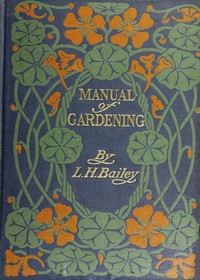
The catalog record for Manual of Gardening (Second Edition) A Practical Guide to the Making of Home Grounds and the Growing of Flowers, Fruits, and Vegetables for Home Use — Background and Themes provides practical reading context through 158,709 words, 11 hr 31 min estimated reading time, and 25 detected text sections.
The text analysis averages about 16.0 words per sentence, while the detected sections provide another way to judge how the source is divided.
Project Gutenberg metadata also associates the work with “Gardening,” connecting these edition facts with the source record’s subject description.
Explore this collection
These alternatives are selected using recorded categories and estimated reading time.
About 854 minutes
Plants Soil
196,350 recorded words. 163 minutes difference from this book's estimate.
View Gutenberg source #16232About 328 minutes
Plants Soil
75,356 recorded words. 363 minutes difference from this book's estimate.
View Gutenberg source #11892About 290 minutes
Plants Soil
66,542 recorded words. 401 minutes difference from this book's estimate.
View Gutenberg source #4342Search stored excerpts and compare books → Choose by your preferences →
Choices use stored catalog measurements. Estimates vary with reading speed. A shared category is a catalog label, not a claim that two books have the same argument or literary quality.
Search reads excerpt text stored with this catalog and links to its associated Gutenberg record. The connection is stored in the site database; this tool does not recheck that every excerpt is word-for-word identical to that external record. Excerpt search does not cover every chapter and does not verify historical publication dates.
Catalog snapshot checked: 2026-09-25. Coverage: 91 public books, 91 available source excerpts.
Read the complete public-domain text at its original source.
Read on Project GutenbergL. H. Bailey's Manual of Gardening (Second Edition) opens not with soil preparation but with a chapter titled 'The Point of View,' asserting that a garden is fundamentally a picture in the landscape. The catalog subject 'Gardening' suggests a broad how-to, but the excerpts reveal a work equally concerned with design theory, grading, and the interplay of plant forms. Bailey devotes substantial space to the 'general plan or theory of the place,' discussing birds, cats, and the defects of lawn flower-beds before addressing any single plant. This editorial note explores how the manual's practical instructions are embedded within a coherent aesthetic framework, and how the catalog subject alone fails to capture its dual nature as both a design treatise and a grower's handbook.
The excerpts show Bailey insisting that 'the planting is part of the design or picture.' He warns against 'defects in flower-growing' and advocates for flower-borders and old-fashioned gardens as deliberate compositions. The table of contents lists chapters on grading, terraces, walks, and bounding lines before any mention of seeds or soil. This ordering suggests that Bailey considered the physical shaping of the ground—the 'execution of landscape features'—as foundational. The catalog subject 'Gardening' implies a focus on plants, but the manual treats the land itself as the primary medium. Bailey's discussion of 'the picture in the landscape' and his examples of 'a small back yard' and 'a city lot' indicate that his advice is meant for homeowners shaping a coherent outdoor room, not merely for growers maximizing yield.
In the section on ornamental plants, Bailey devotes several paragraphs to vines, offering a detailed list of species for screens, walls, and ground covers. He distinguishes between 'tender vines' like nasturtiums and 'hardy vines' like Virginia creeper, and notes that 'high climbing in annual plants may be at the expense of bloom.' This observation ties practical growth habits to visual effect. He recommends the Japan ampelopsis for its brilliant fall color and the actinidia for its 'large thick glossy leaves, not affected by insects.' The inclusion of native vines—even poison ivy, which he says 'cannot be recommended' for cultivation—shows a botanist's eye for utility and risk. The catalog subject 'Gardening' does not hint at this level of species-specific guidance, nor at Bailey's willingness to discuss wild plants as worthy of consideration.
The table of contents reveals a deliberate sequence: 'The Point of View,' then 'The General Plan,' then 'Execution of Landscape Features,' and only later 'The Handling of the Land' and 'The Handling of the Plants.' This ordering implies that Bailey expected readers to conceive a design before digging. The excerpts confirm that he provides both philosophical justification and step-by-step instructions—for example, how to 'make the rows straight' and how to 'secure a firm sod.' Yet the catalog subject 'Gardening' collapses this layered approach into a single category. The manual's second edition (1910) updates earlier advice, but the excerpts do not indicate what changed. Readers should note that the book's organization itself argues for a methodical, design-first approach to home grounds, a nuance the catalog cannot convey.
Bailey's manual rewards readers who approach it as both a reference and a statement of principles. The catalog subject 'Gardening' is accurate but thin; the excerpts show a work that blends aesthetic theory with practical botany. Readers interested in the history of landscape design or in early twentieth-century horticultural writing will find the manual's structure and voice as instructive as its plant lists. The second edition's date—1910—places it at a moment when American suburban gardening was expanding, and Bailey's emphasis on 'home grounds' rather than commercial production reflects that context. Approach the text as a period document that argues for thoughtful, designed gardening, not merely a collection of tips.
There’s something tender about Bailey’s insistence that a garden begins with a plan, not a seed. When I read his careful notes on paths and hedges, I think of older books on my shelf, particularly The Culture of Vegetables and Flowers From Seeds and Roots 16th Edition — Edition Insights, which feels like a quiet conversation with the same patient earth. Both speak of hope measured in seasons.
Answer a few questions and save a private reflection on this device.