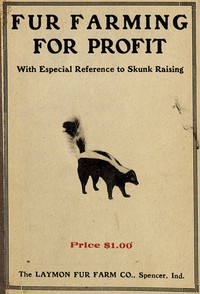
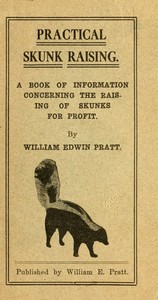
Fur Farming for Profit, with Especial Reference to Skunk Raising — Text and Context
Edition facts
Before opening Fur Farming for Profit, with Especial Reference to Skunk Raising — Text and Context, the edition data offers a quick orientation: 22,616 words, 1 hr 39 min estimated reading time, and 3 detected text sections.
The text analysis averages about 20.3 words per sentence, while the detected sections provide another way to judge how the source is divided.
Project Gutenberg metadata also associates the work with “Skunks,” connecting these edition facts with the source record’s subject description.
Calculated from edition completeness, EPUB availability, text structure and catalogue metadata. Not a user rating.
How this score is calculated
- Description quality20 pts
- Title & short description10 pts
- Source metadata20 pts
- Text length15 pts
- Chapters / structure15 pts
- EPUB file integrity20 pts
Total of 100 points, scaled to a 2.5-5.0 range. Editions with an empty description or a missing EPUB file are not scored.
Read the Text
General Character of The Skunk.
The skunk is a little understood animal. By this we mean, that ordinary people, other than naturalists or scientists, little understand the habits and value of skunk. By some the skunk is classed as a reptile or varmint, and on account of its odor, is detested. Other animals throw scent, notably the mink and muskrat, of course not to the extent that the skunk does.
It is on account of this scent, that skunks are detested. We have animals on our farm which have never thrown a grain. And are yet in their wild state. They do not easily become frightened, hence have no use for their means of protection. That's the only time they use it, and seldom when fighting among themselves.
To make a success out of anything, it is admitted one must know the thing. To be a successful farmer one must know what to raise and how. So with raising of skunk, one must understand skunk, just as one understands horses, cows, sheep or poultry. And skunk, when properly understood can be raised in captivity at a great profit. 500,000 skins were shipped to London last year, besides the skins which were used here in domestic manufacture.
It is surprising to note the change in conditions, due largely to the enlightenment of the rural population to the benefits of the skunk, also to the rapid increase and value of their pelts. Many skunk farms are in existence, the owners making a business of raising these animals for their pelts. While this may be a queer business, nevertheless it is perfectly legitimate, and as far as known, profitable. A ready sale of the pelts is to be had, and the skins from these domesticated animals generally bring higher average prices, being well handled and killed at a time when the fur is at its best. The domestic animal like cultivated fruits, are larger and in every way more valuable than the wild animal.
The skunk is found in nearly all the states and territories of the Union and climate and geographical conditions are responsible for the great variation in size and color of its pelage. There are very few fur-bearing animals as plentiful, and especially in the civilized sections, that bring such a handsome income to the farmer as does the skunk. As noted, the chief difference in character, besides the size of the animal itself, lies in the color of its fur.
The body is 16 to 22 inches long, its tail from root to farthest point of fur, 12 to 16 inches, the latter being covered with hair, the color of which varies, depending upon the color of the fur on the body. For instance, the fur on the tail of a black or short striped skunk is black or nearly all black, (first grade) while that of the broad or narrow striped skunk is interspersed with black and white hairs. While the skin of the animal is very valuable, the tail is rarely used, though manufacturers of late years have consumed the hair in the manufacture of brushes and similar purposes. The legs are short and close to the body, the paw is naked and the five toes on each foot are closely grown together like that of the badger. The foot is well adapted to digging, but they dig very little in the tame state. The toes are not webbed; the head is small, with short, rounded ears and rather long, projecting nose, with two small piercing eyes.
The Skunk a Clean Animal.
The skunk in general appearance is always neat and clean, and in walking seemingly takes special pride, like the peacock, as when promenading, its tail is erect and its back peculiarly curved. Very few animals are as harmless as this creature and were it not for the peculiar odor which it distributes when in danger, it would be more hunted and probably eradicated in sections. Its principal weapon, as heretofore noted, is a peculiar secretion and fluid possessing a very disagreeable odor. This fluid is of a pale yellow color and is discharged by the animal when in danger, in thin-like streams and with such accuracy and aim as to strike any object within 6 to 12 feet. The fluid is secreted in two annal glands from which by the contraction of the sub-caudal muscles and by uplifting of the tail it is discharged in the form as stated above. These sacs are now removed with very little trouble by farmers, and without endangering the fur or breeding qualities of the animal, or ill-effect to the operator.
The removal of the scent sac has a tendency to increase the size of the animal ultimately. We believe, too, that it requires less food to sustain life, consequently it is considered a profitable operation to perform. It is certain that the altered animal becomes more easily domesticated.
Learn to remove the scent sacs and thus avoid all complaints of neighbors and any personal inconvenience. If you learn to do this you can sell your striped skunks for pets or curiosities and in this way get good prices though the skins would be of small value.
The animal is carnivorous, nocturnal, not entirely terrestrial, as occasionally he is known to climb trees, perhaps not of choice but rather compulsion, being forced to this fancied secure position by the hunter or his dog. Consequently his arboreal, like his amphibious habits, are rather undeserved credentials. The theory that the animal climbs the trees in search of food and birds, is discredited. The animal is beneficial in many ways to the farmer, and his eradication from any farming community should be prevented, and laws prohibiting the wanton destruction encouraged.
The contrast in size of the animal and the important variation in the color of its pelage, due to climatic and geographical differences, cannot be denied. The breeding and inter-breeding of the different colored furred species is the principal explanation why the young of a litter are so much unlike in color. The color usually dominates to the black. It is proven that 50% of the young of a white female will breed blacks if the male is black. To breed stars, the male and female should be all black, if possible. 90% of such young will be black, and it is possible to raise to maturity 90% of such litters. It is our experience that the female at rutting time will cohabit with more than one male like a dog or rather like a cat which it more generally resembles.
The predominating color of the fur of all species is black and white with the exception of the Texas skunk, which due to a peculiar soil, is of reddish cast. Some of the animals have a clear coat of fur, others are all black excepting a small white star, but the majority have two stripes, some terminating at the center of body, on others the stripe continuing from the forehead over the body, terminating at the tail.
This carnivorous and nocturnal animal is unlike most every other animal possessing these habits. He can be seen in the early morning returning to his haunts, and once in a while in the middle of the day; at no time is he in a hurry, or will he discommode himself by getting out of your sight or especially away from your path. His mode of locomotion is slow, and rarely will he be found away from his haunt a greater distance than one or two miles. His abode is usually in a hollow log, under some old barn or granary, or in a hole on the sunny side of some hill. He enjoys a sun bath, probably more than does the bear or the badger. His meal is made up by free consumption of worms, bugs, grasshoppers, mice, birds and eggs. In some sections he is known to be quite a vegetarian, consuming as he does, roots, berries, vegetables, and fruits. Occasionally frequents the hen-roost, not only for eggs, but for the hen as well. The young like bread and milk, while we feed the old hominy hearts mixed with water and milk.
The animal passes the winter season in a state of incomplete hibernation, and at regular intervals he will arise, come out of his abode and expose his body to the sun, and judging from the effluvium, empty its distended pouches, but the stench thus caused, soon ceases, which is not the case when it is spurted under irritation or in self-defense. Dr. Coues states "that the animal uses this secretion in the relation of its perpetuation of the species, though overshadowed by its exaggeration into a powerfully effective means of preservation of the individual, is evidently the same as in other species of Mustelidae, each one of which has its own emanation to bring the sexes together, not only by simply indicating their whereabouts, but by serving as a positive attraction."
In the case of the skunk, it would seem that the strong scent has actually tended to result in a more gregarious mode of life than is usual in this family of mammals; and it is certain, at any rate, that the occupancy by one animal of a permanent winter abode serves to attract others to the same retreat. Burrows are sometimes found to contain as many as a dozen individuals, not members of one family, but various adult animals drawn together. One other effect of the possession of such unique powers is seen not so much in mode of life as in the actual disposition of the creature. Its heedless familarity, its temerity in pushing into places which other animals instinctively avoid as dangerous, and its indisposition to seek safety by hasty retreat, are evident results of its confidence in the extraordinary means of defense with which it is provided.
In the domesticated state they do not use the scent only under extreme agitation. Dogs create this excitement, man seldom, even when handling them. When held by the tail, they are really unable to throw the scent.
The animal that has a clear, white-furred pelt is very sparingly found, in fact so seldom, that many consider it a freak of nature and not a distinct species.
Personally we do not find it pays to raise white skunk, save as pets, or the females for breeding purposes. We dispose of them before they have become an expense to us. It is the wise man who can judge when to kill and when to keep.
The animal that has a black coat of fur is found in many states, those of New York, New Jersey, Pennsylvania, Michigan, Wisconsin, and Eastern Canada, are better furred, and in consequence command better prices than those coming from the central states. The black skunk is also found in Illinois, Indiana, Kentucky, Arkansas, Virginia, North Carolina and South Carolina, in fact in every locality excepting in the northwestern states, also northwestern parts of Canada. The animal cohabits with the other species, and there is no apparent rule governing the breeding and inter-breeding and the probable coloration of the offspring. Somewhat disregarding the color of the parents, the litter contains black, white, short, narrow and broad striped youngsters. But 90% will "take after" full black parents. If you use Star bucks you can reasonably expect Star stock. The fur of the black skunk, especially the eastern variety, is soft, wavy, and of a deep lustrous black. Those animals that have only a small white furred star at the forehead are commercially called "black skunk."
Great care should be taken in selecting the male breeders to avoid in-breeding. A skunk matures, or its fur becomes prime and salable in six months. The female brings forth young in a year. The life of a skunk is from five to seven years.
This animal inhabits the same section as the black skunk, the only difference between them is that the small white star of the former develops into prongs or two distinct white-furred stripes, starting at the forehead and terminating at or about the shoulders or center of body. Quite often the forehead is entirely covered with white fur, and immediately beginning at the top of head the white hair continues in two prongs, each varying in width from three-eighths to three-fourths of an inch. Should the white stripes continue clear across the body and terminate at the nail, such skins cannot be classed as short striped but are known as long, narrow or broad stripe.
Short striped skins are second in value, the price being about one-third less than that of the black skins. The white stripes are of no value to the manufacturer, and for that reason the skin that has the greatest amount of black fur is worth more and the value lessened by the increase of the white stripe. The fur of the tail is black with intermingled white hairs. The disagreeable odor is removed by the dresser (tanner) and by the time the skin reaches the manufacturer, it is cleansed from all impurities and ready to be made into garments.
Narrow Striped Skunk.
This animal inhabits nearly every state and territory of the Union and greater part of Canada, and is the true American skunk. His coat of fur is black, excepting two white stripes beginning at the forehead and terminating at the tail. The width of these stripes varies somewhat, depending upon the size of the animal, usually three-eighths to three-fourths of an inch. There is always a goodly portion of black fur between these stripes. The white stripes are narrow and close together, but widen apart at center of back, and again narrowing when close to the root of tail. The largest animals of the skunk family come under the long or narrow striped species.
This animal is found in common with the previous species, and its difference is only in the width of the white stripe which is wider, and the quantity of black fur on the skin is lessened, thereby diminishing the value of the skin. There is no apparent iron-clad rule, or a dividing line between, or just where and when a skin should be called broad stripe and not a narrow striped skin. This naturally must be left largely to the judgment and discretion of the buyer or the manufacturer, who, in grading, seeks an average more than any particular dividing line. The tail is covered with hairs with occasionally interspersed black hairs.
This animal has a long, horizontal white stripe extending from forehead, continuing over the body, terminating at root of the tail; the latter is covered with white fur and is probably more bushy in proportion to its size, than the other northwestern species. The skin is of no great value. The fur is rather coarse and the skins undesirable.
From the above description it will be noted that the value of the pelt lies principally in the quantity of black fur; diminishing by the increase of white and increasing by the lessening of the white fur.
It may be of interest to note that skunk fur after it is manufactured is not sold as "skunk," but is a good substitute for many different kinds of fur which has a higher value placed upon it.
Of late years the white stripes that are cut out of the skins are being used in the manufacture of spurious tails which are dyed to imitate the natural tail of mink, marten, etc. At other times these white pieces are sold in connection with other fur scraps or cuttings to hat manufacturers. Only those skins that are prime in leather and full furred, command good prices.
Fur Farming--Supply and Demand.
From the dawn of history in this country the fur trade has been an important branch of commerce and had much to do with the rapid advance of discovery and exploration in the early days. But the extensive trapping operations since that time have sadly depleted the ranks of all species of fur-bearing animals and some of the most valuable are rapidly nearing extinction. This is especially true of the central and eastern portions of the United States, and the time is approaching when the ever increasing demand for furs must be met by some way other than trapping the wild animals--but how? Fur farming appears to offer the only solution to the problem.
The raising of fur-bearing animals is still in its infancy, but many experiments have been tried out from time to time, and it is a proven fact that if it is undertaken and carried out in an intelligent manner, the industry is bound to be successful; and why not? All of our domestic animals and fowls were wild creatures at one time.
There are practically no new and unexplored regions to trap and even in faraway Siberia, which we are taught to believe a land of wilderness and a fine fur-producing country, reports say that fur-bearers are becoming scarcer each year. The regions which have not yet been explored by the white men, have for many years been trapped by the savage inhabitants. Fur traders push into all accessible districts, and the trappers also, sometimes bring their goods hundreds of miles in order to trade with the white people. South America produces some furs, but the catch is not heavy, perhaps because there is not much trapping done there. But the furs from the more distant regions are, as a rule, of the more valuable kinds, and cannot supply the demand of the great middle class of people, the largest consumers. Such furs cannot take the place of those of the muskrat, skunk, raccoon and oppossum, for these furs are usually made up to imitate the more expensive kinds. But as the supply decreases the demand increases at an equal rate.
The skunk, mink and muskrat do well in settled sections. There is always a cash market for raw furs and since the discovery of America, raw furs have been an important article of commerce. An industry paying the hunter and trapper probably $15,000,000 yearly is one that should receive attention. The demand for furs is increasing as the population of the world is becoming more and more. Again furs are being put to more uses than ever. While the demand for furs is increasing, what of the supply? The day, perhaps is not far in the distance when the demand will call for two or three times as many furs as today. Where are they to come from, if not from fur farming?
A well known fur dealer in Minneapolis sizes up the situation in a nut-shell:
"Under proper conditions, with intelligent care, raising fur animals can be made to pay. The raiser starting on a small scale and increasing as their knowledge increases. Most all successful business is built up by starting small."
Conda J. Ham, in the Hunter-Trader-Trapper Magazine, says:
"Did you ever stop to seriously think where your furs and your fur coats would come from twenty or thirty years from now? At the rate fur-bearing animals are being killed off at the present time, there would not be fur enough thirty years from now to properly clothe the nobility of the old world, to say nothing of our American women who must have their new furs each season, and the others who must have at least one or two sets during a lifetime. The fur industry is admittedly fast dying a violent death. Some other remedy than those already prescribed must be discovered. We still have sections of the country where the same wild state of nature exists that could have been found three hundred years ago. We still have plenty of fur-bearing animals to keep alive their species if proper conditions prevailed. Therefore, it would seem that the problem to solve is, how can these conditions be best secured.
"Mr. Norman A. Wood, expert taxidermist in the University of Michigan's museum, the man most familiar with the animal life within the state and one of the greatest authorities on animal life in the whole Northwest, declares the fur industry can be saved only through the medium of great fur farms. His study of the situation has convinced him that the commercial growing of fur is coming to be one of the great industries of America.
"In various parts of the country such farms are to be found, and the profit derived from them has been sufficient to prove the success of the venture. Skunk farms have been started in various parts of the United States within the past few years and are proving paying enterprises.
Hermon Basil Laymon opens his 1913 manual with a personal anecdote about being “brought up among skunk,” a claim he uses to establish authority. The book’s subtitle, “with Especial Reference to Skunk Raising,” signals its niche focus, and the content bears out that specificity. Laymon’s prose is direct and instructional, often shifting between first-person narrative and step-by-step directives. The excerpts show a writer who values concrete detail—how to stretch a pelt, where skunks den, what to feed them—over rhetorical flourish. His voice is that of a practical farmer who has learned “by diligent study and the best of all ‘practical experience.’”
A Personal Stake in Skunk
Laymon’s introduction is notably personal. He recounts capturing “a female and her litter” and later acquiring “a star buck,” framing his enterprise as a gradual, hands-on experiment. This autobiographical opening is unusual for a farming manual of the period, which often began with general principles. Laymon admits his farm “was not a success from the start,” a candid admission that undercuts any pretense of effortless expertise. The phrase “things are looking bright for yours truly” injects a colloquial, almost boosterish tone. By grounding his advice in his own setbacks, Laymon positions himself as a relatable authority rather than a distant expert. The reader is invited to learn from his mistakes, not just his successes.
The Vocabulary of the Fur Trade
Laymon’s diction reveals the commercial realities of early twentieth-century fur farming. He uses terms like “prime,” “graded,” and “well handled” to describe pelts, reflecting a market where buyers assessed skins “entirely by the amount of black fur.” His instructions for packing furs emphasize practical concerns: “Never ship furs until they are perfectly dry,” and “Put two shipping tags on each package.” The inclusion of a sample advertisement for “LIVE MINK WANTED” and the names of specific dealers (e.g., “William Weddle, Spencer, Ind.”) grounds the text in a specific economic network. Laymon’s language is transactional, treating skunks as livestock whose value is realized through careful processing and shipping.
Skunk Behavior Through a Farmer’s Eyes
Chapter V, “Habits of The Skunk,” blends natural history with practical observation. Laymon notes that skunks “seem to thrive best in the farming sections” and “often appropriate the den of the woodchuck,” details that reflect his rural Midwestern perspective. He describes them as “nocturnal animals” that “do not wander far from the den” except in fall and during the mating season. The description of their diet—“mice, insects and grubs”—is concise, but Laymon adds a comparative note: because skunks are “slow moving animals, they can not catch the more active animals and birds as do the other members of the weasel family.” This ecological aside shows Laymon thinking like a farmer who observes his animals’ limitations.
Hands-On Instructions for Pelt Preparation
Laymon’s directions for skinning and stretching are remarkably detailed. He advises using a jackknife to make “a little incision in the tip of the tail” to allow air circulation, and warns that “the loss of the tail will detract heavily from the value of the skin.” His method for stretching involves nailing the pelt to a board, spacing nails “1½ or 2 inches apart,” and ensuring the nose does not “slip over the end of the board.” The instruction to “put a little salt in the tail to keep it from tainting” in warm weather is a specific, low-tech solution. These passages read like a master class in fur handling, with Laymon anticipating common mistakes—over-stretching, broken tail bones, improper drying—and offering remedies.
Laymon’s manual is best read as a period document of agricultural entrepreneurship, not a timeless guide. His voice is that of a self-taught specialist who values “practical experience” over theory. Readers interested in the history of fur farming, early twentieth-century rural economies, or the domestication of a notoriously maligned animal will find this text a rich primary source. The book’s narrow focus on skunk raising, combined with Laymon’s unpretentious prose, offers a window into a forgotten corner of American agriculture.
That rainy afternoon, Laymon’s worries about spoiled pelts and ornery stock felt almost tender. His patient, calloused pragmatism lingered, so I drifted to Practical Skunk Raising A Book of Information Concerning the Raising of Skunks for Profit — Reading Companion almost without deciding to. It was like hearing the same quiet rain on a different roof—same mud, same careful hands, just another barn.
Liam Brown
2 weeks agoScarlett Jones
3 weeks agoAnthony Clark
2 weeks agoAlexander Robinson
1 week ago-
Michelle Jones - 4 weeks ago
I picked this up hoping for modern advice, but it's largely a relic of its time. The information on skunk handling and fur markets is outdated and not applicable today. The writing is a bit rambling and lacks practical guidance that could be used now. I would only recommend it to historians of agriculture, not to anyone actually considering fur farming. -
Elizabeth Norman - 2 weeks ago
This book is a surprisingly thorough guide to fur farming, with a special focus on skunk raising. It covers everything from selecting breeding stock to building enclosures and marketing pelts. The author's practical tips based on real experience are invaluable. I feel fully equipped to start my own small operation! A must-read for anyone interested in niche agriculture or traditional fur farming. -
Chelsea Hughes - 2 weeks ago
An interesting historical guide that provides detailed instructions on fur farming, particularly skunks. It's quite specific and gives a clear picture of the processes involved. However, the book is obviously dated, and modern animal welfare standards and market conditions have changed significantly. Still, for those researching historical farming practices or alternative livestock, it's informative.
How will you remember this book?
Save your reaction, strongest insight, and memorable passage.
Mia Wright
4 weeks ago