About 26 minutes
Practical Skunk Raising A Book of Information Concerning the Raising of Skunks for Profit — Reading Companion
Farming
5,968 recorded words. 1 minutes difference from this book's estimate.
View Gutenberg source #47460
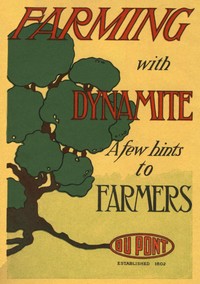
The source record for Farming with Dynamite: A Few Hints to Farmers — Edition Insights measures this digital text at 5,713 words, 25 min estimated reading time, and 1 detected text section.
The text analysis averages about 22.0 words per sentence, while the detected sections provide another way to judge how the source is divided.
Project Gutenberg metadata also associates the work with “Explosives in agriculture,” connecting these edition facts with the source record’s subject description.
Explore this collection
These alternatives are selected using recorded categories and estimated reading time.
About 26 minutes
Farming
5,968 recorded words. 1 minutes difference from this book's estimate.
View Gutenberg source #47460About 99 minutes
Farming
22,616 recorded words. 74 minutes difference from this book's estimate.
View Gutenberg source #42888About 119 minutes
Farming
27,287 recorded words. 94 minutes difference from this book's estimate.
View Gutenberg source #11555Search stored excerpts and compare books → Choose by your preferences →
Choices use stored catalog measurements. Estimates vary with reading speed. A shared category is a catalog label, not a claim that two books have the same argument or literary quality.
Search reads excerpt text stored with this catalog and links to its associated Gutenberg record. The connection is stored in the site database; this tool does not recheck that every excerpt is word-for-word identical to that external record. Excerpt search does not cover every chapter and does not verify historical publication dates.
Catalog snapshot checked: 2026-09-25. Coverage: 91 public books, 91 available source excerpts.
Read the complete public-domain text at its original source.
Read on Project GutenbergThe Du Pont Powder Company’s 1910 booklet Farming with Dynamite opens with a bold claim: dynamite is “actually safer to handle” than gunpowder. The text immediately confronts a farmer’s likely fear, then pivots to promise “wonderful value” through the use of their “Red Cross” brand. The prose is direct, almost conversational, addressing the reader as “you” and positioning the company as a helpful correspondent. This is not a neutral manual but a piece of promotional literature that blends technical instruction with salesmanship.
The booklet’s first rhetorical move is to redefine dynamite as a tool of safety. It acknowledges that farmers “have a wrong idea about dynamite” and that they “believe it is dangerous to handle.” The response is not a technical lecture but a reassurance: “after more than a hundred years’ experience,” the company can state that “anyone can use our ‘Red Cross’ Dynamite without harm.” The word “harm” is carefully chosen—it implies bodily safety, not property damage. The text then pivots to the economic benefits, listing them in a bold, all-caps header: “SAVES MONEY TIME LABOR.” This structure—address fear, offer safety guarantee, then list profit—recurs throughout the booklet.
The booklet contrasts dynamite with traditional methods using vivid, concrete language. Pulling stumps with a machine is “the hardest kind of work” that “liable to injure seriously your horses.” Burning stumps “destroys the chief fertile elements of the soil.” Dynamite, by contrast, costs “about one-third the cost of pulling and chopping them up.” The numbers are specific, the comparisons stark. The text also uses verbs of ease: “you can dynamite all those stumps” suggests a simple, almost effortless action. The promise is not just efficiency but transformation—clearing land yields “new, rich soil that needs no fertilizer.”
The booklet is organized as a list of “Chief Uses of Dynamite on the Farm,” each explained in detail. This structure mimics a catalog, allowing the reader to scan for their specific need: stump removal, hard-pan breaking, orchard planting, ditch digging, road making, and regenerating old farms. Each use is presented as a problem-solution pair. The text also includes a call to action: “write for a copy of our ‘Handbook of Explosives for Farmers, Planters and Ranchers,’ which will be sent free of charge.” This layered approach—short booklet plus free handbook—creates a funnel for customer engagement.
The authorial voice is that of an established company with “more than a hundred years’ experience.” The tone is confident, almost paternal: “We will be glad to correspond with you about any special requirements of your farm.” The use of “we” and “you” creates a direct, personal relationship. The company’s founding year (1802) and home office (Wilmington, Del.) are prominently displayed, reinforcing credibility. The text also includes a list of branch offices across the United States and Mexico, suggesting a national reach. This is not a farmer writing to farmers; it is a corporation speaking to a customer, using the language of partnership.
The booklet is best read as a historical artifact of agricultural marketing. Its claims about safety and cost reflect early twentieth-century efforts to industrialize farming. Readers interested in the rhetoric of technology adoption or the history of explosives in agriculture will find this a concise example of how a manufacturer addressed farmer skepticism through direct, benefit-driven prose.
There’s something almost tender about a century-old pamphlet insisting dynamite will solve your stump problem—that same earnest confidence, that belief in a clever fix, carries over into Fur Farming for Profit, with Especial Reference to Skunk Raising — Text and Context. I find myself smiling at how seriously these old booklets took their odd, practical dreams. They trusted the soil, and the future, more than we often do.
Build a private reading journal entry for this title.