Texas Honey Plants — A Reader’s Guide

(0 User reviews)   53
In Category - Livestock
Sanborn, Charles Emerson, 1877-, Scholl, Ernest E. (Ernest Emmett), 1881- Project Gutenberg 2012 Not confirmed
Bee culture; Honey plants -- Texas Readers of public-domain and historical texts
Project Gutenberg digital edition en

Edition facts

Words 11,199
Reading time 49 min
Text sections 3

This digital edition of Texas Honey Plants — A Reader’s Guide is described by source-level measurements including 11,199 words, 49 min estimated reading time, and 3 detected text sections.

The text analysis averages about 11.4 words per sentence, while the detected sections provide another way to judge how the source is divided.

Project Gutenberg metadata also associates the work with “Bee culture,” connecting these edition facts with the source record’s subject description.

A 1908 agricultural bulletin cataloging Texas honey plants with botanical descriptions, bloom times, and beekeeping notes. The authors' terse, observational style blends scientific taxonomy with practical field reports, revealing the uneven yields and seasonal rhythms that shape Texas apiculture.
Share
Editorial Edition Score 4.5/5

Calculated from edition completeness, EPUB availability, text structure and catalogue metadata. Not a user rating.

How this score is calculated
  • Description quality20 pts
  • Title & short description10 pts
  • Source metadata20 pts
  • Text length15 pts
  • Chapters / structure15 pts
  • EPUB file integrity20 pts

Total of 100 points, scaled to a 2.5-5.0 range. Editions with an empty description or a missing EPUB file are not scored.

Edition quality

Read the Text

Produced by Frank Zago

TEXAS AGRICULTURAL EXPERIMENT STATIONS.

--------------------------

DEPARTMENT OF ENTOMOLOGY.

College Station, Texas.

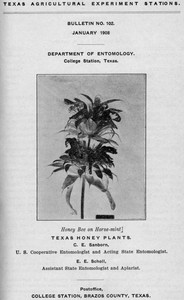
[Photograph: Honey Bee on Horse-mint]

_Honey Bee on Horse-mint_

U. S. Cooperative Entomologist and Acting State Entomologist.

Assistant State Entomologist and Apiarist.

--------------------------

COLLEGE STATION, BRAZOS COUNTY, TEXAS.

TEXAS AGRICULTURAL EXPERIMENT STATIONS

--------------------------

--------------------------

(Board of Directors A. & M. College.)

K. K. LEGGETT, President Abilene

T. D. ROWELL, Vice President Jefferson

A. HAIDUSEK La Grange

W. B. SEBASTIAN Breckenridge

H. H. HARRINGTON LL. D., President of the

J. W. CARSON Assistant to Director and

W. G. WELBORN Vice Director and Agriculturist

M. FRANCIS Veterinarian

E. J. KYLE Horticulturist

JOHN C. BURNS Animal Husbandry

R. L. BENNETT Cotton Specialist

C. E. SANBORN Co-Operative Entomologist

N. C. HAMNER Assistant Chemist

E. C. CARLYLE Assistant Chemist

L. McLENNAN Deputy Feed Inspector

A. T. POTTS Deputy Feed Inspector

J. H. RODGERS Deputy Peed Inspector

H. E. HANNA Deputy Feed Inspector

C. W. CRISLER Chief Clerk

W. L. BOYETT Clerk Feed Control

F. R. Navaille Stenographer

A. S. Ware Stenographer

W. S. HOTCHKISS, Superintendent Troupe, Smith County

S. A. WASCHKA, Superintendent Beeville, Bee County

NOTE--The main station is located on the grounds of the

Agricultural and Mechanical College, in Brazos County. The postoffice

address is College Station, Texas. Reports and bulletins are sent free

upon application to the Director.

This preliminary bulletin on Texas Honey Plants represents work of

the Department of Entomology dating through the office tenures of

Professors Mally, Newell, Sanderson and Conradi. They each have

authorized and aided in the collection of the flora and data contained

To Mr. Louis H. Scholl, of New Braunfels, Texas, Assistant and

Apiarist from 1902 until 1906, the Department is directly indebted for

the material contained herein, except as is otherwise designated.

Mr. Ernest Scholl, now Assistant and Apiarist, has furnished

material as shown herein. He is now working on a continuation of the

Mr. D. C. Milam, of Uvalde, formerly Foul Brood Inspector, has also

contributed, as is shown.

The main body of the work, however, has been accomplished through

the services of Mr. Louis H. Scholl, and much credit is due him, since

he has done more in this Department, and perhaps more than any other

person in helping to build up the Bee Industry of Texas. His data are

followed by this mark *

This publication treats of many of the Texas honey plants in a brief

technical manner. In addition, wherever possible, the common name is

used in connection with the description.

The sequence followed by Coulter in his Botany of South West Texas

is herein mainly followed. In some instances quotations from Small's

Botany of Texas were used, as is shown in the publication. The plants

are discussed by families.

Not only is the honey producing qualities of the plants mentioned,

but frequent mention is also made of the respective quality and yield

of pollen and propolis. Data are included in many instances concerning

the weather conditions and its effects upon the yield of certain

It is hoped that this will be a great help to apiarists in selecting

locations for bees, since the value of bees depends entirely on the

environment under which they may be placed. Again it may help in

selecting certain plants to be planted that might prove to be very

beneficial to an established apiary.

The geographical distribution is given in a general brief way, so

that one is less apt to be confused concerning the abundance in nature

of certain plants. In this connection it must be remembered, however,

that on account of extended cultivation in Texas, some of the common

wild plants are becoming less numerous than formerly, while cultivated

varieties are becoming more common.

Two indices are contained in this bulletin. The first contains all

the common or vernacular names, and the second contains the latin or

technical names. The latter is complete, since some plants are known

only by the technical appellation.

TRIPLE-LEAFED BARBERRY. Berberis trifoliata Moric.

Barberry family. Berberideae.

"On gravelly slopes and foothills from the Gulf coast to the Limpia

mountains." (Coulter). Hunter, gravelly hills; honey yield abundant,

also pollen; fine for early brood rearing. January and February.*

PRICKLY POPPY. Argemone platyceras (Link. and Otto.)

Poppy family. Papaveraceae.

"Abundant in valleys and along dry hillsides." (Coulter). Roadsides,

waste fields and prairies. Honey yield unimportant, but abundance of

pollen during the dearth of summer. May and July.*

"This plant is abundant along the Brazos valley. Bees work heavily on

it in June, carrying heavy loads of pollen, which they store in nearly

every comb, thus making it disagreeable in the honey combs sometimes."

POPPY. Papaver rhoeas L.

Poppy family. Papaveraceae.

Cultivated in flower gardens. Honey yield not important and plants

PEPPERGRASS. PEPPERWORT. Lepidium Virginicum L.

Mustard family. Cruciferae.

"In all situations, Quebec to Minnesota, Kansas, Florida, Texas and

Mexico. Naturalized in Europe." (Small). Found in all kinds of places;

honey yield not important; some pollen. June to August.*

GREGGIA. Greggia camporum Gray.

Mustard family. Cruciferae.

"Mountains of Western Texas." (Coulter). Honey yield early but not

abundant; also pollen helps early brood rearing. Hunter; waste fields

and fertile prairies. Honey yield early, but not abundant; also

pollen; helps early brood rearing. February.*

COMMON TURNIP. Brassica rapa L.

Mustard family. Cruciferae.

Cultivated and sometimes escaped; bees work on the blossoms, honey

and pollen. June and July.*

BLACK MUSTARD. Brassica nigra Koch.

Mustard family. Cruciferae.

Cultivated and escaped; bees sometimes busy on it. June and July.*

MIGNONETTE. Reseda odorata L.

Mignonette family. Resedaceae.

College: cultivated on Apiary Experimental plats. Honey yield good;

plants not plentiful enough for surplus. June and July.*

PORTULACA. Portulaca grandiflora Hook.

Purslane family. Portulaceae.

Cultivated in ornamental flower beds. Honey yield good as it comes

during time when few others in bloom; also abundance of highly colored

pollen, red, orange and yellows. June until frost.*

SALT CEDAR. Tamarix gallica L.

Tamarisc family. Tamariscineae.

"A common European Mediterranean shrub which seems to have escaped in

many places in Texas." (Coulter). "On roadsides, in thickets and waste

places; warmer parts of Southern United States, naturalized from

Southern Europe." (Small). College Station; cultivated ornamental

shrub bees worked well on it, but number of trees scarce. May and

FRINGED POPPY MALLOW. Callirrhoe digitata Nutt.

Mallow family. Malvaceae.

"Common on prairies and in valleys." (Coulter). Hunter; prairies and

lowlands. Honey yield not important; some pollen. May and June. A good

pollen yielder during May at College Station.*

SPANISH APPLE. Malvaviscus drummondii. Torr & Gray.

Mallow family. Malvaceae.

"From Rio Grande to the Colorado and Northeastward." (Coulter). In

lowlands and along streams. June and July.* "Plentiful along Comal and

Guadalupe rivers, New Braunfels, Texas. Not important." (E. Scholl).

ROSE OF SHARON. SHRUBBY ALTHAEA. Hibiscus Syriacus L.

Mallow family. Malvaceae.

"In various situations New Jersey and Pennsylvania to Florida and

Texas." (Small). Cultivated ornamental, in gardens and parks; honey

yield not important and plants few, but bees work busily on it; honey

and pollen. May to Sept.*

SPRING SIDA. Sida spinosa L.

Mallow family. Malvaceae.

"In cultivated grounds, waste places on roadsides, New York to Iowa,

Florida and Texas. Widely distributed in the tropics." (Small). Waste

places, fields and along roads; some honey and pollen; not important.

NARROW-LEAFED SIDA. Sida angustifolia Lam.

Mallow family. Malvaceae.

"In dry soil Texas to Arizona; also in Mexico and tropical America."

(Small). In dry soils; bees found upon it; yields pollen. June to

COTTON. Gossypium herbaceum L.

Mallow family. Malvaceae.

Cultivated staple crop in the fields for fibre. Honey yield good,

steady flow till frost, honey white and of good quality. Main source

throughout cotton belt. Nectar glands on ribs of leaves and on bracts

of buds, blooms and bolls. June to frost.*

JAPANESE VARNISH TREE. Firmiana platinifolia (L.) R. Br.

Chocolate family. Buettneriaceae. HBK.

College Station: Cultivated ornamental tree on campus; honey yield

very heavy but of short duration some seasons longer. May and June.*

BASSWOOD. AMERICAN LINDEN. Tilia Americana L.

Linden family. Tiliaceae.

"A large and handsome tree of the Atlantic States, extending in

Texas to the Valley of the San Antonio River." (Coulter). On forests

of Eastern Texas, yields large quantities of excellent honey. May and

LARGE-FLOWERED CALTROP. Tribulus cistoides L.

Bean-caper family. Zygophylleae.

Hunter: in fields and waste lands; honey yield good until noon when

flowers close; also much pollen. April, August.*

GREATER CALTROP. Kallstroemia maxima (L) T. & G.

Bean-caper family. Zygophylleae.

"Tribulus maxima." (Coulter). "Common in dry soil throughout

Southern and Western Texas." (Coulter). Hunter: in fields and waste

lands. Honey yield good in morning, blossoms closing by noon except

in cool weather; good as it comes in the dearth of summer; also

abundance of pollen. April to August.*

YELLOW WOOD SORREL. Oxalis stricta L.

Geranium family. Geraniaceae.

"Eastern and Southern Texas." (Coulter). Waste soils and open

woodlands; not plentiful for bee forage. May, August.*

TOOTH-ACHE TREE. PRICKLY ASH. SEA ASH. PEPPERWOOD. Xanthoxylum

Rue family. Rutaceae.

"Colorado to Rio Grande." (Coulter). "Along or near the coast,

Virginia to Florida, Arkansas and Texas." (Small). Hunter: woodland

prairies; honey yield good; bees work busily on it. April, June.*

HOP TREE. Ptelea trifoliata L.

Rue family. Rutaceae.

"Throughout Southern and Western Texas." (Coulter). In woodlands and

along rivers and creeks. Honey yield good; very good in favorable

seasons where abundant. May and July.*

HARDY ORANGE. Citrus trifoliata L.

Rue family. Rutaceae.

College: planted for hedges, scarce; honey yield fair for early

brood. Bees worked on it abundantly. March.*

TREE OF HEAVEN. Ailanthus glandulosus Desf.

Quassia family. Simarubaceae.

"In waste places and along streams, more or less extensively

naturalized in the United States and Southern British America. Native

of China." (Small). Hunter: cultivated for shade and escaped. Honey

yield fair in good seasons, pollen; also nectar glands on leaf blades.

UMBRELLA CHINA TREE. Melia azedarach L.

Melia family. Meliaceae.

"A favorite shade tree and extensively naturalized in Central and

Southern Texas." (Coulter). Cultivated ornamental shade tree and

escaped. Honey yield helps early brood rearing. February, March.*

POSSUM HAW. BEAR BERRY. Ilex decidua Walt.

Holly family. Ilicineae.

"A species of Southern States and extending in Texas to the Valley

of the San Antonio." (Coulter). College; along lowlands, creeks and

streams. Honey yield good but short; in warm spring early and valuable

for early brood. March, May.*

YOUPON. Ilex Caroliniana Trelease.

Holly family. Ilicineae.

"A species of the Gulf States and extending into Texas. Limit

uncertain." (Coulter). Hunter: low woodland thickets; not important.

BRASIL WOOD. LOGWOOD. Condalia obovata Hook.

Buckthorn family. Rhamneae.

"From the Guadalupe to the Rio Grande and west of New Mexico."

(Coulter). Hunter: in woodlands, dry soils; honey yield not very

important but comes well in dearth of summer. July, August.* "Abundant

along Carter's Creek. Honey yield good during May." (E. Scholl).

RATTAN VINE. Berchemia scandens Trelease.

Buckthorn family. Rhamneae.

"A species of the Southern States extending into Texas where its

western limit is uncertain." (Coulter). Along ravines and low

woodlands; honey yield good, giving surplus in favorable years but

dark amber colored, used in manufacturing-houses. April.*

COLUMBRINA TEXENSIS. Gray.

Buckthorn family. Rhamneae.

"From the Colorado to the Rio Grande westward to New Mexico."

(Coulter). Floresville, slopes, adobe hills. Honey yield good but not

enough for surplus. Also some pollen. April.*

CULTIVATED WINE GRAPES. Vitis (?) (Varieties).

Vine family. Ampelidaceae.

Cultivated in orchards; good for pollen. April, May.*

MOUNTAIN GRAPE. Vitis monticola Buckley.

Vine family. Ampelidaceae.

"Peculiar to the hilly limestone regions of Western Texas, not

extending to the low country nor to the granite mountains." (Coulter.)

Hunter: in woods and forests; honey yield fairly good and pollen

valuable for brood rearing. March.*

COW ITCH. Cissus incisa Desmoul.

Vine family. Ampelidaceae.

"In shady places from the Colorado to the Rio Grande and

westward. An ornamental vine known as "Yerba del buey."

(Coulter). Hunter: along fences and edge of thickets; honey yield

keeps bees out of mischief during dearth. Surplus where

plentiful. April, to August.*

SOAPBERRY. WILD CHINA. Sapindus marginatus Willd.

Soapberry family. Sapindaceae.

"Common along creeks throughout Texas from Louisiana to New Mexico

and Mexico. Smaller west of the Colorado river." (Coulter). Along

rivers and creeks and sometimes along uplands; honey yield good, heavy

flow in favorable seasons gives surplus. June.* Evergreen shrub,

blooms in April; yields quantities of honey and pollen where enough

bushes." (Milam, Uvalde).

COMMON BALLOON VINE. Cardiospermum Halicacabum L.

Soapberry family. Sapindaceae.

"Guadalupe to Rio Grande." (Coulter). "In thickets and waste places

New Jersey, Missouri, Florida, Texas and tropical America; summer and

fall." (Small). Hunter: in creek bottoms; honey yield fair but plants

not abundant. April, July.*

MEXICAN BUCKEYE. Ungnadia speciosa Endl.

Soapberry family. Sapindaceae.

"Common along rocky valleys and in the mountains from the Valley of

the Trinity through Western Texas to New Mexico." (Coulter). Hunter:

"mountainous woodlands. Honey yield good in dearth but not plentiful.

DWARF SUMACH. Rhus copallina L.

Sumach family. Anacardiaceae.

"A sumach of the Atlantic States extending through Eastern and

Southern Texas to the Rio Grande." (Coulter). Hunter: small shrubby

tree rocky hillsides and woodland prairies. Honey yield good giving

surplus in favorable seasons depending upon rains. Reported as a honey

plant in most of the beekeepers reports received. August.*

GREEN SUMACH. Rhus virens Lindh.

Sumach family. Anacardiaceae.

"From the Colorado to the Rio Grande and westward." (Coulter). In

stony, hilly woodlands. Bees are some seasons busy on it. October.*

BLUE LUPINE. BLUEBONNET. Lupinus subcarnosus Hook.

Pulse family. Leguminosae.

"Common lupine of Southern and Western Texas, 'covering fertile

slopes with a carpet of purple blue.' (Harvard), as early as March."

(Coulter). Hunter: places in open woodlands. Honey yield good; also

pollen of very bright and orange colors. March, April.*

ALFALFA OR LUCERNE. Medicago sativa L.

Pulse family. Leguminosae.

"An extensively cultivated forage plant which has long been an

introduced plant in Southern and Western Texas." (Coulter). Cultivated

for hay crops; honey yield fair; early summer and fall; better in

irrigated regions. May, August.* "Large number of bees were seen on it

at New Braunfels, Texas. June 19th, 1907. A good thing in North

MEDICK. BURR CLOVER. Medicago denticulata Willd.

Pulse family. Leguminosae.

"Naturalized in Western Texas." (Coulter). College: abundant on

campus lawns. Honey yield sparingly in summer, not important. February

SWEET CLOVER. Melilotus alba Desv.

Pulse family. Leguminosae.

Distribution not definite. Cultivated and along fence rows; honey

yield good and of fine quality; scarce and should be cultivated for

honey. May to October.* "An important honey plant in North Texas." (E.

YELLOW SWEET CLOVER. Melilotus officinalis (L) Lam.

Pulse family. Leguminosae.

Colorado along roadsides, escaped. Honey yield good; claimed to be

superior to and earlier than M. alba by beemen. Should be cultivated

on the poor soils of Texas. April to September.*

RED CLOVER. Trifolium pratense L.

Pulse family. Leguminosae.

College Station: cultivated on experimental plats. Blooms in summer;

not important, not much grown and deep corollas. June.*

WHITE CLOVER. Trifolium repens L.

Pulse family. Leguminosae.

"May be found wild in Texas." (Coulter). Along roadsides and on

lawns. Cultivated at College, but did not grow as conditions were too

dry. Honey yield good and one of main sources in States north of

EYSENHARDTIA. Eysenhardtia amorphoides. H B K.

Pulse family. Leguminosae.

"Throughout Southern and Western Texas, South of the Colorado."

(Coulter). Hunter: on light soils and woodlands and known as "Rock

Brush" by beemen. Honey yield abundant. Blooming after heavy rains.

Honey fine quality. March, May.*

BLACK LOCUST. Robinia Pseudacacia L.

Pulse family. Leguminosae.

"Native from Pennsylvania to Iowa, Georgia and Indian

Territory. Also naturalized in the northeastern part of North

America." (Small). College: cultivated on campus; honey yield good if

no cold weather; bees work on it abundantly. March, April.*

CASSIA. Daubentonia longifolia (Cav.) DC.

Pulse family. Leguminosae.

Low and damp places; sandy soils; bees on it frequently but

apparently of little value. July, September.*

MEXICAN GROUND-PLUM. Astragalus Mexicanus. A. DC.

Pulse family. Leguminosae.

"Prairies throughout Texas." (Coulter). Hunter: in open prairies

honey yield abundant when season is favorable; drouth injures

Pulse family. Leguminosae.

Honey yield good; fair quality, light color. Cultivated for forage

crops and for enriching soils. June, August.*

COW PEA. Vigna Sinensis (L) Endl. (Var. ?).

Pulse family. Leguminosae.

Cultivated for forage crops and for enriching soils; honey yield

good; fair quality, light color. June, August.*

JAPANESE DELCHOS. Dolichos lablab L.

Pulse family. Leguminosae.

Cultivated in Apiary Experimental plats; no bees on it; other plants

in bloom. June, August.*

GARDEN PEA. Pisum sativum L.

Pulse family. Leguminosae.

Hunter: cultivated widely; honey yield unimportant, some pollen; not

visited much by bees. March, April.*

RED BUD. Cercis occidentalis Torr.

Pulse family. Leguminosae.

"Far Western and North Mexican species extending into Western

Texas." (Coulter). Aids early brood rearing. March.*

RED BUD. JUDAS TREE. Cercis Canadensis L.

Pulse family. Leguminosae.

"In rich soil Ontario to Minnesota, New Jersey, Florida and Texas."

(Small). Hunter: in woodlands. Honey yield fair, aiding in early brood

rearing. March, April.*

RETAMA. Parkinsonia aculeata L.

Pulse family. Leguminosae.

"Throughout Southern and Western Texas." (Coulter). In sandy soils

and low swamps. Blooms spring and throughout summer; bees work on it

more or less all summer. May, Sept.*

HONEY LOCUST. Gleditschia triacanthos L.

Pulse family. Leguminosae.

"An Atlantic species extending at least to the Valley of the Brazos

river and common in cultivation." (Coulter). College Station: Along

ravines and valleys; very heavy honey yield but of short duration.

MEZQUIT TREE. SCREW BEAN. Prosopis juliflora DC.

Pulse family. Leguminosae.

"The chief woody plant of the wooded table-lands and high valleys

throughout southern and western Texas, often forming impenetrable

thickets." (Coulter) Hunter: throughout the black land prairies; honey

yield abundant, main source in State, good light honey. April, and

Neptunia lutea Benth.

Pulse family. Leguminosae.

"In Eastern and Southern Texas, extending as far up the Rio Grande

as Eagle Pass." (Coulter). College, open prairies; not plentiful, bees

rarely found on it; some pollen. May.*

SENSITIVE BRIAR. Schrankia angustata Torr. and Gray.

Pulse family. Leguminosae.

"Found in Texas as far as San Diego and probably in the San Antonio

region." (Coulter). Hunter: open prairies; honey yield not important;

plants scarce; pollen. April to September.*

HUISACHE. Acacia Farnesiana Willd.

Pulse family. Leguminosae.

"From San Antonio to the Gulf Coast and lower Rio Grande."

(Coulter). Very plentiful in richer soil of Southwest Texas; honey

yield good for stimulating early brood rearing; also pollen. February,

HUAJILLI. Acacia Berlandiera Benth.

Pulse family. Leguminosae.

"From the Nueces to the Rio Grande and west to Devil's River. Common

on the bluffs of the lower Rio Grande." (Coulter). On dry and rocky

hills in solid masses generally. Honey yield very heavy and main

surplus in Southwest Texas; fine quality, white; considered the best

honey in Texas in quality. April.*

PARADISE FLOWER. CATSCLAW. DEVILS CLAWS. Acacia Greggii Gray.

Pulse family. Leguminosae.

"In dry or rocky soil, Texas, New Mexico." (Small). Floresville: All

over Southwest Texas. Honey yield very abundant, a main yielder of

fine quality honey. April.*

ROUND-FLOWERED CATSCLAW. Acacia Roemeriana Schlecht.

Pulse family. Leguminosae.

"Throughout Texas south of the Colorado and west to El Paso."

(Coulter). Hunter: in brushy woodlands; honey yield is heavy, of fine

quality, but plants not abundant. April and May.*

Pulse family. Leguminosae.

"From the Guadalupe to the lower Rio Grande and west to the Pecos."

(Coulter). Very plentiful throughout Southwest Texas, on prairies.

Honey yield of no importance. Bees gather pollen from it occasionally

PLUM. Prunus domestica L.

Rose family. Rosaceae.

Hunter: in orchards and escaped. Honey yield good with "fruit

bloom." Helps to build up colonies of bees. February.*

WILD PLUM. Prunus (sp.)

Rose family. Rosaceae.

College Station: planted on campus. Honey yield good but of short

PEACH. Amygdalus Persica L.

Rose family. Rosaceae.

"In waste places and cultivated grounds throughout the United

States." (Small). Cultivated in orchards; honey yield good; with

"fruit bloom" builds up colonies in spring. January to April.*

BRIDAL WREATH. Spiraea Virginiana Britt.

Rose family. Rosaceae.

Cultivated ornamental shrub. Honey yield unimportant; bees sometimes

DEW-BERRY. Rubus trivialis Michx.

Rose family. Rosaceae.

"A Southern blackberry, apparently common in Eastern, Southern and

Western Texas." (Coulter). Common wild, little cultivated; bees on it

busy; honey and pollen. February, April.*

Cultivated widely; honey yield unimportant; pollen gathered from it

sometimes. Spring, summer and fall.*

APPLE. Malus malus (L) Britt.

Rose family. Rosaceae.

Cultivated in orchards; honey yield early; helps in brood rearing;

good where abundant. March, April.*

PEAR. Pyrus communis L.

Rose family. Rosaceae.

A much cultivated fruit tree, important for early honey and pollen.

HAWTHORN. WHITE THORN. Crataegus spathulata Michx.

Rose family. Rosaceae.

"A species of the Gulf States and extending to the lower Colorado in

Texas." (Coulter). In woodlands and creeks; good for honey and pollen.

HAWTHORN. WHITE THORN. Crataegus arborescens Ell.

Rose family. Rosaceae.

"A species of the Gulf States and extending to the lower Colorado in

Texas." (Coulter). College Station; in woodlands and creek banks;

honey yield good, bees found busily on it; also pollen. April.*

CREPE MYRTLE. Lagerstroemia Indica L.

Loose strife family. Lythraceae.

"In waste places in and near gardens; widely cultivated and

sparingly naturalized from Maryland, Florida and Texas."

(Small). Cultivated ornamental on campus; honey yield occasionally

good and visited much by bees. June, October.*

JUSSIAEA. Jussiaea repens L.

Evening Primrose family. Onagrarieae.

The bulletin opens not with a flourish but with a bureaucratic roll call: the governing board of the Texas Agricultural Experiment Stations, the station officers, and a preface that traces the work through four entomologists' tenures. This institutional framing sets a tone of methodical, collaborative science. The authors, Sanborn and Scholl, then proceed to list honey plants in a compressed format—Latin name, common name, family, a brief habitat note, and a terse assessment of honey yield. The voice is that of a field observer, not a literary naturalist: entries such as “honey yield good but pollen attaches to bee's feet and cripples them” convey practical knowledge with blunt economy.

A Catalog of Yields and Seasons

The bulletin’s core is a list of plants, each entry a miniature report. The authors consistently grade honey yield with adjectives like “good,” “light,” “sparing,” or “very heavy of fine quality but very short duration.” Bloom months are given as ranges—May to November for White Brush, June to November for Morning Glory—revealing the long, staggered flowering seasons of Texas. Some entries note bee behavior: bumble bees visit Blue Sage more than honey bees; Silk Weed’s pollen “cripples” bees. The language is observational, not explanatory; the reader must infer the ecological implications.

Voice of the Field Observer

The authors’ prose is lean, almost telegraphic. Entries often begin with a location (“College: cultivated ornamental shrub on campus”) or a habitat (“On light soils of Southwest Texas”). They cite botanists Coulter and Small for distribution, but the yield assessments are their own. The preface credits Louis H. Scholl for most of the data, and his mark (*) follows certain entries. This layered authorship—Sanborn and Scholl compiling, with earlier collectors acknowledged—gives the bulletin a cumulative, collaborative texture. The voice is that of a working apiarist, not a poet: “A few bees visited it. Soon died.”

Pace and Structure: The Bulletins Within

The bulletin’s pace is steady, each plant entry a discrete unit. But the text is interrupted by two long sections of Project Gutenberg boilerplate—copyright, license, donation requests—that break the flow. These are artifacts of the digital edition, not the original. The original bulletin likely had a continuous list. The entries themselves vary in length: some are a single line, others include notes on cultivation or bee damage. This irregularity mirrors the uneven importance of each plant to beekeeping. The authors do not rank or prioritize; they simply record, leaving the reader to weigh the evidence.

Readers should approach this bulletin as a primary source for early twentieth-century Texas apiculture. The terse entries reward slow reading: each yield grade and bloom month is a data point. The authors’ restraint—no grand conclusions, no recommendations—leaves the practical application to the beekeeper. For modern readers, the value lies in the specificity: a record of plants and their honey potential, unvarnished by later interpretation.

That rainy afternoon, the bulletin’s dry notes on mesquite bloom times felt like someone’s patient ledger of the world. The bees’ uneven luck, the waiting for rain—it lingered. Later, thumbing through it again, I found myself pulling down an old companion volume on waterfowl, Ducks and Geese: Standard Breeds and Management — Reading Companion, and its quiet breed notes carried the same unhurried rhythm, like one field notebook leading to another.

There are no reviews for this eBook.

0
0 out of 5 (0 User reviews )

Add a Review

Your Rating *
  • ...
    Michael Duncan - 1 month ago
    {'rating': 3, 'text': "This is a useful reference for identifying nectar and pollen sources in Texas, and the seasonal information is quite helpful. However, the botanical language can be a bit technical for a casual beekeeper, and some of the plant names have changed since publication. Still, it's a solid foundation and offers a historical perspective that enriches your understanding of the local ecosystem."}

  • ...
    Christopher Heath - 1 month ago
    {'rating': 2, 'text': "The content is quite dated, and the lack of clear photographs makes plant identification challenging. The text is dense, scholarly, and not very engaging for the average reader. While it's historically interesting, it doesn't offer much practical value for today's beekeepers, especially considering the many modern and more visual guides available. I'd recommend skipping this one unless you're a historian."}

  • ...
    Jason Annette Randolph - 3 weeks ago
    {'rating': 5, 'text': "As a beekeeper in Texas, this book has been an absolute godsend. The detailed descriptions of honey plants native to our region, along with their blooming times, have dramatically improved my hive health and honey yield. The practical knowledge is invaluable, and the historical context adds a fascinating layer. It's clear, comprehensive, and a must-have for anyone serious about apiculture in the Lone Star State."}


Reader reflection

What was your reading experience?

Capture what you thought, learned, and would like to remember.

Your progress 0 / 10
1

How far have you progressed with this book?

2

How did the book work for you overall?

3

Would you pass this book on to a friend?

4

Did the language feel accessible?

Related eBooks