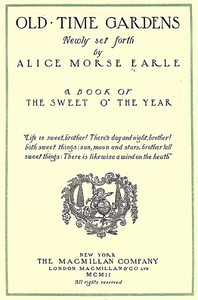
Alice Morse Earle opens Old-Time Gardens, Newly Set Forth not with planting instructions but with a meditation on the word “sweet” borrowed from a Gypsy song: “Life is sweet, brother! There's day and night, brother! both sweet things.” This epigraph sets the tone for a work that treats gardens as repositories of memory, language, and sensation. Earle draws on colonial diaries, seventeenth-century herbals, and her own walks through New England dooryards to reconstruct the look and feel of gardens that were already vanishing by 1901. The book is organized by theme—box edgings, herb gardens, lilac tide, sun-dials—rather than by season or plant family, and its prose moves freely between practical observation and literary allusion.
Color as a Language of the Garden
Earle devotes an entire chapter to “The Charm of Color” and another to “The Blue Flower Border,” treating hue as both a sensory experience and a historical puzzle. She notes that the Bible offers no mention of floral fragrance until the Song of Solomon, and that Homer’s epics never name blue or green. “Some German scientists have maintained that as recently as Homer's day, our ancestors were (to use Sir John Lubbock's word) blue-blind,” she writes, adding that this notion “fills me, as it must all blue lovers, with profound pity.” Earle’s own color vocabulary is precise and personal: she distinguishes lilac from mauve, orchid from heliotrope, and observes that “the color name comes from a flower name” in the case of violet, lavender, and rose. She also quotes the French writer Edmond de Goncourt, who viewed the garden “with the eye of a colorist” and compared a variegated bush to a piece of bric-à-brac. These passages reveal Earle’s method: she moves from a specific observation about a tint to a broader cultural or historical remark, grounding abstract discussion in concrete examples.
The Wildflower Gatherer and the Economics of Beauty
In a striking digression, Earle describes a man who for forty years has harvested wildflowers from a secret meadow, gathering “over two thousand stems of Pogonia” in a single morning. “For a little handful of these flower heads he easily obtains a dollar,” she reports, noting that he supplies the public schools and serves as a botanical authority. The portrait is unromantic: the work requires “heavy rubber boots in marsh mud and water reaching nearly to the waist.” Yet Earle calls it “happy work,” and the passage stands as one of the few moments in the book where labor and commerce enter the garden idyll. It also illustrates her willingness to include contemporary figures alongside historical ones—a choice that keeps the book from becoming a mere antiquarian catalog. The gatherer’s knowledge is earned, not borrowed from books, and Earle treats his expertise with the same respect she gives to Gerard and Parkinson.
The Evidence of the Excerpts: What the Catalog Subjects Omit
The Project Gutenberg record lists “Gardens” and “Landscape gardening” as subjects, but the excerpts reveal a book equally concerned with language, perception, and social history. Earle discusses plant names in a dedicated chapter, traces the etymology of color terms, and reflects on the difficulty of describing “pinky-purple” shades that are “nameless.” She also includes a chapter on “Tussy-mussies” (nosegays) and another on “Joan Silver-pin,” a figure from folklore. The catalog subjects do not capture this blend of horticulture, philology, and anecdote. Moreover, the book’s structure—twenty chapters with titles like “In Lilac Tide” and “A Moonlight Garden”—suggests a thematic rather than practical organization. Readers expecting a guide to planting or design will find instead a discursive essay on the cultural meanings of gardens, supported by quotations from poets, diarists, and herbalists. The excerpts show that Earle’s interest lies less in how to garden than in how gardens have been remembered and described.
Earle’s book rewards a slow, nonlinear reading. The chapters are self-contained enough to be browsed in any order, but cross-references—to a color mentioned earlier, to a plant name explained elsewhere—accumulate into a coherent argument about the garden as a site of layered meaning. Readers interested in the history of horticulture will find detailed descriptions of box edgings and herb beds; those drawn to cultural history will appreciate the digressions on color perception and wildflower economics. The index and list of illustrations provide useful entry points, and the many quotations from seventeenth- and eighteenth-century sources invite further exploration of the works Earle cites.
Reading Old-Time Gardens, I felt the quiet patience of those who tended flowers by name and scent, not just sight. It reminded me of an afternoon spent with Gardening for Little Girls — Context and Discussion, where the same gentle wonder appears—teaching through soil and seed rather than rush. That lingering warmth stays with me, like a faded petal pressed between pages.