
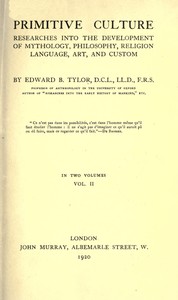
Primitive culture, vol. 2 (of 2) : Researches into the development of…
Forget dry anthropology. Edward Tylor's second volume is a detective story about the human mind. Tylor takes us on a global tour of myths, rituals, and beliefs from ancient cultures. His big idea? That 'survivals'—old habits and thoughts that stick around long after their original purpose is gone—are everywhere in so-called advanced societies. He connects the dots between ancient nature worship and modern poetry, between old magic and new science. The plot, so to speak, is his quest to prove that human culture develops in stages, and that our 'civilized' world is built on a foundation of 'primitive' thought.
Why You Should Read It
This book is humbling. Reading Tylor, you start seeing the 'primitive' in your own daily life. That lucky charm on your keychain? The way we personify storms or machines? Tylor would call those survivals. His writing can be old-fashioned, but his central argument feels incredibly modern. He treats ancient cultures with a surprising respect, arguing for a shared human logic instead of dismissing them as childish. It makes you question what parts of our own culture will look like curious 'survivals' to people 500 years from now.
Final Verdict
Perfect for anyone curious about why we think the way we do. It's a foundational text, so it's a must for students of history, anthropology, or folklore. But it's also great for the casual reader who loves big ideas. Be warned: it's a product of its time, with some outdated terms and views. Read it not as perfect truth, but as a brilliant, ambitious map of the human imagination. It's less about ancient people and more about us.
This masterpiece is free from copyright limitations. Knowledge should be free and accessible.
Nancy White
2 years agoHaving followed this topic for years, I can say that the language used is precise without being overly academic or confusing. It definitely lives up to the reputation of the publisher.
Susan Anderson
4 months agoHaving read the author's previous works, the footnotes provide extra depth for those who want to dig deeper. A mandatory read for anyone in this industry.
James Thompson
7 months agoHaving explored several resources on this, I find that the footnotes provide extra depth for those who want to dig deeper. This exceeded my expectations in almost every way.
James Garcia
1 year agoI appreciate how this edition approaches the core problem, the nuanced approach to the central theme was better than I expected. This should be on the reading list of every serious professional.








John Lee
9 months agoGreat value and very well written.