N
Nicole Bixler
Guest
- Thread Author
- #1
Quick answer:
Tracking student movement in schools gives districts an accurate record of when students left class, their destination and how long they were out of class. A digital hall pass provides real-time data that helps administrators investigate incidents, shows parents and school boards how the district protects students and identifies gaps in hallway supervision.
There is a lot to manage when it comes to student safety on your K-12 campuses, and it’s especially challenging to supervise the hallways. While teachers supervise their classrooms, when students leave class to visit a restroom, a water fountain, the nurse or another location, safety risks increase. School supervision staff can’t be everywhere at once, and school campuses have blind spots.
Tracking student movement in schools is essential for creating safer school environments, but the focus isn’t discipline. It’s so your district can create a compliance trail and show stakeholders, such as parents and your school board, that you’re doing everything you can to protect students. Student movement data also gives your team visibility into what happened during an incident and how to improve supervision procedures.
In this blog post, we’ll explore how student movement documentation impacts your district safety plan and how you can automate the process.
Establishing an accurate incident timeline and improving supervision procedures
When an incident related to student conduct, a threat, or a medical emergency happens on a school campus, the administrative team will start an investigation. The team needs to collect facts, along with an accurate sequence of events.
Without an automated student tracking system for schools, it’s difficult to collect those facts and build a clear timeline of what happened. When incidents happen while students are out on hall passes, administrators have to manually look at paper sign-out sheets that may not have accurate details or may have missing details. Or if students carry wooden blocks or wear hall pass vests to leave class, there may be no details at all. This wastes a lot of valuable time during an investigation window, especially for critical cases.
When your district prioritizes tracking student movement in schools through automated documentation, school administrators can instantly access the details they need to gather for an investigation. They can pull up data that shows exactly when a student left a room, where they were supposed to be headed, and how long they were gone. This data helps administrators resolve their investigations more quickly and provide interventions so incidents don’t escalate further.
It also gives school teams visibility into where they need to improve their supervision procedures. Close to 90% of students say their school has hallway supervision, according to the National Center for Education Statistics, and student movement data helps those teams improve their supervision plan. Reliable records can help administrators understand the sequence of events, evaluate whether procedures were followed and make changes.
Providing evidence of student protection to parents and school boards
Parents, school board members and your community care a lot about school safety and exactly what your district is doing to protect children. In a 2025 Gallup poll, 41% of parents of K-12 students said they fear for their oldest child’s physical safety at school. These stakeholders don’t just want to see your supervision policies. They want to see the steps your school teams take every day, and when incidents occur, they want to know why.
For example, if a parent wants to know the sequence of events that led to their child being bullied, they have a right to know. If the school isn’t able to provide that information, though, or is relying on details that students and teachers are trying to remember, the parent is not going to trust the district.
Instead, if the school is able to show when the involved students left class, where they were supposed to be, and how long they were out of class, that log of student movement provides concrete evidence.
This documentation gives your district two benefits:
- Transparency: The discussion with stakeholders is not focused on emotions only. Instead, it provides accurate data on out-of-class movement to share with stakeholders.
- Protection from liability: An audit trail proves that your school district is maintaining its duty of care.
Overall, having accurate, real-time documentation shows stakeholders that the district has taken the necessary steps to protect students.
Problems with paper hall passes
Many schools manage student movement out of class with paper hall passes, student agenda logs, clipboards, laminated passes and even brightly colored vests. These manual methods are simple but they aren’t efficient and they create safety risks.
Here are three drawbacks of manual hall passes:
1. They’re easy to falsify
Students might write down the wrong departure time, write another student’s name or even scribble in their teacher’s initials to “approve” the pass.
2. There is no real-time visibility
A paper hall pass doesn’t show any alerts like overdue passes or show a list of all students currently out on a pass. In an emergency, it’s impossible to know which students in the school are currently out on a pass.
3. Administrators can’t identify patterns or trends
If administrators want to look at who is regularly spending too much time out of class or who is coordinating meetups during class, clipboards, vests or student agenda logs are not going to help. Plus, an administrator doesn’t have time to look through hundreds of handwritten records.
Benefits of a digital hall pass in schools
There is a solution to reducing safety risks, identifying vulnerabilities in a school supervision plan and providing better protection to students outside of the classroom. The Cybersecurity and Infrastructure Security Agency (CISA) states that in K-12 schools, there are “a wide variety of threats ranging from weather-related natural hazards, to student fights in hallways, to violence involving the use of weapons. These and other types of school safety-related incidents are all significant cause for concern for local education agencies; they affect not just those involved, but the broader school community as well as members of the surrounding community.”
To proactively improve hallway safety, many K-12 districts are now choosing to adopt a digital hall pass.
Hāpara Hall Pass automates hall passes, saving instructional time and providing real-time visibility into student movement.
Save instructional time with quick pass approval
Instead of teachers writing out hall passes, students can request them from their school device or a classroom kiosk. Teachers can approve or deny the pass with just a couple of clicks. Or, passes can be set to auto-approve. Teachers, nurses, counselors, front office staff and administrators can also create passes for students.
See student movement in real time
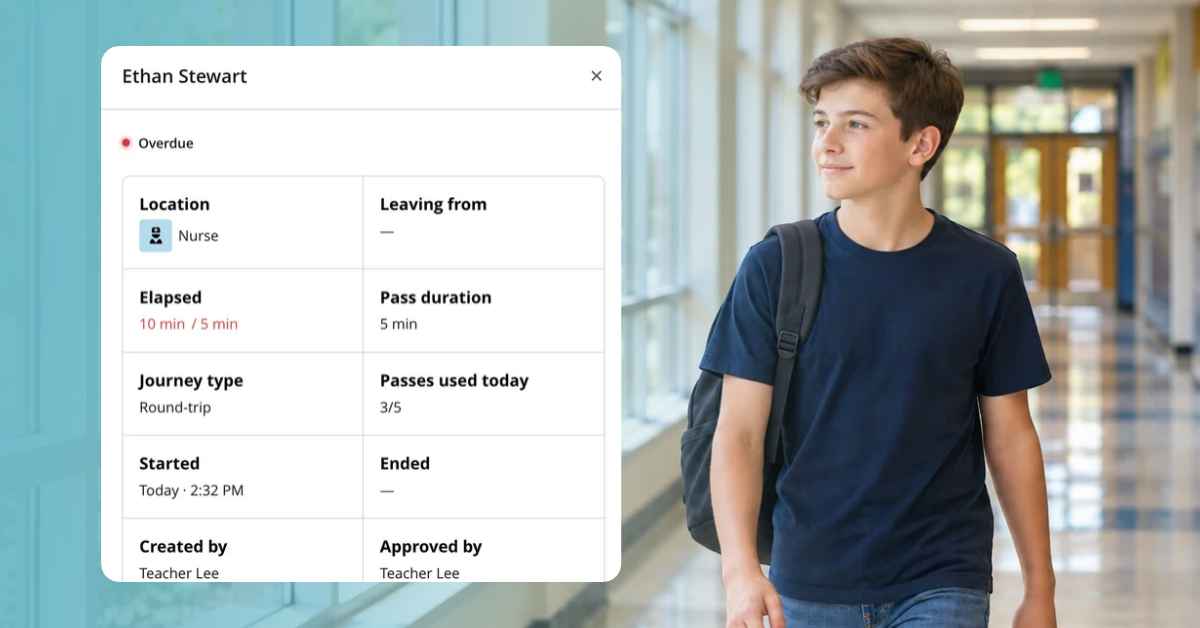
Hāpara Hall Pass automatically timestamps the hall pass, showing administrators exactly when a student left the classroom, where they were supposed to be headed and when they arrived.
Administrators and safety staff see a bird’s-eye view of all active passes and overdue passes. They can also search for a student to pull up their hall pass history.
Track chronic absenteeism from class
Analytics show administrators:
- Students who are “frequent flyers” who are out on passes most often
- Times of day hall passes are used most often
- Hot spot locations in the school where students are requesting passes to
- Staff who are approving hall passes most often
- Peak hall pass times by location
The data gives school teams the insight to limit hall passes, turn off hall passes for specific locations and identify lost instructional time.
Cherylanne Lee is a technology coordinator for the Hawaii Department of Education. Her school already uses Hāpara Classroom Management. They recently switched from another hall pass solution to Hāpara Hall Pass because of its affordability and easy implementation. The administrative team and teachers find the analytics especially helpful. Her team uses hall pass data to understand how much class time students are missing.
She says, “If they’re going to the health room every day for 20 minutes, that’s a significant amount of class. I think teachers need to know that, and their parents need to know that.”
At Tabernacle Township School District, Technology Coordinator Kyle Calderwood deployed Hāpara Hall Pass for fourth grade and up. Calderwood said his school’s principal uses the analytics to look at which locations students are visiting and which students are leaving class most often. When a student has taken several passes in a single day, school leaders can see which staff members issued them and follow up from there.
The weekly view is especially helpful for administrators. For example, looking at the past seven days of data, Calderwood noticed that some students had as many as 17 hall passes in one week.
Pause all passes during an emergency
In an emergency or during a safety drill, administrators can pause all passes across the school, so students and staff can’t request, approve or create passes. It also instantly shows all students who are out of their classrooms on a hall pass and where they are located.
Prevent student meetups with encounter prevention
School administrators can also set up student pairs in Hāpara Hall Pass for encounter prevention. To reduce bullying or prevent student bathroom meetups that lead to vaping or vandalism, administrators can set up encounter prevention pairs so that two students can’t request hall passes at the same time.
Adopting software like Hāpara Hall Pass means your district can be proactive about student safety instead of scrambling to pull together details and figure out what led to an incident. Your district can then build trust, showing stakeholders exactly how you are protecting students outside of the classroom.
Interested in how Hāpara Hall Pass could help your school district? Book a personalized tour with our team.
Frequently Asked Questions
Why is tracking student movement in schools important?
Tracking student movement gives administrators an accurate record of when students leave class, where they’re headed and how long they’re gone. That data helps administrators investigate incidents and shows parents and school boards how the district protects students outside the classroom.
What are the problems with paper hall passes?
Paper hall passes are easy for students to falsify and don’t show which students are out of class in real time. They also make it very challenging for administrators to identify patterns, like students who leave class often or meet up in restrooms.
What are the benefits of a digital hall pass in schools?
A digital hall pass solution like Hāpara Hall Pass automatically timestamps every pass, shows all active and overdue passes in one view and gives administrators analytics on hall pass trends in a school. Administrators can also pause all passes during an emergency and instantly see which students are out of class.
How do you track chronic absenteeism from class?
A digital hall pass like Hāpara Hall Pass tracks every time a student leaves class on a hall pass and how long they’re gone. Analytics show “frequent flyers” who are out on passes most often, so school teams can identify lost instructional time and follow up with students.
How does a digital hall pass help with preventing student bathroom meetups?
Hāpara Hall Pass lets administrators set up encounter prevention pairs, so two specific students can’t be out on hall passes at the same time. Administrators can also turn off passes to specific locations that are hot spots for meetups.
The five biggest challenges schools and districts are facing right now
Learn how to respond to concerns about classroom screen time, ways to manage student AI use during instruction and assessments and more!
Download our free e-book
The post Why tracking student movement in schools protects students and your K-12 district appeared first on Hāpara.